Showing posts with label Barry Lee Wendell. Show all posts

Sunday, June 5, 2022

The Campaign So Far

 I haven't written on this blog about my campaign for Congress since I signed up to run, more than four months ago. I had a challenger in the primary, Angela J. Dwyer, a Black woman from Martinsburg, in the Eastern Panhandle of West Virginia. We met once in person, at the opening of the Democratic Party office in Shepherdstown, at the far end of the Eastern Panhandle. Rather than drive back from there, over 150 miles, I drove to my sister's house in Maryland and spent two nights with her. 

I attended events in Brooke, Hardy, Jefferson, Marion, Marshall, Ohio, Randolph, Taylor and Wetzel Counties before the primary. I met online with people in Berkeley County, and recorded a video for Tucker County. I understand better how beautiful West Virginia is, driving home through the hills and mountains, watching the change of seasons from winter to spring, sometimes on one trip across the mountains. 

I heard from people about problems I didn't understand, like the long wait to get an appointment at the VA Hospitals in Clarksburg and Martinsburg. I learned from reading about students at WVU lobbying in Charleston,  about the mental health crisis on college campuses nationally and in our state. 

I won the primary, although Angela Dwyer won a few counties and did not embarrass herself in any way. It was a good, clean campaign. The Republican candidates, who had much more money, endorsements and name recognition, ran ads on television. Alex Mooney, endorsed by Donald Trump, ran ads accusing his opponent, David McKinley, endorsed by Governor Jim Justice and Democratic Senator Joe Manchin,  of being a supporter of Nancy Pelosi and giving Biden "a victory" by voting for the infrastructure bill, which will bring billions of dollars to West Virginia to repair our crumbling roads and bridges. McKinley bragged that he "Voted with Trump 92% of the time."

Alex Mooney won the Republican primary to the chagrin of many. He faces an ethics investigation over his use of campaign funds for personal use and lying about it. The Dominion-Post, our local paper in Morgantown, ran an editorial against Mooney, suggesting that McKinley could get back in the race somehow. My name was not mentioned.

I've recently met online with Lacy Watson, the sole Democratic candidate in District 1, our state's other Congressional District. He's bright and articulate, and he was wearing a "Doors" tank top. We aim to be the Raphael Warnock and John Ossoff of West Virginia.

Lacy and I noted that the Charleston Gazette-Mail has not mentioned either of us since the election. The Morgantown Dominion Post hasn't mentioned me either, although they have trashed Alex Mooney. Today (6/5) they printed a letter I wrote about the need to ban assault weapons. Originally it was an op-ed piece, but they insisted I shorten it to a letter, and cut out the political part, naming names of people who have failed America, notably Ronald Reagan, Mitch McConnell and West Virginia's Senator Shelley Moore Capito. I did a twenty-minute interview with Channel 10 and WRNR in Martinsburg, and there was a front-page interview with me in the Parkersburg  News and Sentinel, so there is some coverage of the campaign in the district. 

I haven't raised a lot of money, and half of that has been from friends and family in Maryland, Florida, New York and California. The other half is from people I know here in West Virginia, and people who want an alternative to Alex Mooney. I'm disappointed about not having more support from the state and national Democratic Party, from the Gay and Lesbian Victory Fund, and West Virginia Can't Wait. I've gotten advice, but no official endorsement, from Working Families Party. 

Still, I have an organization that's meeting weekly and I'm hoping to get things done soon. Yesterday (June 4) I drove to Martinsburg to spend time at the Eastern Panhandle Pride event. The event was different from what I'm used to, but I lived in West Hollywood. Times have changed, too. There are a lot more variations on "gay" "lesbian" and "queer" than there used to be. I met lots of people and gave out flyers for my campaign. I feel like I've aged out of the active LGBT community, but it was great to be with my spiritual grandchildren for an afternoon.

I'm optimistic about the campaign, partly because Alex Mooney is in deep trouble over ethics violations, and because the last President's influence is waning. I have something to say to people: I will be present, I will support women's rights, trade unions, people over corporations. I want to ban assault weapons, strengthen the background checks for gun purchases and have a national permitting plan. That resonates with my constituency. I'm also proud that so many people have offered to help, from my junior high classmates (Sudbrook 1964, Pikesville Maryland) to people I've met on the way and others who've heard about my campaign. I have to also thank my husband, Joe Hample for encouraging and supporting me, even if it means being away from him more than either of us want.

Even if I don't win, I've had something important to say. I've come to know the northern half of the state much better, to appreciate its natural beauty and the diversity of the population. It's a thrilling ride, by far the coolest thing I've ever attempted.


Tuesday, April 12, 2022

Autobiography- Early morning 4/12

 The first school year I was in New Orleans, I had a roommate named Jack. We found each other from Tulane's housing office, and rented a shotgun house a block from the Mississippi near Audubon Park.  Jack was a senior undergraduate in engineering; I was a first year grad student in Urban Studies. Jack was from a prominent South Alabama family, and a good student, but tried to be rough. He bathed infrequently, rode a motorcycle and liked to sky dive as a hobby. He had a disturbed girlfriend from a decaying Chattanooga family. Jack was crazy handsome when he cleaned up, not that I noticed. 

We moved in together fifty years ago this coming fall. We only stayed together that one school year. He wanted to keep the house, so I took an apartment alone the next year, and we rarely saw each other after that. I left New Orleans a year later.

I still think about Jack, mostly what he said to me when we split up our household. He said " I think you're gonna make it big one day, Wendell, but I ain't sayin' how old you'll be." I didn't sleep well tonight, maybe because I had my second booster shot against COVID-19 on Friday, maybe because of what I ate ( I cooked tonight), or because I walked in Core Arboretum for nearly ninety minutes this afternoon and overdid it. 

So as I lay awake, I thought about what Jack said to me in May of 1973. Maybe he was right. I've been with the same man for more than sixteen years now. We're married, we own a home and two cars, and we have an old cat, who is on "home hospice" with us. And I'm running for United States Congress. Others are shocked that I could run for Congress, and maybe I'm surprised, too. I know enough now, and while I am not likely to win, it's not because I can't do the job or lack qualifications. It's taken me the fifty years since Tulane to become that person who is stable, confident and capable.

 Maybe some other night when I can't sleep, I'll write more about what I've gone through.


Wednesday, August 12, 2020

High Holy Days 5781

 The  holidays, Rosh Hashana and Yom Kippur, are  a month  away now. Like all religious denominations, Jewish congregations are trying to figure out how to safely do services. For most Jews, God sends people to tell you how to be saved from trouble. So we take good advice, like doing services online. There was  talk of doing services for the holidays outdoors, but that didn't seem workable. What the board at Tree of  Life Morgantown decided was to prerecord the services, then have them on YouTube at the appropriate time. My husband, Joe Hample, is the rabbi at Tree of Life. I have worked as a cantorial soloist (someone who sings at services but doesn't have a formal certification), so they decided to ask me to sing a few things, and chant in Hebrew from Deuteronomy and First Samuel. I've done the chanting before.

Last Sunday, Joe and I dressed for the holiday and went to the temple, where a congregant who works in tech recorded us doing the evening service for Rosh Hashana. I've been busy with my class at OLLI and Morgantown city council and haven't rehearsed much. I didn't have a lot to do at the service, and it went pretty well, although I was exhausted from getting up early after not sleeping well, and being there for four hours.

I was panicked about how all this would go. People tell me I sing well, but when I last worked, seventeen years ago, I did vocal exercises every day. I don't sing as well as I did. The last year I worked, 2003, was  the  worst year of my life, worse even than 2020. My sister was ill at the beginning of the year, and stuck home. Her son, then eleven, couldn't go out because two people were randomly shooting people in the Washington area, where they lived. My mother had pancreatic cancer. I visited Baltimore, where my mother lived, for her 75th birthday. While there, I suffered a heart attack. My mother died five weeks later.

My goal at the time was to retire from the school district in 2004, and work full-time somewhere as a cantor. I auditioned for a job that came up in August 2003 when a cantor suddenly left his post, and I was hired. My cardiologist had advised me not to do that, but I hadn't yet (maybe still haven't) killed off my closet Type-A personality. I did the job, sixty miles east of Los Angeles, after buying a new car with the first of my inherited money. I have never been so exhausted in my life. It was a hard job anyway, rehearsing with a choir and singing the music left by the former cantor (we sang in the same key, which may be why I was hired). I got  along well with the rabbi there, but not so much with the choir and director. They were talking about hiring a full-time soloist in July, maybe me, but I looked around and decided I didn't want to live in that community. They ended up not hiring a cantor anyway. The whole experience was debilitating and depressing.

When Joe and I moved to Morgantown in 2012, there was talk at Tree of Life of using me as a cantor, which I squelched. I felt like I had closed that chapter of my life. Now they want me to do a few things, not beyond possibility, but still a drain on my not abundant energy. Joe has taken on most of the singing, which was too much for him. He's been working like mad to get it together. The people in charge, like those at most congregations, don't realize how hard it is to do the holidays.

I don't typically have panic attacks, but when I started going over the music, I thought about my mother,  my own precarious health, and what had  happened to my family all those years ago. It wasn't pretty.

I've calmed down now and I've accepted my role, but like most things I'm doing, I keep thinking I won't do it again. I'm still here, well after my "use by" date, my sister is healthy, her son grown up and married. I try to just count my blessings instead of obsessing about the past. Joe and I plan to visit with my sister in Maryland at the end of August, and maybe, as is my custom before the holidays, we'll visit my parents in the cemetery in Baltimore County. 


Monday, June 25, 2018

The Haymaker Forest


Our City Council, where I represent our Seventh Ward,  agreed, 6-1 on first reading,  to buy a piece of forest in and adjacent to the city for park land that was about to be developed. A second reading was to be held on June 19, allowing us time to reconsider and get input from the public. Our local Fox News radio outlet asked all of the Councilors to come on the radio, and I agreed to come on the Friday before our meeting, June 15. The hosts, Dave and Sarah, were easier on me than they had been with the last two Councilors they interviewed, but they couldn't get me to say I would vote against this purchase. The big problem was the cost, at 5.2 million dollars. People were out all week on Facebook demonizing the Council generally, and me and Mark Brazaitis particularly about this purchase. I told Dave and Sarah I didn't think opponents would show up for a meeting, because they typically don't. They begged people to come out and oppose us on Tuesday and took my statement as a challenge.

After Friday's radio program, more ugly personal stuff was posted against me and Brazaitis, who has been the real force behind our plans for Haymaker, including someone who posted several times how much Brazaitis' family paid for their house. Our addresses are already public information. I kept track of the people who called us names or impugned our character in the days leading up to the meeting, twenty-nine in all. People who sent thoughtful e-mails and messages to me in particular, got thoughtful and polite answers back. If they wrote to all of the Councilors, I answered if they were from my ward.

I counted forty-eight speakers on the topic of Haymaker Forest on Tuesday, thirty-seven opposed, and eleven in favor. I had my list of the name-callers and character assassins, but only four showed up and one of them apologized for his online rudeness. The others were more rational than they had been online. Ultimately, we voted to postpone action. This means we could try to negotiate a lower price, or we could lose this land to development, which would be a shame.

Meanwhile, there is a court suit against the six of us Councilors who voted in favor of this purchase on first reading, and the online people are worried that I have a Nixon-like enemies list.

I handled all of this as well as I could. I beefed up my privacy settings on my personal Facebook page, although the page I manage, Barry Wendell, Morgantown Councilor, Ward 7, is open.

The issues, the real ones that people brought up, are the price we agreed to pay without a current assessment and that this was all brought up in a hurry at the end of May to be voted on June 5 and 19, and the deal closed by June 29. People complained that there was no plan for the park, and that it would not benefit most people in the city, only those in the area immediately adjacent to it (including Councilor Brazaitis.)

The argument for doing this was that there was already a bulldozer, and even if we felt it was a rip, the developers held all the cards. In our long-range plan for the city and county, Haymaker was supposed to be open space. Much of the property is outside city limits, where the deck is stacked in favor of developers, there is no zoning, and no need to put in curbs and gutters, sidewalks or even reasonably navigable streets.

We had a "process error." People in the City and County  felt we were not transparent about this purchase. Many, including Mark Caravazos, the city Fire Chief, felt that if we had that much money to spend, we could spend on existing parks, buy a fire truck and replace two fire stations that are obsolete.

The money wasn't going to be from the regular budget and we were going to have to raise it somehow, maybe with a levy on the ballot in April. Since the meeting, the radio broadcasts and the newspaper articles ( the newspaper and talk radio are owned by the same company), I've started getting letters praising Council for looking into the deep future and preserving a beautiful forest for trails. For me, I wanted future generations to marvel at the beauty of the forest and thank our present Council for being far-sighted. Maybe that's just a pipe dream, and we will be forgotten.

We did have a financial plan to buy the forest without going into the city budget; maybe it was too complex for people to get it. And we didn't make it clear enough that we were going to have a commission to decide how to use the park, where to put in trails, provide parking, and other amenities. The commission would also look for other parcels of land that could be repurposed as parks. There were already people from The West Virginia Land Trust and other organizations who offered to volunteer their services.

The budget problems in Morgantown go back decades. Part of the problem is that West Virginia University buys up business property in Morgantown and takes it off the tax rolls. The Monongalia County Commission has a huge tax increment financing district off I-79 just south of the Pennsylvania line that draws businesses. So far, there is only student housing and no schools or public parks, so expenses are kept low. There are many built-up areas just outside city limits that should be annexed, but developers don' t want to be subject to zoning and stricter building code enforcement. Some homeowners don't want to pay for the better police and fire protection, snow removal, and curbside recycling that Morgantown provides.

Taxes are not high here, but many elderly people live comfortably in homes they bought for $30,000 forty years ago that are now worth $300,000 and are taxed accordingly. People over sixty-five (me included) do get a tax break, but for many, that's not enough for them to be able to stay in their homes. I understand living on a fixed income. I was criticized for saying I would raise taxes when so many low-wage people depend on food pantries to get enough to eat. I suggested that strikes be organized against minimum wage employers like Target, Wal Mart and Kroger, and then I was blamed for "shaming poor people."

Those who live outside Morgantown but work inside the city limits pay a "user fee" that has been used to hire more police and to pave the city's streets. They believe that gives them a right to decide what the city does. It does not. Only those living in the city limits have a say. I suggested that people in the County areas concerned about what the City of Morgantown does ask to be annexed into the city.

We have our work cut out for us. We have to make it clear to the residents of Morgantown and Monongalia County exactly what we are up to and how we can pay for it. At the same time, we need to fully fund all the city's services that are perpetually starved, even if it means raising taxes, pushing to annex businesses outside city limits, and confronting West Virginia University, The Monongalia County Commission, and media outlets in town who feel free to demonize us as individuals.

My hope is that we can work out a deal, at the much lower assessed value of the property, to create a beautiful public open space for Morgantown. Meanwhile, plans are afoot to confront our inadequate budget, and figure a way to make Morgantown, more than it is already, the best place to live in West Virginia.


Sunday, February 25, 2018

Most of February

I returned from my trip to Maryland and Virginia on Monday, February 6, to more cold and snow, and lots more meetings and demonstrations. Although I was well over my illness, whatever it was, I was sleeping through the night, with two naps, one after breakfast and one late afternoon. I went back to the new gym I joined just before I get sick, where I am a hot young guy, instead of being the oldest one, by at least twenty years, and more often, forty years, at my old gym. I've gone to two weeks of line dancing classes, much easier than the Israeli dance I attended for twenty-five years in L.A., but for all my scoffing, just about what I can do for an hour, now.

My world was shocked by the February 14 shootings at Marjory Stoneman Douglas High School, in Parkland, Florida. That particular suburb didn't exist when I left South Florida in 1984, but I recognized from the names that the students were a generation or two later version of the people I knew from my time in Miami: Cubans, Jews, African-Americans, whose parents had become affluent and educated, and moved north and west to a new, "safer" suburb, away from Miami. Maybe because I recognized these kids more than those from other shootings, or because I have cousins who grew up near there and are now still in their twenties, I took this hard. And these kids, smart and media savvy, were able to express their grief and desire for change to the world in way that previous survivors could not. I posted about this on my own social media and spoke at length about the need to ban assault weapons nationally at our February 20 Morgantown City Council meeting. Our Morgantown Interfaith Association held a vigil on the 21st downtown. One candidate for state legislature was there, and I attended from City Council. I've checked Twitter, and besides my relentless tweeting, and retweeting students from Stoneman Douglas, what we got from our politicians was "thoughts and prayers" from our Republican congressman and our Senator, who also thanked "first responders." Not even that much from our Democratic Senator, nor from any of our state Delegates or Senators. Meanwhile, in Charleston, our state capital, Republicans, who have a majority in both houses, are busy passing bills to demand that colleges allow concealed carry of weapons on campus,  and that weapons be allowed in cars at any business. More on these horrible people later.
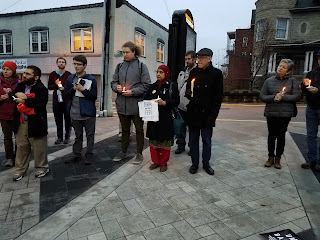
Interfaith vigil against gun violence Thursday, February 22. This is less than half of the group
The President spoke with some of the students, one of whom saw on his note card the expression "I hear you," meaning it was in his script to say that. At the end of the week, when funerals were held for the first students, the Jewish ones, who by custom have to be buried as soon as possible, the President was on the golf course at Mar-A-Lago. Students and parents spent the week trolling Florida Governor Rick Scott and Senator Marco Rubio, who refused to say he would no longer accept campaign money from the NRA. Conservative pundits on television and in the news have suggested that the students who spoke out were actors, or that the whole thing was the fault of the FBI, who knew about the shooter, or that we need better mental health screening, or raise the age when someone can purchase an assault weapon. Of course, the administration would love to end Medicaid, and has tried to cut off the Affordable Care Act's expansion of Medicaid, which provides much of the mental health and drug addiction benefits to the poor.

I remember the shootings at the club in Orlando, the church in Texas, the outdoor concert in Las Vegas (where the shooter was over sixty) and now, in Parkland. What these all have in common is that the shooters had an arsenal of legally-acquired weapons, including AR-15-style weapons. If one is not frightened of the NRA or receiving buckets of campaign cash from them, it is obvious that these weapons have no civilian use and should be banned. I find it hard to believe that America's children should be "collateral damage" so that everyone with a grudge can have an assault weapon. I can't imagine that we have such cowards in both parties running our government.

Meanwhile, our representatives in Charleston proposed a one percent raise for teachers, the first in ten years, while increasing premiums for health insurance and retirement, which would wipe out even that pitiful raise. Additionally, they introduced bills to insist that the teachers' unions get written permission each year to deduct union dues from teachers' salaries, and to end awarding full-time union leaders, all teachers, retirement credit in the system. They voted to lower standards for new teachers, since they can't fill many positions with qualified applicants, and they want home-schooled kids to not need a GED to get a state-sponsored college scholarship. There was a bill this year to mandate an elective course in the Bible, and to allow school districts to write their own science standards. Read into that what you will.

Teachers went to Charleston to protest, and they were effectively locked out by the House Speaker adjourning the session at 11 A.M. until 6 P.M., when visitors would not be allowed. The net result of this is that teachers in all fifty-five counties in this state walked off the job. Thanks to Messrs. Mason and Dixon, and to former President Lincoln, West Virginia is oddly-shaped. Many people in the state could easily commute to teaching jobs in Pennsylvania, Ohio, Maryland or Virginia, where the pay is lots better than in West Virginia. Instead of dealing with these pay and benefit disparities, the Legislature has voted this session, not to pass a budget, which is their main job, but to ban Medicaid from paying for abortions, to create an unnecessary extra level of courts, to allow clergy to not perform weddings they object to (they already can do that) and to give a tax break to out-of-state corporate interests.

The teachers in every county in the state walked off the job Thursday and Friday, forcing the schools to announce in advance that they would be closed, and as of Saturday night, it looks like they won't be back Monday, either. Arrangements were made for social service agencies to provide food for kids and families at lunch, and people were asked to drop off food and supplies at food pantries throughout the state. It's a sad commentary that many kids in West Virginia only get a decent meal at school. It rained last Thursday, the 22nd, in the morning, although this week the weather has been freakishly warm, breaking records Wednesday, Thursday and Friday. With all the rain we've had, there have been flood watches and warnings. I went Thursday afternoon for less than an hour during a break in the rain to stand with teachers from North Elementary, near my house. Parents brought shipments of coffee and donuts from a nearby store while I was there, and a woman introduced me to her developmentally disabled son Anthony, who recognized and hugged his former teachers, held a sign to passing motorists, and screamed with pleasure when a car honked at us. His mother told me that Anthony, at three, could not stand up, and she was told that he would never get much past the mental stage of an infant. She took him to kindergarten at North Elementary, where the teachers worked with him, and although she no longer lives in our county, she wanted to come out to support the teachers at North. While our state votes, or in the last election, voted Republican, people I've spoken to support the teachers.
Teachers picketing near Morgantown's North Elementary, Thursday afternoon, 2/22

We had a marathon five-hour City Council meeting Tuesday, February 21, where we picked six people from the ten we interviewed for our new Health and Wellness Commission. In the regular meeting, later, we passed, 6-1, an ordinance to give a tax break to businesses who spend at least five million dollars on new development or improvements to an existing business downtown or in an area that becomes annexed to the city. I had my doubts, which I expressed to the Mayor and City Manager at a meeting Monday. Joe and I had been out the previous Thursday with our gay social group, only five of us that night, at the south end of downtown We started with drinks at a hotel, then adjourned to an Indian restaurant with a buffet. Lots of people were there for the yummy food, but I couldn't help notice the empty storefronts and surface parking lots at that end of downtown. Despite my misgivings about the bill, because I'm not in favor of tax breaks for big business, generally, I voted for it, in the hope that something will give our downtown a boost. Two people spoke against the bill, one a friend , and one of our Councilors, with good reason, voted against it. I hope that we can now do something for smaller businesses in the area, which was one of the objections, and that, ultimately, new development will provide jobs and an increased tax base for our city. We didn't adjourn until 10:30.

Wednesday dawned with a temperature of 65 F. (average low 24 F. for the date) and it was supposed to get warmer. Joe had office hours and a work-related dinner date, so I decided to go to Pittsburgh for a "big city fix." I picked five historic places and figured on lunch somewhere, a stop at a CD store I know about in the Strip District, just north of downtown, and a bookstore, possibly the one in Squirrel Hill. I thought I might hit a movie if it rained, and stay past dinner. I visited numbers 121 to 125 on Wikipedia's list of historic places, bought three CDs from my list of the best-selling albums of the first decade of this century (by Faith Hill, Lenny Kravitz and No Doubt) and visited a book store on Carson Street in Pittsburgh's South Side Flats. More on that later.

Of course, it started to rain not far into Pennsylvania. It's about 75 miles from our house, at the north end of Morgantown, to Central Pittsburgh, and although it hit 72 early in my stay in the city, the rain came on and off, and by the time I left at 3:30, it had dropped to 47 F. I started downtown at the Pittsburgh Renaissance District, the twentieth century rebuild of the historic center of the city at the point where the Allegheny and Monongahela Rivers meet  to form the Ohio. I got there close to noon and paid $4.00 to park on the street for an hour. I took a few pictures, saw a demonstration by high school students at Market Square, protesting the shootings in Florida, and lunched at a chain restaurant that serves noodle dishes.

Pittsburgh Renaissance Historic District, Wednesday, 2/21

Gateway Center, Pittsburgh, one of the entrances

Flooding along the Monongahela River in Point Park

Students holding a vigil, Market Square, Pittsburgh, 2/21. The glass building is the headquarters of Pittsburgh Plate Glass


From there, I headed north to the CD store (which also has records and comic books) then just east to "Reymer Brothers Candy Company," a 1906 building, now used as offices. The candy company no longer exists.
Reymer Candy Company, 1425 Forbes Avenue, Bluff District

I crossed the Monongahela River from there, to Carson Street, once an old working class neighborhood at the foot of a bluff and subject to flooding, now gentrifying. It looks like Morgantown's High Street if it were three miles long instead of two blocks.
I visited the Pittsburgh Mercantile Company Store, near the east end of Carson Street, built 1906-7, and originally, according to Wikipedia, a "company store" for a steel company. It has lately been converted into apartments. The steel company no longer exists.

2600 East Carson St., South Side Flats, Pittsburgh


Cruising down Carson Street, I saw a banner advertising a book store and decided to drop in. A sign on the door said "Closed Saturday for Sabbath." I was surprised, as this was never a Jewish part of town. The guy who greeted me was as pale and Nordic looking as anyone I'd ever met,  adding to the mystery, but when he called for the owner to answer a question, a young man in a kippa and tzitzit (ritual fringes) came over. We talked a bit, and he told me he had a non-Jewish last name (which I don't recall now) because he was Jewish only because his mother's mother was Jewish. He was a waiter before he opened the bookstore, but he quit because he had to work Friday night, the busiest night at a restaurant. He had only lately decided to become a religious Jew. I told him I was married to the Reform rabbi in Morgantown, a man. He just shrugged that off. I didn't see anything I was desperate for in the store, so I went on to my fourth historic place, Pittsburgh Terminal and Warehouse Company, built between 1904 and 1906 to link rail and barge traffic through the city. It is now used as offices.
333-400 East Carson Street, South Side Flats

I had one last place to visit, Prospect School, above Southside Flats in Mt. Washington. I turned on the GPS on my phone to get to this place, as the streets in that neighborhood wind around a bit. The school was built in 1931 and now has been converted into apartments.
Former school, Mt. Washington

It was close to 3:30, raining and cold. I figured out how to get to the Interstate home, got stuck in traffic leaving Pittsburgh (the downside of the "big city fix," )but made it home just after five, in time to feed the cat, and sleep for an hour before fixing dinner for myself. It was 60 F. and not raining in Morgantown.

It is now Sunday night, still too warm, raining, with flood watches and warnings throughout the state. The teachers will be off again tomorrow, while trying to get some kind of respect from the Governor and Legislature.

Joe and I did our bit Saturday, attending Empty Bowls, a charity event for food pantries and soup kitchens, where you get soup from restaurants, bread, home-made cookies and a bowl to take home. Almost everyone in Morgantown seems to show up at Empty Bowls.


At Empty Bowls, with Danielle Walker, candidate for WV Delegate in our district

Joe and I at home showing off our new bowls


We have a City Council meeting Tuesday, and Wednesday night, the end of the month, is the Jewish holiday of Purim, also, on the Jewish calendar, the fifteenth anniversary of my mother's death. It's a joyous holiday, but not for me. I keep busy for a retired person in a small town.

In my online world, people are angry that national newspapers are still looking to interview Trump supporters in "The Heartland" while ignoring the importance of a state-wide teacher strike in West Virginia, and television news covers C-PAC, which has become, you should pardon me, an Evangelical Klan rally. I've reminded people that "THE REVOLUTION WILL NOT BE TELEVISED."


Sunday, December 31, 2017

2017

When people ask how everything's going, I usually say "My life is great, but the world is coming to an end." I have the usual complaints: ten prescriptions, twenty extra pounds, not as cute as I used to be, and a life expectancy of... better not go there.

But I have a solid marriage to a handsome and smart man who puts up with me, we own a house that will be paid for when I'm ninety-five, we own two cars and a cat who loves us. The cars are six and seventeen years old, but we have them. We traveled together to Canada this summer, visiting Montréal, Québec and Ottawa. We were able to attend a wedding of the son of Joe's best friend from high school in New York, and a few days later, we flew to Memphis to spend Thanksgiving with Joe's aunt and uncle, his sister and brother and lots of cousins. We didn't have political tensions with the relatives because we are all on the same page. I only embarrassed Joe's Aunt Natalie by pointing out that Joe and I are married when she called us "my nephews." We spent time with my sister, both here and at her home in Greenbelt, Maryland, and on one visit with her, I attended my high school class's fiftieth reunion. It was there that I saw commonalities with people whose lives and views are different from mine, but with whom I shared life in a different century, a different world.

As to the world, there is climate change, there is the current President of the Confederacy, I mean, the United States. It's easy to get confused that way.

In 2016, I ran for a seat in the West Virginia Legislature. I came in eighth of eight candidates in the Democratic primary. The first five candidates made it to the general election. This year, some political people asked me about running for City Council. I found that I had more friends than I knew in the city, and not just the people who helped with the campaign. The election was at the end of April, and we were installed in early July. I have become friends with all the other Councilors, and although we disagree about some specific things, we are generally in agreement about broad goals for Morgantown. We signed on to the Paris Climate Accords, and voted for a Human Rights Ordnance that includes sexual orientation and gender identity.

I was able to continue my goal of visiting one county per month, within three hundred miles of Morgantown in any state. The cities I visited were Lynchburg, Virginia, Jim Thorpe, Pennsylvania, Denton, Maryland, Bowling Green, Virginia, Westminster, Maryland, Carrollton, Ohio, Galax, Virginia, Grayson, Kentucky, Olean, New York, State College, Pennsylvania and Urbana, Ohio. Although I was worried about visiting places that voted heavily Republican in 2016, I never had any problems. Part of that is that I traveled to these places alone, I'm older, I can pass for white, and can adjust my speech to a local accent. I do understand what "privilege" means.

Joe and I have both been teaching at OLLI, Osher Life-Long Learning, affiliated with WVU's School of Public Health. Joe's Bible classes are well-attended by an enthusiastic mix of seniors, as are my classes, which this year have covered pop music in 1962, 1963 and 1964. Last winter, I taught a four-week session called "Bruce Springsteen is 67." I've learned lots from my research, and my students, most of whom graduated high school in the 1960s, love going back in time.

Our life here is good. We can live comfortably on our income, Joe is healthy, I'm stable, and we are recognized in town, and respected by our constituencies, if not by everyone in Monongalia County.

Our challenge is to keep going. It's no secret that our Jewish community in Morgantown is aging, as are we, and our cars. The United States government has made itself the enemy of liberals generally, and of gay people in particular, and we must be vigilant and hopeful for the future. I make it a point to attend demonstrations about healthcare, about immigrant rights, including pro-Dreamer and anti-immigrant ban events. I spoke in Charleston last month against the EPA's proposal to scrap the
Clean Power Plan.

My usual resolutions are to lose twenty pounds, and to clean up and organize the house. I have lost a few pounds this year, very few, and I'm working on organizing paper at home. In light of the scandals this year around sexual harassment, I have promised to stop ogling HYMs (Handsome Young Men). I've been harmless for quite some time, but that doesn't stop me from checking out someone attractive from head-to-toe, or even flirting. I'm cutting that out. I can see that it is unwelcome, disrespectful to my husband, and makes me look foolish. If I can find a way, I will tell my age 70ish straight male friends to cut it out with young women as well.

I remain optimistic, at least for the short term. I might feel differently if I were twenty-eight instead of sixty-eight. We all need to work together for change.

Here are some pics:

Monument Steps, Lynchburg, Virginia, January

A nighttime demonstration at WVU, January

Jim Thorpe, Pennsylvania, during "Winterfest," only it was 65 F., February

Speaking at a candidate forum, February

At "Everyone Is Welcome" day at West Virginia's State Capitol, with Joe and Alexandra Kadner, March

19th century schoolhouse, Denton, Maryland, March

At Morgantown High's production of "Hello, Dolly!" with our friend and cast member, Sarah, April

The new Morgantown City Council, with the City Clerk on the far left, May

Caroline County, Virginia Courthouse, Bowling Green, May This is where the Lovings were tried for having an interracial marriage


Main St., Westminster, Maryland, June

Asking  Senator Shelley Moore Capito not to "waffle" on healthcare, June

We saw Senator Bernie Sanders speak in Charleston, June

Joe and I with my sister Robin at Cheat Lake Park on July 4

Along the Blue Ridge Parkway in Carroll County, Virginia, July

Joe in Montréal, August

Québec City, August

Ottawa, August

Prayer Service at Coopers Rock Overlook with Rabbi Joe and members of Tree of Life

With our friends Jerryl Lynn and Amanda, visiting us from Eureka, California, September

Olean, New York, September

An enthusiastic crowd on our first reading of the Human Rights Commission Ordinance, which includes sexual orientation and gender identity, October

at Woodlawn High's 50th reunion, Columbia, MD, October, with friends, some from elementary school


Elk Point Lighthouse, Cecil County, Maryland, October

High Street, Bellefonte, Centre County, PA, November

With Larry Siegel in Tappan, New York. We have been friends since January 1950, November

At a formal wedding, New City, New York, November

Joe, his brother Henry and sister Martha, Memphis, November

Round barn, Urbana, Ohio, December

Joe speaking at a demonstration for gun control in downtown Morgantown, December with Morgantown's Interfaith Association

Sunday, October 15, 2017

The Reunion

You might think about the reunion fifty years after your high school graduation at the time you graduate, but you don't really think that it will ever happen. At seventeen, I couldn't imagine sixty-seven. That would make me almost the same age as my grandmother! Unthinkable. And yet, somehow, the day arrives.

Two years ago, the class of '65 invited all the sixties classes from our school, Woodlawn, in Baltimore County, just west of Baltimore City, to join them in their reunion. I was planning to go to that. Our school only opened in 1961, with no seniors that year, so 1963 was the first graduating class, and I knew people from the classes from '63 to '69. I sent in my money, but a visit to the cardiologist a week before confirmed that I needed work done, and I was hospitalized Tuesday before the weekend, and three new stents were placed in my arteries. I had to admit I could not drive 200 miles over the weekend to a reunion. This year, my fall cardiologist visit is after the reunion, this week, and I'm hoping I will be okay.

I asked a few people I know if they were planning to attend, but they were not. One of my very best friends from those years died in 2012. Another friend, who left our school after eleventh grade, wouldn't spend a hundred dollars to attend.

I was nervous about going. Joe and I drove to my sister's house, twenty miles from the venue, where we stayed Friday and Saturday night. He had agreed to do a wedding for the daughter of a high school era friend (different school, different year) in downtown Washington.

I had directions to the venue, a hotel in Columbia, Maryland, where many of my classmates live now, in the next county west of Baltimore County. Columbia, a private development, didn't exist until our senior year. I used to go by there on Saturday nights with a daredevil friend at 100 miles per hour on empty two-lane U.S. 29, which is now a six-lane expressway jammed with traffic, on the way to visit friends in Silver Spring. I dressed for the reunion in my dress-up hipster clothes and had lost a few pounds, but still, I didn't look anything like my high school picture. I didn't know if people would speak to me at all.

I need not have worried. People were friendly. I pretended to remember people I didn't. I was greeted at the door by two women who grew up a few blocks from me and were in my class in first grade. A woman from the 'hood reminded me that she had graduated from Johns Hopkins with me, after transferring in junior year, the first year Hopkins had women undergraduates.

I sat with the former student council president, who had been kicked out of Yale freshman year after a raucous demonstration, had lived in West Virginia, become a leftist activist, then a Christian and now a religious Jew again. He is still dedicated to social justice issues. He thought we were on a similar path, and I imagine we are.

Everyone was upbeat, and did not discuss politics. We were there to catch up, to get a look at our old friends and compare and contrast. People tended to gloss over the sadness in their lives, but if you dug into them, you could find illness, the loss of a spouse or child, divorce, the fear of being alone in old age, the feeling that we may have lost our looks or passed up chances that would have improved our lives. My heart went out to everyone, happy or pretending.

There was a little book, where we had sent in about our current marriages, children and grandchildren. Most of us were retired and spending our time traveling. There were several marriages in our class, or with students in other years. Some were married very young (two in or just after eleventh grade) two marriages were between Jews and Christians, not at all common then, but still married. People asked me how I came to live in West Virginia after twenty-five years in Los Angeles, and I told them I was married to a rabbi, a man, and he was hired by a congregation in Morgantown. Most people knew that Morgantown is the home of West Virginia University. A few smiles froze and eyes glazed over on hearing this, but not many. And I have become friends with some classmates on Facebook, so they knew about it. The only other openly gay man in the class, I found out from reading our little book and doing some research, died two years ago. I knew he had AIDS, but he may still have died from something else.

People were surprised that I not only remembered them, but what street they lived on, and one (still) pretty girl told me I was the cutest boy in our class. I felt like I was on a playground from my childhood, and many of my friends were there, all trying to look like their grandparents. I still think of us all as the teenagers we were then, despite everything we have been through.

I enjoyed myself, and I was friendly to everyone, even people I could have held a long-time grudge against, and I felt like that favor was returned. We are all turning sixty-eight this year, and chances are we won't make it to a sixtieth reunion.

Despite our differences, we all shared a common experience many years ago. There was an understanding of how things were then, and we all knew each other when we were somewhat less guarded. We had to be honest with each other; we all came from the same place.

I'm glad I went to this reunion. I feel more grounded having seen how things turned out for everyone, including being able to see how things turned out for myself. I'm grateful to still be alive, and for my life to have turned out surprising, and surprisingly good.
With friends from the neighborhood: top, L. to R: David, Jimmy, Ann and me, bottom, L to r. Nancy and Harriett
I won Russ Margo's CD as a raffle prize. Here he is with me after autographing it. It's good!

With Lenny, my friend since 7th grade, and his wife, Shelley

With Connie (still married to classmate Darryl) in her mascot uniform for the Woodlawn Warriors

Monday, February 20, 2017

Carbon County, Pennsylvania and Mauch Chunk

I had a stressful few weeks, leading services at temple and writing a sermon, teaching a four-week class about Bruce Springsteen called "Bruce Springsteen is 67!", and beginning a campaign for Morgantown City Council. I did the service, which went well, finished the class, likewise, and I'm waiting for printed cards before I go door-to-door for my campaign. I was at three meetings Sunday, and other meetings Monday, Tuesday and Thursday nights. My campaign committee met with me Saturday afternoon. I was ready to go.

The weather reports suggested that Presidents' Day Weekend was going to be unseasonably warm, and might break some records. How I relax is to disappear for two or three days to someplace I've never been before. I have a list prepared: counties within three hundred miles of Morgantown, in any state, in alphabetical order. Carbon County, Pennsylvania is number fifty-six.

Jim Thorpe is the county seat, and I remember reading in school about how the town came to be named that. The original name was Mauch Chunk, and there was an East Mauch Chunk. The two merged to become Jim Thorpe when the great athlete was entombed here in the 1950s. Thorpe attended an Indian school in Carlisle, Pennsylvania, maybe a hundred miles west of here. His third wife made a deal with the city, and the tomb is here with statues and plaques telling his story.

Presidents' Day weekend is "Winterfest" here where you can rent snowmobiles and have a great wintry experience. There is only one chain motel on the edge of the county, although many bed and breakfast places in town, all booked. I looked at PurpleRoofs.com, a site for gay-friendly B&Bs and found one listed. Two men own it. I called and spoke to one of the owners. They were booked solid, as were two other places he recommended. He said he and his spouse were from Pennsylvania, but had lived in the Seattle area for twenty years. They felt that social attitudes had improved enough that they could move back. He said there is still some static, but they are happy to be in their home state. I told him that my husband and I were in West Virginia the last five years after more than two decades in California, and that we were both from the East. Maybe it was just time for us to be back near where we were from.

Meanwhile, through the local tourism website, I found an ancient hotel in the heart of the city, and was able to book a room. With detours off the highway for lunch, gas and bathrooms, it was 300.5 miles to the hotel from our house. It was about 58 F. at 4 P.M., apparently down from a high of 62. Small piles of snow lined the gutters, but a snowmobile was out. People rented bicycles. I walked around the town, took pictures of a few historic sites, then came back to the hotel to rest up. I dined at a little Chinese place, similar to the one in Lynchburg last month, walked around the town some more, although it was empty by 7 P.M.

Today, I was out from 9:15 until after 5. Jim Thorpe, with 4800 people, is only the third largest borough (Pennsylvania for "city") in the county. Lehighton with 5500 and Palmerton with 5400 are larger. (The figures are rounded from the 2010 Census via Wikipedia). I also visited Lansford, Nesquehoning, Weatherly and Weissport. None of them were as old or as fixed up as Jim Thorpe.

Carbon County was so-named because of the anthracite coal that was mined here starting in the 1820s. The problem was how to get it from the steep mountains to the cities, and the solution originally was a canal paralleling the rough Lehigh River, and later a train, used as a roller coaster ride in later years. The canal is used mostly for recreation, and a part of the train route is used for tourists on holiday weekends, like this one.

The coal is mostly gone, although I saw a few mines open to the roads in the county. It's still a beautiful place, but on many of the mountainsides, the trees are gone and there are gashes left by minig, and abandoned factories. Some of the towns seem to be hanging in there, but Lansford, which has a historic district, has next to no commercial life.

I didn't bring appropriate clothing for outdoor activities. Still I hiked a bit of the Appalachian Trail on the southern border of Carbon County and swampy with newly-melted snow. I visited  a string of parks along the Lehigh River, the canals and the railroad line.

I got back to Jim Thorpe after 4:30, parked the car and walked  the six blocks of Broadway that is most of the town. In California, we would call Broadway a "canyon" because of the steep hillsides on both sides of the street, held up by massive stone walls, visible behind the structures on the street. The first few blocks are touristy shops and B&Bs, but farther up, there are real people living in the houses. Old-timers' homes are covered in aluminum siding; the gentrifiers have taken the fronts back to brick.

In many of the towns, I still saw "Trump" signs and even some Confederate flags. I felt some sympathy for the people. especially when I saw the empty storefronts in a town like Lansford, once prosperous, apparently, and now just sad. People with brains and ambition probably left generations ago, but the towns are pretty, and there is a certain majesty to the scarred landscape and the abandoned industrial sites.  I wish things had turned out better for most of these towns. Even in Jim Thorpe, the school is now apartments, the jail and some of the churches are museums, the stores sell expensive soaps and candies to tourists.

There is a mall of sorts in Lehighton, with a chain supermarket and a few other stores. I even found a synagogue there, Temple Israel of Lehighton. Their website says they are "A Jewel of a Shul", founded in 1924, and undergoing "Re-Jew-Venation." The rabbi lives in much-larger Allentown, about 30 miles away. Her husband works in the Jewish community there.

I'll be home tomorrow (Tuesday), ready to work full-time on my election campaign.

I took lots of pictures.
Nesquahoning High School, now apartments

Along Broadway, Jim Thorpe

Race Street, Jim Thorpe

Carbon County Courthouse, Jim Thorpe

Harry Packer Mansion, Jim Thorpe


Asa Packer Mansion, Jim Thorpe

Railroad Depot, Jim Thorpe

The Inn at Jim Thorpe, where I stayed

Public Library, Broadway, Jim Thorpe

Russian Church, Palmerton

Appalachian Trail on the southern border of Carbon County

Blue Mountain Ski Resort, still active in warm weather

Summit Hiigh School , now apartments, Summit Hill

Once the end of the Mauch Chunk switchback Railway, Summit Hill

I found this moving, Lansford

Empty storefront, Lansford

St. John the Beloved Coptic Church, Lansford


Tomb of Jim Thorpe, Jim Thorpe (formerly East Mauch Chunk)

Temple Israel, Lehighton

Falls in Hickory Run State Park

Carbon County Jail, now a museum, West Broadway, Jim Thorpe

Once the home of a large patriotic and religious fraternal organization which disbanded in 1964. Now restored, Lansford


Along the Leihigh Canal, Weissport

Abandoned machinery, near Little Gap

covered bridge, Little Gap

Train station, Lehigh Railroad, Jim Thorpe
St. Mark's Espiscopal Church, Jim Thorpe