Saturday, October 28, 2017

Cecil County, Maryland

It is 270 miles from Morgantown to Elkton, the county seat of Cecil County. You might think, from driving 240 miles through Maryland, that it was a big state. Much of the way, however, you can see West Virginia from the road, or walk to Pennsylvania from the exits. At Hancock, Maryland is only three miles wide.

I visited Cecil County this week, my sixty-fifth county to visit within three hundred miles of Morgantown since I moved here in July, 2012. These trips were my retirement project while playing spouse to the town's new rabbi, my husband, Joe Hample. Since July, I am out of retirement in my supposedly part-time job as representative for the Seventh Ward on Morgantown's City Council. Only three meetings a month, and committees, and demonstrations and events I'm asked to attend. I like it, but it makes it harder for me to get away. Our meetings are on three Tuesdays, and since October had five Tuesdays this year, I was off two of them.

I try to visit my parents' grave in Owings Mills before the High Holy Days. This year we were in Canada, and I didn't get there. It was only a few miles off the Beltway to go see them, so I did.


I grew up in northern Maryland, about sixty miles west of Elkton, and when I was a child, my family drove through Cecil County on our frequent trips to New York, where my grandparents and most of my parents' families  lived. What I knew as an adult was this: that Elkton, having the first courthouse in Maryland coming from the northeast, was a haven for quickie marriages, there being no blood test or waiting period required to marry before 1938. My grandmother's sister, Aunt Mary, told me that she and her Italian-American boyfriend were married in  Elkton, in what she called "Marry-land." The JFK Expressway, Interstate 95 from Baltimore to Wilmington, Delaware, was ordered built by President Kennedy because there was a scandal. Ambassadors from newly-independent nations in Africa driving US 40 from Washington to New York were not served in restaurants in Aberdeen and Havre de Grace in Harford County, nor in Elkton, in Cecil County. A state-owned restaurant was built in the median of the highway and everyone was served. President Kennedy attended the ribbon-cutting a week before he was murdered, and the highway was named for him. Cecil County also was home to a resurgent Ku Klux Klan chapter in the 1960s. In the last presidential election, the current president was favored with sixty-three per cent of the vote.

Cecil County borders Delaware and Pennsylvania both, and Elkton is only about twenty-one miles from Wilmington, fifty-one miles from Philadelphia, and fifty-eight miles from Baltimore. It looks like Maryland as I remember it, a handful of colonial buildings, little suburban houses, and big trees, reminding me of the hay fever and asthma attacks I suffered through as a child. There is corn, lots of it, although this year the stalks were brown and wrinkled from a long, blazingly hot and dry summer. My sister, when I told her where I was going, thought she had visited a lighthouse on a trip from her senior center. Cecil County lies at the point where the Susquehanna River, traveling through New York State and Pennsylvania, and flooded with seawater, becomes Chesapeake Bay.

I booked a motel for two nights off I-95 near  North East, along the bay in the western part of Cecil County. My Usual Chain gave me two free nights based on accumulated points. The clerk seemed unhappy.

I napped a bit, then headed out to find two historic places in North East, one the lighthouse at Turkey Point in South Elk Neck State Park. It was farther than I thought it would be, and I got there just at sunset, 6:13, 16 minutes earlier than in Morgantown, when the park was to close. It was nearly a mile to walk on a trail, but I got there in time to snap a shot in the fading light. Walking back, people were coming out to the point in Quaker garb, in family groups.  I drove back up to town with the "low gas" light on and made it to a gas station where our ten-gallon tank car took ten and a half gallons. I stopped at a chain of pizza places, ate a chicken parmesan sub, and headed back to the hotel. I never found the other place, a covered bridge.
Turkey Point Light, 1833, South Elk Neck State Park

I still had fifty places on the National Register of Historic Places to visit, and plotted different ways to see all of them on Monday, my one full day in Cecil County. I finally gave up and picked every fifth one, giving me ten places to visit throughout the county. The other things I do: visit a mall, a college, a synagogue and a big park, would have to wait. I had already done the park, there is only a Messianic synagogue, which I saw, on US 40 in Elkton in a beige box of a building, and there is no mall. I passed Cecil College, the local two-year school, near where I stayed in Northeast, but didn't stop .

I was up too late and on my alternate day diuretic Monday, which made my day difficult, because I needed more bathrooms than available. Twice, I had to duck out somewhere to pee. I'm one step away from adult diapers.

I did manage  to find my ten places and photograph them. One place is a 17th century waterfront estate down a long country road, and posted with "No Trespassing" signs. This happens often in Tidewater Virginia and Maryland. I didn't get that picture. Also, some of the places on The National Register are archaeological sites that no one wants you to find. I skipped those.

It should no longer be surprising that the it reached into the 70s F. during the day in late October. 2017 will likely be the warmest year of the last 150 or so since records have been kept. West Virginia politicians, and the US government think climate change is a "hoax."

Here are the pics:
West Nottingham Meeting House, 1811, near Colora

Elisha Kirk House, 1813, near Calvert

Rock United Presbyterian Church, originally 1761, remodeled 1872 and 1900, near Elkton

Cecil County Courthouse, Elkton, 1939

Mitchell House, Main Street, Elkton, between 1769 and 1781

painted parking meter and Halloween decoration, Elkton

Painted elk. There are several of these throughout Elkton

Holly Hall, Elkton, 1810-1820, off a main street, surrounded by fast food places and shopping centers, abandoned

Elk Landing, about 1780, near Elkton, in a park

St. Francis Xavier Church, dedicated 1797, near Warwick

site of the wharf in Charlestown Historic District

Main St., Port Deposit

Paw Paw Building, 1821, Port Deposit, built as a chuech

Walkway along the Susquehanna River, Port Deposit, looking south to the I-95 and US 40 bridges


Cecil seems to be a depressed place. Bainbridge Naval Station was once a major employer near Port Deposit. It now lies abandoned behind locked gates. I didn't see much going on in downtown Elkton. There are wealthy people who own shorefront homes and it is possible to commute to Wilmington, Delaware. The last place I visited, Port Deposit, is an old town on the Susquehanna at the base of a cliff. I saw some tourist-oriented places there, but all of them were closed on Monday afternoon, and many of the historic structures are decrepit and/or abandoned. Across the railroad tracks that front the river, there are new condo buildings. A sidewalk along the water is open to the public.

Having eaten too much at breakfast Monday at the motel, I skipped lunch, napped late in the afternoon, and went looking for a place to eat. I ended up at a chain buffet restaurant, located in a truck stop off I-95 north of Elkton at the Delaware line. The clientele may have been mostly travelers. There are now two state-owned restaurants on I-95, serving only several brands of fast food. In addition to the heavy-set people one might expect at a buffet, I saw many African-Americans and Spanish-speakers. I thought that odd, in a largely Caucasian-populated county. Still, anyplace in the South, including Maryland, that is a small restaurant, bragging about "family-owned" or "since (any date before 1965)" , were I African-American, I would be wary of how I might be treated. For me also, I like an anonymous sort of place where you can pick-and-choose what you want to eat.

I drove back leisurely on Tuesday, detouring off the Baltimore Beltway to drive through Pikesville, from Greenspring Avenue to Old Court Road., through Sudbrook Park and down Campfield Road past my elementary school to see the house where I grew up. I still often dream that I live in that house, sometimes waiting, alone, for my parents to come home.
Wendell-Washington House, 1953 (remodeled), Lochearn Census Defined Place, Baltimore County, MD

Sunday, October 15, 2017

The Reunion

You might think about the reunion fifty years after your high school graduation at the time you graduate, but you don't really think that it will ever happen. At seventeen, I couldn't imagine sixty-seven. That would make me almost the same age as my grandmother! Unthinkable. And yet, somehow, the day arrives.

Two years ago, the class of '65 invited all the sixties classes from our school, Woodlawn, in Baltimore County, just west of Baltimore City, to join them in their reunion. I was planning to go to that. Our school only opened in 1961, with no seniors that year, so 1963 was the first graduating class, and I knew people from the classes from '63 to '69. I sent in my money, but a visit to the cardiologist a week before confirmed that I needed work done, and I was hospitalized Tuesday before the weekend, and three new stents were placed in my arteries. I had to admit I could not drive 200 miles over the weekend to a reunion. This year, my fall cardiologist visit is after the reunion, this week, and I'm hoping I will be okay.

I asked a few people I know if they were planning to attend, but they were not. One of my very best friends from those years died in 2012. Another friend, who left our school after eleventh grade, wouldn't spend a hundred dollars to attend.

I was nervous about going. Joe and I drove to my sister's house, twenty miles from the venue, where we stayed Friday and Saturday night. He had agreed to do a wedding for the daughter of a high school era friend (different school, different year) in downtown Washington.

I had directions to the venue, a hotel in Columbia, Maryland, where many of my classmates live now, in the next county west of Baltimore County. Columbia, a private development, didn't exist until our senior year. I used to go by there on Saturday nights with a daredevil friend at 100 miles per hour on empty two-lane U.S. 29, which is now a six-lane expressway jammed with traffic, on the way to visit friends in Silver Spring. I dressed for the reunion in my dress-up hipster clothes and had lost a few pounds, but still, I didn't look anything like my high school picture. I didn't know if people would speak to me at all.

I need not have worried. People were friendly. I pretended to remember people I didn't. I was greeted at the door by two women who grew up a few blocks from me and were in my class in first grade. A woman from the 'hood reminded me that she had graduated from Johns Hopkins with me, after transferring in junior year, the first year Hopkins had women undergraduates.

I sat with the former student council president, who had been kicked out of Yale freshman year after a raucous demonstration, had lived in West Virginia, become a leftist activist, then a Christian and now a religious Jew again. He is still dedicated to social justice issues. He thought we were on a similar path, and I imagine we are.

Everyone was upbeat, and did not discuss politics. We were there to catch up, to get a look at our old friends and compare and contrast. People tended to gloss over the sadness in their lives, but if you dug into them, you could find illness, the loss of a spouse or child, divorce, the fear of being alone in old age, the feeling that we may have lost our looks or passed up chances that would have improved our lives. My heart went out to everyone, happy or pretending.

There was a little book, where we had sent in about our current marriages, children and grandchildren. Most of us were retired and spending our time traveling. There were several marriages in our class, or with students in other years. Some were married very young (two in or just after eleventh grade) two marriages were between Jews and Christians, not at all common then, but still married. People asked me how I came to live in West Virginia after twenty-five years in Los Angeles, and I told them I was married to a rabbi, a man, and he was hired by a congregation in Morgantown. Most people knew that Morgantown is the home of West Virginia University. A few smiles froze and eyes glazed over on hearing this, but not many. And I have become friends with some classmates on Facebook, so they knew about it. The only other openly gay man in the class, I found out from reading our little book and doing some research, died two years ago. I knew he had AIDS, but he may still have died from something else.

People were surprised that I not only remembered them, but what street they lived on, and one (still) pretty girl told me I was the cutest boy in our class. I felt like I was on a playground from my childhood, and many of my friends were there, all trying to look like their grandparents. I still think of us all as the teenagers we were then, despite everything we have been through.

I enjoyed myself, and I was friendly to everyone, even people I could have held a long-time grudge against, and I felt like that favor was returned. We are all turning sixty-eight this year, and chances are we won't make it to a sixtieth reunion.

Despite our differences, we all shared a common experience many years ago. There was an understanding of how things were then, and we all knew each other when we were somewhat less guarded. We had to be honest with each other; we all came from the same place.

I'm glad I went to this reunion. I feel more grounded having seen how things turned out for everyone, including being able to see how things turned out for myself. I'm grateful to still be alive, and for my life to have turned out surprising, and surprisingly good.
With friends from the neighborhood: top, L. to R: David, Jimmy, Ann and me, bottom, L to r. Nancy and Harriett. 
I won Russ Margo's CD as a raffle prize. Here he is with me after autographing it. It's good!

With Lenny, my friend since 7th grade, and his wife, Shelley

With Connie (still married to classmate Darryl) in her mascot uniform for the Woodlawn Warriors

Thursday, October 12, 2017

Panic and Grief

Things have been tough lately for a lot of people. The parents of a friend in California were evacuated from Santa Rosa because of the fires there, and may have lost their house. Many people in Puerto Rico are still without water, food and power weeks after Hurricane MarĂ­a blew over the island. In Miami, where I used to live, the main streets downtown were under water because of Hurricane Irma. And Hurricane Harvey in Houston flooded the city and poisoned the waters nearby when chemical plants were destroyed. A man in Las Vegas shot into a crowd at a country music festival. The whole nation is in crisis.

Then there is the current national administration. The President is clueless and vindictive. He models himself on Vladimir Putin. His henchmen, Mike Pence, Scott Pruitt and Jeff Sessions, are bent on destroying individual freedom, environmental progress, and the voting rights of many Americans. The President threatens a nuclear war with North Korea. That would likely be the end of all of us.

I was elected to Morgantown's City Council earlier this year. I was helped by people who are appalled at the clumsy stupidity and arrogance of our national government. In addition to approving bond sales for redevelopment, tweaking the city's codes and fixing the streets, we have signed Morgantown to the Paris Climate Accords, and will pass an LGBT rights ordinance next week. We are doing what we can to fight fascism in the United States. It looked like we would be attacked by bused-in anti-gay protestors, but so far that hasn't happened. Two weeks ago, while we were worried about this, the President was going to visit Morgantown, to be interviewed by Sean Hannity. Friends of mine were planning protests, and a motorcycle gang said they would come and protect the President. Meanwhile, the whole city would be shut down. I had visions of what happened in Charlottesville happening here in my town.

The President cancelled. He traveled instead to Las Vegas to meet with people injured in the mass shooting there. His party will block any attempt to stop the proliferation of weapons in this country. We are all just sitting ducks.

On a personal level, my life is good. I have a strong marriage; we own a modest house and two aged cars. We travel, and I will be at my fifty-year high school reunion this weekend. Suncrest, the neighborhood where we live, is suburban and leafy, but in the city of Morgantown, where I am the first openly gay man, the first in a same-gender marriage, to be elected to Council.

It's strange that what has most disturbed me this week is not any of the above. Last week, tree surgeons parked down the street from us, and started hacking off limbs  from a beautiful oak tree, still mostly green, and towering over a modern ranch house. At first, I thought maybe they would just cut a few branches. After a day, I saw five or six blue jays in the street by this house. Their nests must have been destroyed. I noted also, that some tree limbs were over the roof of the house, and that it was planted too close to the house. Actually, the house was likely built too close to the tree, probably fifty years ago. They cut the whole tree down. When I saw the workers there, I wanted to scream "Murderers!" at them, like I want to do with people who have NRA stickers on their car.

Maybe it's just that this tree was more visible to me than fifty-eight people shot to death in Las Vegas, or people without food and water in Puerto Rico, or the current EPA allowing the use of a pesticide known to have a negative effect on children's brains.  There's so much outrage over everything this administration has done in just ten months, that I can't process it. Instead I use the fallen oak tree as a means to process my grief and rage over every senseless thing that is happening in my country. That's what I think, anyway.

Saturday, September 16, 2017

Cattaraugus County, New York


Olean is the largest city in this county, and I booked a slightly more expensive motel from Not-My-Usual-Chain because it was right downtown. Normally, I'm not in favor of giving tax credit or free land to big corporations, but the motel was just about perfect, and more importantly, I spent a lot of time in the heart of the city, and spent (for me) a lot of cash. I'm not sure this motel was an urban renewal project, but I would bet it was.

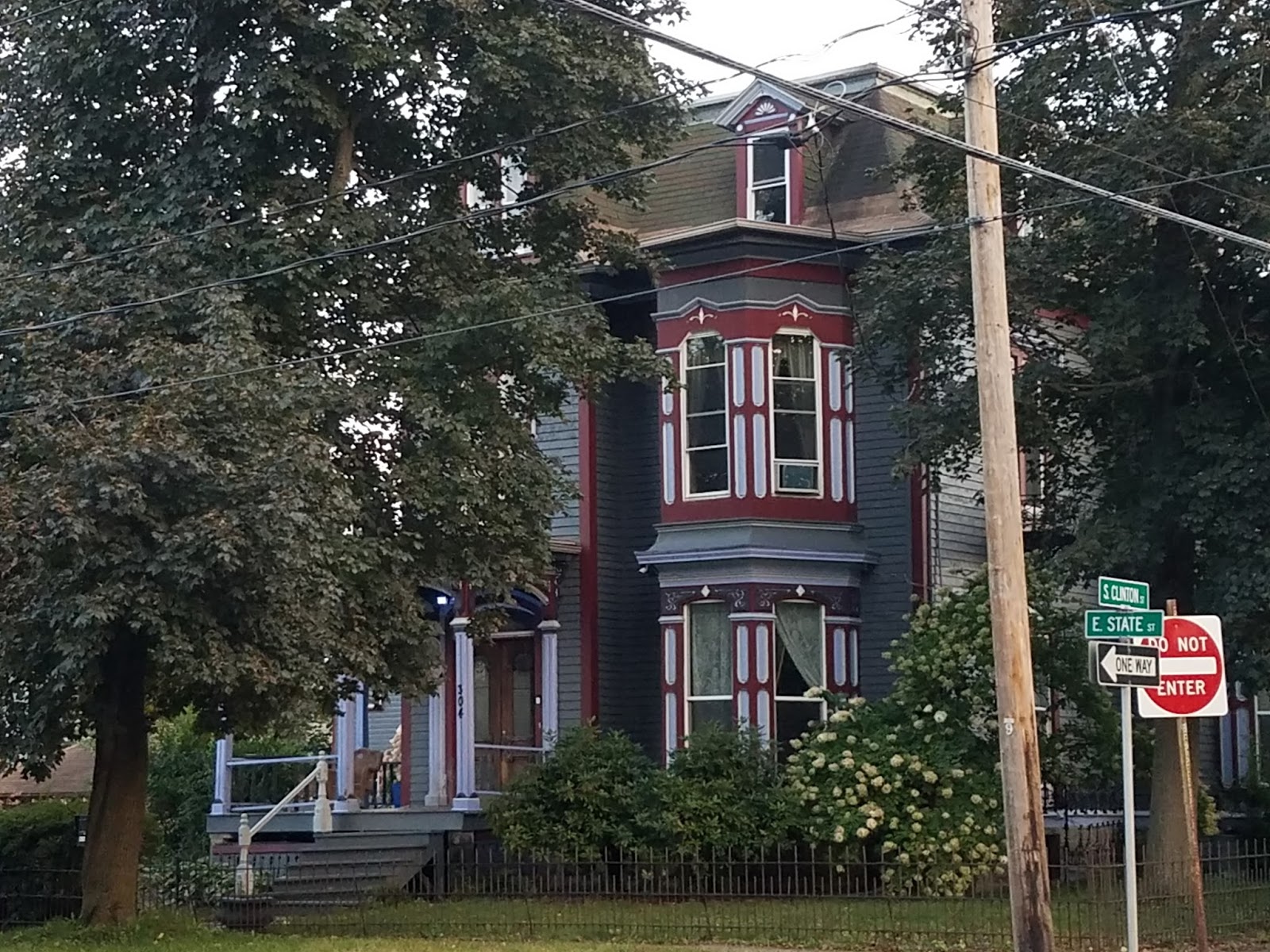
My guide was Paul. I met him, his father and his seven-year-old daughter Friday night. The father, whose name I have already forgotten, lives on a side street just off of downtown in a Victorian house listed on the National Register. It was the last of ten places on that list that i photographed. I stopped in front of the house while the three of them were eating fried chicken on the porch and Dad asked me why I stopped. I told them, and the three came down and explained that the house was from 1878 or 1888, and was owned by a sugar magnate in town. Paul explained about downtown. This was collaborated by Alexis, the clerk at the hotel, and by what I saw. I didn't actually go anywhere with these people, but Paul told me some of the history and where to eat dinner.

North Union Street, the Main Street of the town (although there is also a "Main Street," which isn't really) was four lanes with diagonal parking. It was redone with roundabouts at intersections instead of lights, made one lane in each direction, with a median, a bike lane,  and wider sidewalks. People were annoyed with the roundabouts at first, but now they like them.

The town looks like a bigger, New York State version of an Appalachian city, all dollar stores and fast food places. You can see the renewal attempts over the years: a mall next to the railroad tracks (possibly a former industrial park), a community college campus across the tracks (ditto), taller early twentieth century office buildings, looking unoccupied.

The original post office and library are near the corner of State Street, the east-west street heading west to the Wal-Mart and busier stores. A beautiful church and synagogue are a block away. The synagogue has a Facebook page, not updated since May. As I was in town Friday evening, I sent a message asking if there was a service planned. Paul told me the synagogue closed five years ago (indeed, he pointed out that the city's population generally was in steep decline). He said it had been taken over by "black-hat" Jews and expressed some bizarre ideas about what Jews believe. I didn't see anyone identifiably Jewish in town, and the answer I got on Facebook, "No services tonight. Sorry." was sent to me at 7:40, after shabbat had started. A "black hat" Jew would not be on Facebook at that time.

I did photograph the ten places on the National Register in Olean Thursday and Friday night. I visited the mall, which is dying, walked around the Jamestown Community College Olean Branch, ate at a Subway and a Tim Horton's, and Brother's Bistro, a  local restaurant recommended by Paul, which was great.

I typically don't go to good restaurants alone. It makes me uncomfortable. I'm better about it than I used to be, because instead of just looking awkward,  I can check out social media on my phone while awaiting my food. When I came in, about 8:00 Friday night, the restaurant was crowded with a table of fifteen clean-cut kids, college probably, but maybe high school, of many ethnicities, unusual in this overwhelmingly mono-ethnic county. The greeter  offered to seat me at the bar, where I would have been alone, so I asked for the one table for two that was open. Then, other people came in and they sat at the bar, joking with the bartender, while I was alone at my table. Awkward. The food was great though. I noticed here, and at a bar down the street that was open on the street (the weather was warm) that people all seemed to know each other and exchanged friendly greetings. I was the outsider.

Here are the pics from Olean, taken early evening Thursday and Friday
View from Oak Hill Park, Olean, Oak Hill Park Historic District

Olean School No. 10, now owned by a church, 1909

Olean Library, 1909, now an event center

Post Office, Olean, 1910-1912

Monument to the Grand Army of he Republic, 1910, Olean

St. Stephen's Episcopal Church, Olean, 1890

Temple B'nai Israel, Olean, 1929

Jamestown Community College, Olean Branch

Union Street, Olean

Olean Armory, 1919

Beardsley-Oliver House, where I met Paul, his father and his daughter, Olean, about 1890

Conklin-Mountain House, Olean, 1886. The Conklins made wagons

There were twenty-four historic places in other towns and rural areas in the county, and I spent much of Friday chasing them down. Portville, southeast of Olean, has four historic places, and Elicottville, near the center of the county, and the former county seat, has five. Portville is a rural small town, Ellicottville, much larger and at the foot of some hills, is a winter ski resort, with a pretty California-style downtown, full of day spas and expensive chocolate shops. Socially, if not financially, i probably belong with the Ellicottville types, and I can pass for that if I dress up, but I don't want to be there. My father didn't like to hang out with wealthy people, and I grew up in a modest suburban neighborhood. I'm more comfortable where I don't feel like I'm in a competition. I also visited Rock City, a privately run park and souvenir shop south of Olean. It's somewhat like our local Rock City in Coopers Rock State Forest, only more so. When I told people I was from out of town, Rock City was the place they told me to visit.

The last place I visited before heading back to my motel Friday afternoon was Little Valley, the present-day county seat, and a village, in New York's classifications, a small place without much happening. It was thirty miles back to Olean from there.

Of the places I visited in Cattaraugus County, I liked Olean the best. It's pretty, and the city has worked to make improvements like the motel, the streetscape on Union Avenue, the community college campus. There was a site being cleared with signs indicating it was being cleaned up as a "brownfield" zone. I liked the closeness of the people I saw out on the street, and the older buildings from a more prosperous time.

The weather was warmer and sunnier than one would expect from Western New York. The leaves were changing color, not yet at their peak.
Portville Library, originally a house from 1847, expanded and remodeled

Wheeler House, Portville, 1880

Bedford Corners Schoolhouse, near Portville, c.1864

Pfeiffer-Wheeler Cabin, 1941, made of chestnut, at Pfeiffer Nature Center, near Portville

The view from Pfeiffer-Wheeler Cabin

Selfie at Rock City

North Lyndon Schoolhouse, 1844, Lyndon

Salem Welsh Church, 1855, Freedom

Robbins House, 1895, Franklinville

Park Square Historic District, Frankinville

Ellicottville  Historic District

Ellicottville Town Hall, 1829, originally the Cattaraugus County Court House

Victorian House in Little Valley

U.S. Post Office, Little Valley, 1940

There were pro-Trump signs in the outer reaches of the county, such as "Thank you, Jesus, for President Trump," and "Trump-imprison the usurper Obama," but in the larger cities, people seemed more rational and friendly. This is an area that experienced a downturn in population and economic stagnation, but is struggling to come back, and the people who stayed seem to be dedicated to making it work. It was a beautiful place to visit, with leaves starting to turn and a varied topography. It reminded me a bit of the north coast of California, with levees along the Allegany River, Native reservations, and deep ferny forests.

Sunday, August 27, 2017

Carter and Bath Counties, Kentucky


You might think I was too exhausted from travel to Canada to leave again six days after our return for my sixty-second county within three hundred miles of Morgantown, in this case Carter County, Kentucky. You would be wrong.

This project has become more than an obsession, as Zack Hample, my (half) bother-in-law said recently about his catching baseballs. I have to do this, and I like it.

Carter County didn't seem promising. Grayson, the county seat, is small,  2.700 people, just really an exit off I-64 two counties west of West Virginia, and only thirty miles from Huntington. There aren't a lot of historic places, no Jewish community, no mall. It's 234 miles, downtown Morgantown to downtown Grayson, which means two nights.

Looking at the map, I realized that Bath County, two more counties to the west, was still within three hundred miles of Morgantown. Alphabetically, I should have been there in August, 2014, when I visited Bath County, Virginia. I figured I could spend an afternoon there. It had a few more historic places, at least.

I left later than I planned Sunday, not unusual, and arrived in Grayson about four. After a nap, I went out to buy a swimsuit at K-Mart, just down the road, and dined at one of those seemingly ubiquitous Chinese buffet restaurants.

The main street connecting I-64 to Main Street (U.S. 60), about a mile apart,  is Carol Malone Boulevard, a jumble of fast food restaurants, gas stations and motels. I had to research to find out that Carol Malone was an opera singer from Grayson. Kentucky Christian University is along Carol Malone Boulevard. Wikipedia says they had a great choral program, but deleted the music department to focus on athletics.  Ouch. I drove a bit of Main Street, and walked two blocks west of Carol Malone to find the 1907 County Court House.
Kentucky Christian University, just off Carol Malone Boulevard

Carter County Courthouse, 1907, West Main St. (U.S.60) They are reworking the landscaping.

Statue of a World War I soldier, Courthouse lawn, Grayson

West Main St., Grayson


Monday, I tried out my new swimsuit in the motel pool, then headed out to explore Olive Hill, the other town in Carter County, fifteen miles west of Grayson, and then I planned to visit Owingsville, the county seat of Bath County, fifty-three miles west of Grayson, across Daniel Boone National Forest.

Monday, August 21, was a red-letter day, the day of the solar eclipse, 93% in Grayson at 2:33 P.M. I figured to be at Grayson Lake State Park, south of town, to see the eclipse through the trees.

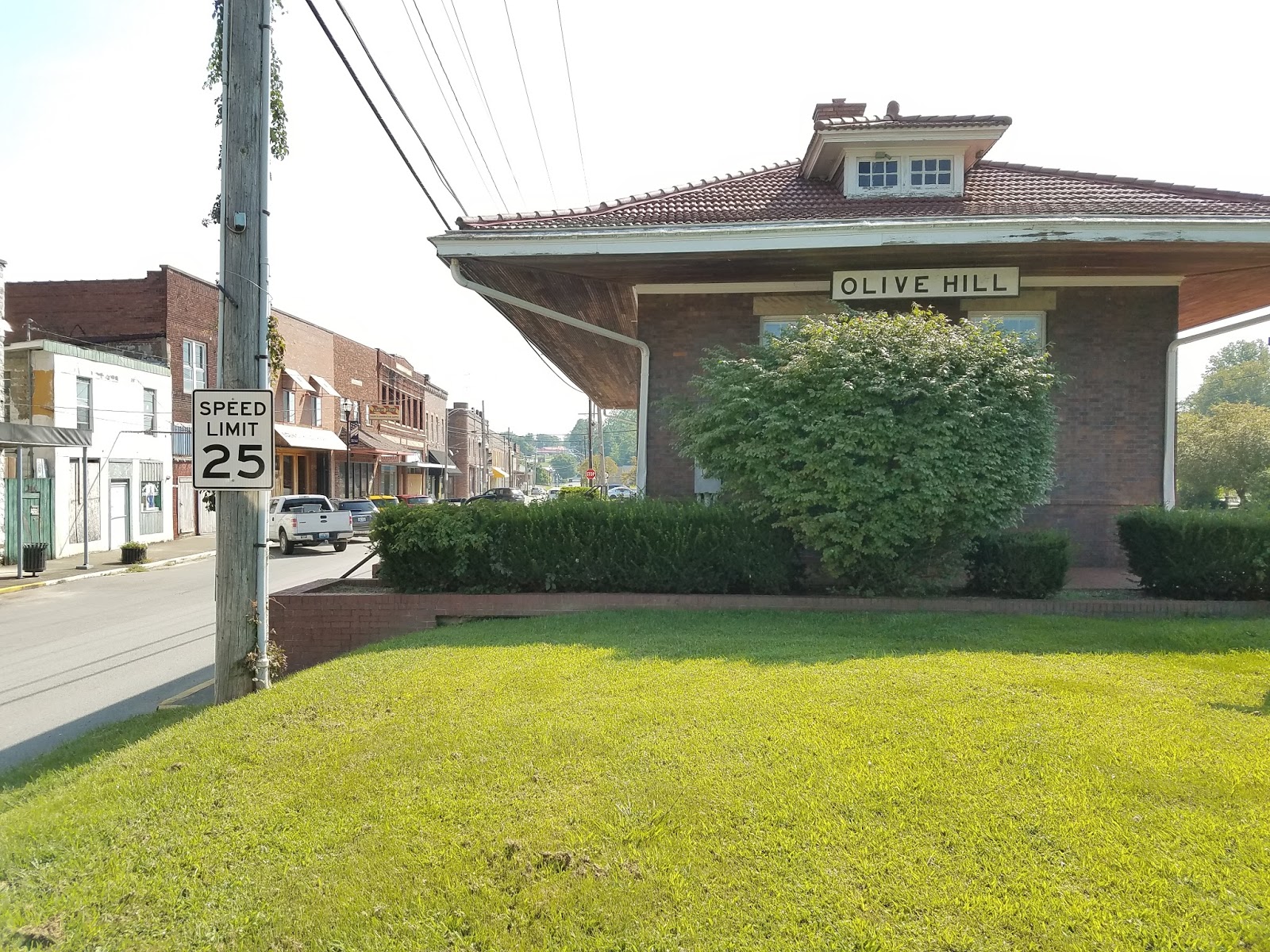
Olive Hill looked like more of a town than Grayson, only half vacant. There is a rail trail along a creek, and a historic railroad station, not used by the railroad.

"Downtown" Olive Hill

Historic train station, Olive Hill
Owingsville, two counties west, and the county seat of Bath County, was founded by Thomas Dye Owings. The plaque in front of his house states he came from Maryland, so possibly from Owings Mills, near where I grew up in Baltimore County. This is an older town than Grayson, and is more picturesque, even though it only has 1,500 or so people. It lies 43 miles east of Lexington.
Bath County Court House, Owingsville
The center of this block is the original Owings House, c.1800


Downtown Owingsville Historic District
Monument to Confederate soldiers from Kentucky, 1907, Owingsville

J.J. Nesbitt House, 1878, Owingsville

I ate lunch at a family-owned pizza place, just off I-64, and thought I found a shortcut to the lake to get me there in time for the peak eclipse. As I was driving, I thought something was wrong with my eyes, as the light dimmed on a bright sunny day.

My shortcut wasn't, typically, and I was about seven minutes late to the lake. The temperature had dropped from 89 to 81 F. in the middle of the afternoon and the light was still dim when I snapped a pic of the marina.

The marina at Grayson Lake. The light is slightly dimmed; this was seven or eight minutes after the peak of the eclipse

I drove back to my motel for a nap, then ate at Shoney's a not-favorite coffee shop place. There is a supermarket in town, and I thought I could get a plate there, but all they had was fried chicken, with two sides. The sides were mac and cheese, mashed potatoes, baked beans and green beans, the latter two both with pork in them. Shoney's has a salad bar at  least.

I was happy to get away, but it didn't seem like much of a place to visit. Before dark Monday, I walked from my motel across I-64, and the mile or so down to Main St. There is a little park with a playground, a new, old-looking log house, which is home to the tourist agency for the county, a covered space with picnic tables and benches under a few trees. The street behind Carol Malone Boulevard is lined with some older homes. There were kids on the playground, two women chatting and eating carry-out from styrofoam boxes at one picnic table, a woman looking at a cell phone at the other picnic table, a man stopped on a motorcycle talking to a friend on the street behind the park. It was still warm out, the temperature having gone back up after the eclipse passed. I could hear and smell diesel trucks passing by. It wasn't much, just a scene, comforting, somehow, of a small-town in America.

I sat on a bench for a few minutes, then walked back to the motel, stopping for a frozen "treat" at McDonald's.