Saturday, March 10, 2018

Chautauqua County, New York


This was different. On most of my monthly trips to a new county, and this was the sixty-ninth, I've picked the week when the weather was going to be at its best. Now that I'm on City Council in Morgantown, I don't have that luxury. Also, Joe and I are going to Key West at the end of the month to my nephew's wedding, and I thought it would be good to leave a week to be back in Morgantown before heading off again. The forecast for Chautauqua County, in far western New York on Lake Erie, the United States' border with Canada, was for snow. A lot of snow. Still, the roads are all Interstate and there are no mountains to cross, unlike driving to Virginia, for instance, so I figured it wouldn't be hard to go 230 or so miles. And generally, it wasn't.

My first stop was a rest stop on Chautauqua Lake near Mayville, the village that is the county seat. I  met David and Joanne, an older couple staffing the tourist center there, and they told me about the Luci and Desi Museum and Chautauqua Institution, closed for the winter, but a gathering place for intellectuals. Lucille Ball is from Jamestown, the largest city in the county. I told them I look for synagogues, and they told me that Chautauqua, when it's open, has two Jewish centers, and they found a synagogue online in Dunkirk, the second largest city, on Lake Erie, with twelve members. I had found a Reform synagogue in Jamestown with thirty members. There is also a mall, a Wegman's (but no Whole Foods) and forty-nine places on The National Register. So I had enough to do.

View of Lake Chautauqua from the rest stop on I-86, which is also Old Route 17, Wednesday, afternoon

My motel was located just outside the city limits of Jamestown. I got to town about three and went downtown to check out what was there.


The Wellman Building, Jamestown, 1897


Downtown Commercial Historic District, Jamestown. This is the Jamestown Hotel, from 1924
Main St., Route 60, Jamestown

Luci and Desi Museum, Jamestown


I drove back to the motel and crashed for at least an hour. Leafing through the motel's notebook, I found an ad for a Chinese buffet, located just south of the Erie Railroad overpass on Main St. Just a block south of downtown, in what looks like a flood plain, there are newish stores: a chain restaurant, drug store, and a medical walk-in office. The food at the Chinese place was good, but both the hot and cold foods were room temperature, except the hot tea and the cold ice cream. It was snowing when I left the restaurant.

I stayed up arranging my day for Thursday. The National Weather Service posted a "Winter Weather Warning" for Thursday, starting at three P.M. and extending to Saturday evening. I thought about going home the next morning, but decided to stick it out.

Thursday was cold, ranging from 21 to 31 F. and there were snow squalls alternating with bright sunshine most of the day. I had six places on The National Register to find in Jamestown, plus the synagogue, before heading off to the rest of the county. I skipped my alternate day water pill. I knew it would be too hard to have to pee every twenty minutes.
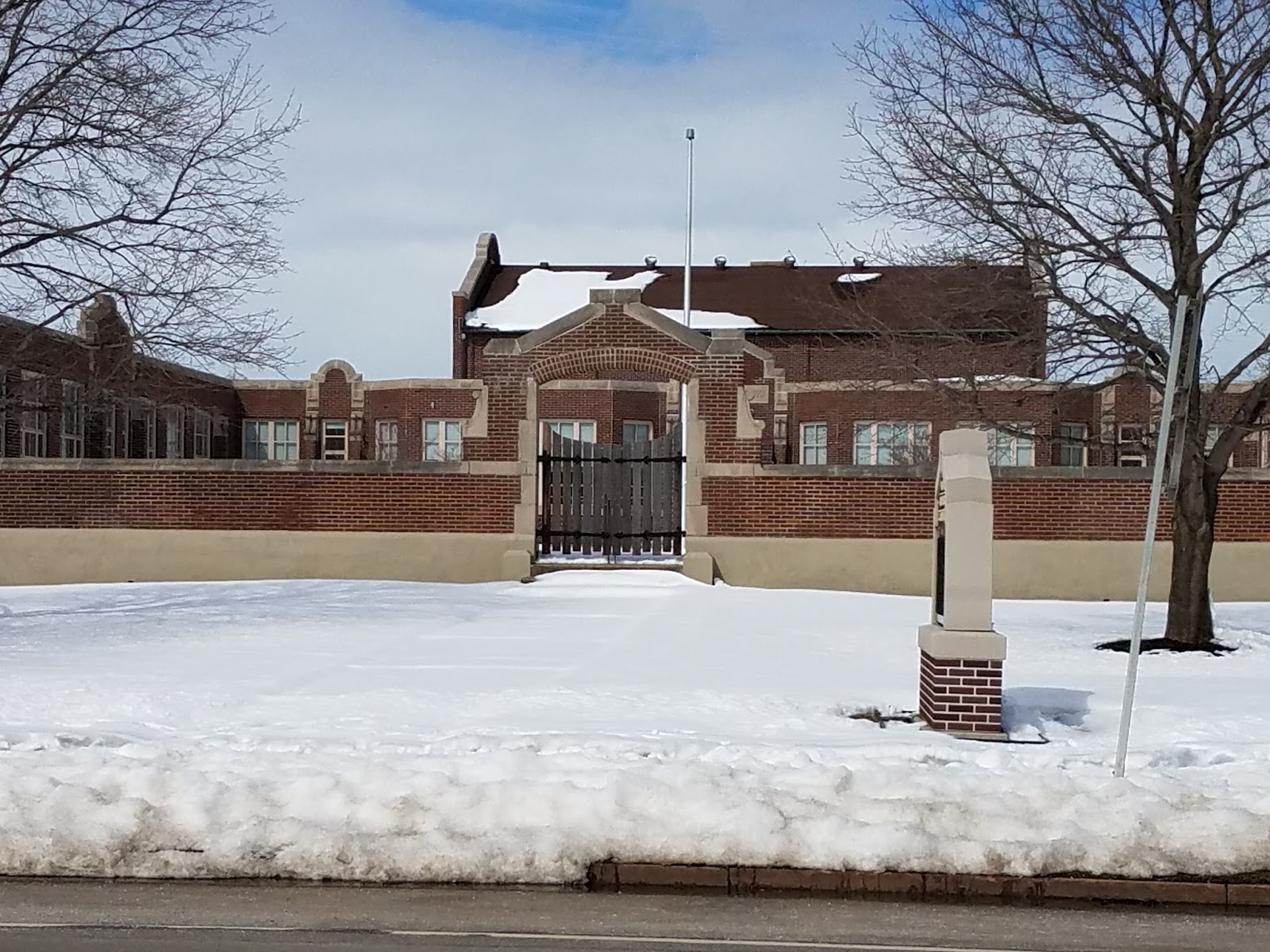
Euclid Avenue School, Jamestown, 1911, enlarged 1920

Lakeview Avenue Historic District, mostly 1890s

Jamestown National Guard Armory, 1932

My search for Jamestown's synagogue was fruitless. The building, behind the armory, is now a church. It's possible that the synagogue still meets elsewhere. The future of Jewish life in small towns is not good.
Erie Railroad Station, Jamestown, 1931. Wikipedia says the last passenger train was in 1970. It is used as a bus hub and, according to a sign outside, will be renovated as a performing arts center.

Partridge-Sheldon House, Jamestown, 1850-67, enlarged 1880. Porter Sheldon was a US Representative after the Civil War

A view of downtown Jamestown from the south, near the Partridge-Sheldon House

Governor Reuben Fenton Mansion (1863) now Fenton History Center, Jamestown
It's 26.5 miles up NY Route 60 from Jamestown, at the south end of Lake Chautauqua, to Fredonia, near Lake Erie. The Commons is a two-square block park along Main Street (US 20) in the middle of town. North of there is a campus of the State University of New York. Fredonia is one of the more prosperous looking towns in the area.
Fredonia Commons, Fredonia

Fredonia Post Office, on the Commons, 1935-36, a Works Progress Administration Project

Fredonia Town Hall and Opera House and the United Methodist Church, Fredonia Commons

On campus at SUNY (State University of New York at Fredonia)
Dunkirk, the second-largest town in Chautauqua County, is just up the road from Fredonia on the border of Lake Erie. Much of the lake is inaccessible, with industrial uses, businesses and parking lots. There is a city park on the lake. I used to work at Social Security in Miami with a young man of Polish heritage who was from Dunkirk. I saw some buildings with words in Polish  and a polish community center in Dunkirk.
Temple Beth-El , Washington St., Dunkirk. They have a webpage on meetup.com, not updated since at least last summer, that shows eleven members

School Number 7, Dunkirk, probably 1920
Coming back down Route 5 along the lake I spotted a combined Tim Horton's and Cold Stone Creamery. Joe and I breakfasted at Tim Horton's in French-speaking Canada, and so I was surprised that the young woman at the register spoke English and said "What can I get for you, Honey." I'm not used to being called "Honey." I had a gooey chicken fajita wrap, with bad fries in a cup (edible drowned in ketchup) and a Diet Coke. I hear that Diet Coke rots your brain, but it goes well with fast food.

Point Gratiot Lighthouse. As you can see, the grounds were closed. This is the office with the lighthouse, still in use, behind it, 1875, on Lake Erie in Dunkirk.

Lake Erie from Point Gratiot Park in Dunkirk
The road into Lake Erie State Park, Brocton, with the bathhouse on the right

Brocton "Welcome" Arch, 1913
It started to snow on the way from Brocton to Westfield, adjacent towns along Lake Erie.
Barcelona Lighthouse and keeper's cottage, 1829, Westfield, now owned by New York State
Coming back to the center of Westfield, which is along U.S. 20, from Barcelona Lighthouse, the snow was coming down "fast and furious." I parked behind Main St. and ducked into the café pictured here with the "open" flag. I had a cannoli and herbal tea. I didn't realize they closed at two. I got there at five of. The snow stopped for awhile, or at least slowed down enough for me to walk around. Westfield has more National Register listings than anyplace else in Chautauqua County. It was once called "Portland" and was an early port and grape-growing region. If it had not already been so late, and the weather threatening, I might have explored more of the town.
E.Main St. Historic District, Westfield

One-time headquarters of Welch's, Westfield. Lake Erie is a major grape-growing area

Town Square, Westfield, part of the French Portage Road Historical District

an early 20th Century block on East Main St., in Westfield

The McClurg Museum, an 1818 mansion, Home of the Chautauqua Historical Society, Westfield
I headed south east from Westfield back in the direction of Jamestown, to Mayville, a village, and the county seat. By this time, it was 3 P.M. and the promised snowstorm showed up.
Chautauqua County Courthouse, 1907, Mayville

Sign bragging about how much snow they get, across the street from the Courthouse, Mayville

I thought I would check out the Chautauqua Community, a resort that has concerts and lectures throughout the summer. It is just south of Mayville and has many historic structures. Although the road by there is along Lake Chautauqua, the snow was coming down so hard that it was impossible to get a clear view of the lake. I passed it by on the way to Lakeview, the western suburb of Jamestown, where there is a traditional enclosed mall. I stopped in to see what was there, and to get out of the weather. They have a Bon-Ton (same company as Elder-Beerman in Morgantown), Penny's and Sear's. There an Office Depot with an outside entrance, and some restaurants that can be entered from inside or outside the mall. Many storefronts in the mall are empty. I stopped in FYE, where I (still) buy CDs in Morgantown, and I bought the new Grammy CD, a collection of songs nominated for Grammys. This gives me an opportunity to see what the latest (last year) music is, and I usually upload it to my antique IPod shuffle to listen at the gym.

I noted the location of Wegman's near the mall and went back to my motel to nap for an hour. I went back out to Wegman's for dinner, where it is now $9.99 a pound for the food bar. I spent $!5 on greens, broccoli, a little piece of salmon, and fruit, trying to eat healthier than I did for lunch. I was back in the room early to catch up on email and social media. There was a party in the next room, which kept me up a bit. I tried to watch some of MSNBC and CNN, thinking I would get smart commentary, but on one of them was an interview with a steelworker and his father, both inarticulate, praising the President's tariffs on imported steel. There were also commercials for medication and cars. I confirmed for myself why I don't watch television at home.

I was out before nine Friday morning in near white-out conditions, drove back to the courthouse in Mayville, then to Morgantown. The weather cleared up at the Pennsylvania line near Erie, and there was less and less snow on the ground as I headed south. I was in Frankin Park, at the north end of Allegheny County, not far from Pittsburgh just past noon. I know there is an Eat 'n' Park there, and my friend Matthew, who I met in New Orleans in 1973, lives nearby. I called him, and since he is unemployed, he came and met me for lunch. It was good to see him again. Schools in Monongalia were closed because of snow Friday. It didn't seem so bad when I got there around three in the afternoon.

Like most of the smaller places I visit, it seems the best days of the area are in the past. The little old towns are pretty, and some have upscale stores, but most don't. Chautauqua Institute is famous, and I know people from all over go there for a week or so in the summer. I'm sure it's beautiful outdoors by the lake in the summer. I perversely enjoyed navigating around in the snow. Go figure!

Sunday, March 4, 2018

More Movie Awards

The people who host the big movie awards show tonight are fussy about who uses their name, so I won't. You know who I mean.

This year, I saw all the Best Picture  nominees, either through screeners sent by S.A.G. for their awards, because I maintain a membership with them, or, sometimes, in a theater. They are all good movies.

"Call Me By Your Name" is an old-fashioned romance, slow and beautiful, only the romance is between a teenage young man and a somewhat older grad student. It's really a Merchant-Ivory production, from the people who made "Howard's End" and "Remains of the Day," only Merchant died some years ago, so the script is by James Ivory, turning ninety this year in June. I especially like Timothée Chalamet, who is twenty-two, playing the seventeen-year old who falls in love with another man. To be that young, and know yourself well enough to play that character, onscreen through most of the movie, and frequently undressed, takes a level of acting expertise and unselfconsciousness I don't think many actors can handle. I would go for Chalamet for Best Actor, for which he has been nominated.

"Darkest Hour" is about Winston Churchill's first month in office as Britain is about to be attacked by Nazi Germany. It ends with the evacuation of Dunkirk, which is what the movie "Dunkirk" is about. Both movies are great history, and Gary Oldman's nominated performance as Churchill is amazing. "Darkest Hour" is meticulous in the details, looks beautiful and rouses one to a patriotism one doesn't see anymore, not anywhere. "Dunkirk" does the same, but is a more modern movie, filled with newer effects, and focused on several individuals, none of whom have what you would call a "star turn." Given a choice of one of the two, I would take "Dunkirk" because the patriotism is not people at home cheering on Churchill by pledging to fight, but follows the actual people doing the fighting, who survive with courage and great luck. I found that more moving.

"Get Out" is a freak show, scary and funny and original. Daniel Kaluuya stands out, and was nominated for Best Actor, but the supporting cast was also great. This movie gets points for being a sock in the nose to racists. Jordan Peele, who is African-American, was nominated for Best Director.

"Lady Bird" has a great costar- Sacramento. It's about a teen girl (Saoirse Ronan) and her mother (Laurie Metcalf), and the teen's desire to leave Sacramento, where she has lived all her life. She takes drugs, has sex with a jerk of a guy (Timothée Chalament again), dyes her hair blue and fights with her mother. I saw it in Memphis with Joe's cousins. The 17-year old girl, whose grandmother hosts Thanksgiving, raved about it. She is smart and, supposedly a "good girl" so I wondered about her identifying with the main character. This is one of the few movies that passes the "Bechdel Test"  where two women relate to each other for more than five minutes without it being about a man. Greta Gerwig was the rare female nominated for Best Director, and Ronan and Metcalf are up for Best Actress and Best Supporting Actress respectively. I'm familiar with Sacramento, and it was really filmed there and looks as charming as it is. I wish there were an award for "Best Location."

"Phantom Thread" was the most annoying movie of the year, at least that I saw. Yes, it looks great, the clothes designed by the lead character (Daniel Day-Lewis) are interesting, if not beautiful, the sets, the score by a string orchestra, all brilliant. But another story about a pretty twenty-something girl in love with a crotchety sixty-year old man? Please. I didn't find any of the characters appealing, and yes, Daniel Day-Lewis is a great actor, but this was so stylized as to be off-putting, and can we talk? No way was that character straight. In addition to Best Picture, Day-Lewis is nominated for Best Actor and Paul Thomas Anderson for Director. I looked at my watch too many times during this movie. We should be gripped, if not entertained, instead of being exhausted and exasperated. End of sermon.

What could be bad about "The Post?" Steven Spielberg directing Meryl Streep and Tom Hanks. It's perfect- for 1978. My sister saw it in Greenbelt, Maryland. She said everyone cheered at the climactic scene. The audience in Greenbelt skews older and well-educated. The movie was about The Pentagon Papers. "Why were they cheering?" my sister asked. "They were all in Washington when this happened. They couldn't have been surprised." Streep was nominated for Best Actress, and of course, she was great. I liked her 1970s outfits, too. I identified her with Hillary Clinton, and Nixon with the current President. I think I was supposed to.

"The Shape of Water" was the most beautiful film this year, romantic and full of fantasy. Guillermo del Toro was nominated for Best Director, another potential slap to the bigots, as he is Mexican. I did feel that he didn't really "get" the early 1960s in America, not having been alive then and not being American. I was also annoyed that we were supposed to be in Baltimore and nothing looked like Baltimore (the movie was filmed in Toronto, parts of which look like Baltimore, but not where this was filmed), and the beginning of the rainy season was part of the plot, but the mid-Atlantic does not have a "rainy season." The 1962 cars were beautiful, and Sally Hawkins as a young woman who works as a janitor and is mute, was terrific, without speaking, quite a trick. Octavia Spencer was nominated for Supporting Actress, but didn't have enough to do,  and Richard Jenkins, nominated for Supporting Actor, was let down by the script. I would have gone for Michael Shannon for Supporting Actor, had he been nominated.

I watched "Three Billboards Outside Ebbing, Missouri" on a S.A.G. screener with Joe. He loved it. I didn't. Not subtle, and "Fuck" seemed to be every other word. For the S.A.G. awards, I voted for Sam Rockwell for Best Supporting Actor for his over-the-top performance, but on thinking about it, I like Woody Harrelson (also nominated) for embodying the warmth and compassion of his character. He was the only one in the movie not screaming all the time. Frances McDormand was nominated for Best Actress, and she was terrific.

I also saw "I, Tonya," just last night, because Margot Robbie was nominated for Best Actress and Allison Janney for Best Supporting Actress. That was an entertaining, different, roller coaster ride of  a movie. Robbie, who can skate (there were doubles for some of the scenes) was all in, if too old, and Janney was blood-curdling. Clever of Robbie to produce this movie and make sure it got done. I also liked Sebastian Stan as Tonya's husband Jeff, handsome, charming and a total dick.

I watched "The Florida Project" and "Mudbound" on screeners. I didn't think Willem Dafoe, nominated for Supporting Actor, had enough to do in "The Florida Project." I might have voted for Bria Vinaite, as the mother in this movie, for Best Actress. Apparently, she had never acted before. I was moved by "Mudbound." Any of the actors in that could have been nominated, but Mary J. Blige was, for Supporting Actress, probably because she was far away from how we know her. I would vote for her. I missed Denzel Washington in "Roman J. Israel, Esq." and Christopher Plummer in "All The Money In The World." Other than those two, I saw all the Picture, Director, Actor, Actress, Supporting Actor and Supporting Actress nominees.

Were I eligible to vote, I would vote "Dunkirk" Best Picture, Timothée Chalamet, Best Actor, Margot Robbie, Best Actress, Woody Harrelson, Best Supporting Actor, and Mary J. Blige, Best Supporting Actress. For Director, I would go for Guillermo del Toro, without being upset if anyone else won unless it was Paul Thomas Anderson.

The awards show is on tonight, soon. I won't be watching it.


Sunday, February 25, 2018

Most of February

I returned from my trip to Maryland and Virginia on Monday, February 6, to more cold and snow, and lots more meetings and demonstrations. Although I was well over my illness, whatever it was, I was sleeping through the night, with two naps, one after breakfast and one late afternoon. I went back to the new gym I joined just before I get sick, where I am a hot young guy, instead of being the oldest one, by at least twenty years, and more often, forty years, at my old gym. I've gone to two weeks of line dancing classes, much easier than the Israeli dance I attended for twenty-five years in L.A., but for all my scoffing, just about what I can do for an hour, now.

My world was shocked by the February 14 shootings at Marjory Stoneman Douglas High School, in Parkland, Florida. That particular suburb didn't exist when I left South Florida in 1984, but I recognized from the names that the students were a generation or two later version of the people I knew from my time in Miami: Cubans, Jews, African-Americans, whose parents had become affluent and educated, and moved north and west to a new, "safer" suburb, away from Miami. Maybe because I recognized these kids more than those from other shootings, or because I have cousins who grew up near there and are now still in their twenties, I took this hard. And these kids, smart and media savvy, were able to express their grief and desire for change to the world in way that previous survivors could not. I posted about this on my own social media and spoke at length about the need to ban assault weapons nationally at our February 20 Morgantown City Council meeting. Our Morgantown Interfaith Association held a vigil on the 21st downtown. One candidate for state legislature was there, and I attended from City Council. I've checked Twitter, and besides my relentless tweeting, and retweeting students from Stoneman Douglas, what we got from our politicians was "thoughts and prayers" from our Republican congressman and our Senator, who also thanked "first responders." Not even that much from our Democratic Senator, nor from any of our state Delegates or Senators. Meanwhile, in Charleston, our state capital, Republicans, who have a majority in both houses, are busy passing bills to demand that colleges allow concealed carry of weapons on campus,  and that weapons be allowed in cars at any business. More on these horrible people later.
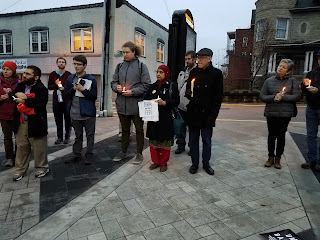
Interfaith vigil against gun violence Thursday, February 22. This is less than half of the group
The President spoke with some of the students, one of whom saw on his note card the expression "I hear you," meaning it was in his script to say that. At the end of the week, when funerals were held for the first students, the Jewish ones, who by custom have to be buried as soon as possible, the President was on the golf course at Mar-A-Lago. Students and parents spent the week trolling Florida Governor Rick Scott and Senator Marco Rubio, who refused to say he would no longer accept campaign money from the NRA. Conservative pundits on television and in the news have suggested that the students who spoke out were actors, or that the whole thing was the fault of the FBI, who knew about the shooter, or that we need better mental health screening, or raise the age when someone can purchase an assault weapon. Of course, the administration would love to end Medicaid, and has tried to cut off the Affordable Care Act's expansion of Medicaid, which provides much of the mental health and drug addiction benefits to the poor.

I remember the shootings at the club in Orlando, the church in Texas, the outdoor concert in Las Vegas (where the shooter was over sixty) and now, in Parkland. What these all have in common is that the shooters had an arsenal of legally-acquired weapons, including AR-15-style weapons. If one is not frightened of the NRA or receiving buckets of campaign cash from them, it is obvious that these weapons have no civilian use and should be banned. I find it hard to believe that America's children should be "collateral damage" so that everyone with a grudge can have an assault weapon. I can't imagine that we have such cowards in both parties running our government.

Meanwhile, our representatives in Charleston proposed a one percent raise for teachers, the first in ten years, while increasing premiums for health insurance and retirement, which would wipe out even that pitiful raise. Additionally, they introduced bills to insist that the teachers' unions get written permission each year to deduct union dues from teachers' salaries, and to end awarding full-time union leaders, all teachers, retirement credit in the system. They voted to lower standards for new teachers, since they can't fill many positions with qualified applicants, and they want home-schooled kids to not need a GED to get a state-sponsored college scholarship. There was a bill this year to mandate an elective course in the Bible, and to allow school districts to write their own science standards. Read into that what you will.

Teachers went to Charleston to protest, and they were effectively locked out by the House Speaker adjourning the session at 11 A.M. until 6 P.M., when visitors would not be allowed. The net result of this is that teachers in all fifty-five counties in this state walked off the job. Thanks to Messrs. Mason and Dixon, and to former President Lincoln, West Virginia is oddly-shaped. Many people in the state could easily commute to teaching jobs in Pennsylvania, Ohio, Maryland or Virginia, where the pay is lots better than in West Virginia. Instead of dealing with these pay and benefit disparities, the Legislature has voted this session, not to pass a budget, which is their main job, but to ban Medicaid from paying for abortions, to create an unnecessary extra level of courts, to allow clergy to not perform weddings they object to (they already can do that) and to give a tax break to out-of-state corporate interests.

The teachers in every county in the state walked off the job Thursday and Friday, forcing the schools to announce in advance that they would be closed, and as of Saturday night, it looks like they won't be back Monday, either. Arrangements were made for social service agencies to provide food for kids and families at lunch, and people were asked to drop off food and supplies at food pantries throughout the state. It's a sad commentary that many kids in West Virginia only get a decent meal at school. It rained last Thursday, the 22nd, in the morning, although this week the weather has been freakishly warm, breaking records Wednesday, Thursday and Friday. With all the rain we've had, there have been flood watches and warnings. I went Thursday afternoon for less than an hour during a break in the rain to stand with teachers from North Elementary, near my house. Parents brought shipments of coffee and donuts from a nearby store while I was there, and a woman introduced me to her developmentally disabled son Anthony, who recognized and hugged his former teachers, held a sign to passing motorists, and screamed with pleasure when a car honked at us. His mother told me that Anthony, at three, could not stand up, and she was told that he would never get much past the mental stage of an infant. She took him to kindergarten at North Elementary, where the teachers worked with him, and although she no longer lives in our county, she wanted to come out to support the teachers at North. While our state votes, or in the last election, voted Republican, people I've spoken to support the teachers.
Teachers picketing near Morgantown's North Elementary, Thursday afternoon, 2/22

We had a marathon five-hour City Council meeting Tuesday, February 21, where we picked six people from the ten we interviewed for our new Health and Wellness Commission. In the regular meeting, later, we passed, 6-1, an ordinance to give a tax break to businesses who spend at least five million dollars on new development or improvements to an existing business downtown or in an area that becomes annexed to the city. I had my doubts, which I expressed to the Mayor and City Manager at a meeting Monday. Joe and I had been out the previous Thursday with our gay social group, only five of us that night, at the south end of downtown We started with drinks at a hotel, then adjourned to an Indian restaurant with a buffet. Lots of people were there for the yummy food, but I couldn't help notice the empty storefronts and surface parking lots at that end of downtown. Despite my misgivings about the bill, because I'm not in favor of tax breaks for big business, generally, I voted for it, in the hope that something will give our downtown a boost. Two people spoke against the bill, one a friend , and one of our Councilors, with good reason, voted against it. I hope that we can now do something for smaller businesses in the area, which was one of the objections, and that, ultimately, new development will provide jobs and an increased tax base for our city. We didn't adjourn until 10:30.

Wednesday dawned with a temperature of 65 F. (average low 24 F. for the date) and it was supposed to get warmer. Joe had office hours and a work-related dinner date, so I decided to go to Pittsburgh for a "big city fix." I picked five historic places and figured on lunch somewhere, a stop at a CD store I know about in the Strip District, just north of downtown, and a bookstore, possibly the one in Squirrel Hill. I thought I might hit a movie if it rained, and stay past dinner. I visited numbers 121 to 125 on Wikipedia's list of historic places, bought three CDs from my list of the best-selling albums of the first decade of this century (by Faith Hill, Lenny Kravitz and No Doubt) and visited a book store on Carson Street in Pittsburgh's South Side Flats. More on that later.

Of course, it started to rain not far into Pennsylvania. It's about 75 miles from our house, at the north end of Morgantown, to Central Pittsburgh, and although it hit 72 early in my stay in the city, the rain came on and off, and by the time I left at 3:30, it had dropped to 47 F. I started downtown at the Pittsburgh Renaissance District, the twentieth century rebuild of the historic center of the city at the point where the Allegheny and Monongahela Rivers meet  to form the Ohio. I got there close to noon and paid $4.00 to park on the street for an hour. I took a few pictures, saw a demonstration by high school students at Market Square, protesting the shootings in Florida, and lunched at a chain restaurant that serves noodle dishes.

Pittsburgh Renaissance Historic District, Wednesday, 2/21

Gateway Center, Pittsburgh, one of the entrances

Flooding along the Monongahela River in Point Park

Students holding a vigil, Market Square, Pittsburgh, 2/21. The glass building is the headquarters of Pittsburgh Plate Glass


From there, I headed north to the CD store (which also has records and comic books) then just east to "Reymer Brothers Candy Company," a 1906 building, now used as offices. The candy company no longer exists.
Reymer Candy Company, 1425 Forbes Avenue, Bluff District

I crossed the Monongahela River from there, to Carson Street, once an old working class neighborhood at the foot of a bluff and subject to flooding, now gentrifying. It looks like Morgantown's High Street if it were three miles long instead of two blocks.
I visited the Pittsburgh Mercantile Company Store, near the east end of Carson Street, built 1906-7, and originally, according to Wikipedia, a "company store" for a steel company. It has lately been converted into apartments. The steel company no longer exists.

2600 East Carson St., South Side Flats, Pittsburgh


Cruising down Carson Street, I saw a banner advertising a book store and decided to drop in. A sign on the door said "Closed Saturday for Sabbath." I was surprised, as this was never a Jewish part of town. The guy who greeted me was as pale and Nordic looking as anyone I'd ever met,  adding to the mystery, but when he called for the owner to answer a question, a young man in a kippa and tzitzit (ritual fringes) came over. We talked a bit, and he told me he had a non-Jewish last name (which I don't recall now) because he was Jewish only because his mother's mother was Jewish. He was a waiter before he opened the bookstore, but he quit because he had to work Friday night, the busiest night at a restaurant. He had only lately decided to become a religious Jew. I told him I was married to the Reform rabbi in Morgantown, a man. He just shrugged that off. I didn't see anything I was desperate for in the store, so I went on to my fourth historic place, Pittsburgh Terminal and Warehouse Company, built between 1904 and 1906 to link rail and barge traffic through the city. It is now used as offices.
333-400 East Carson Street, South Side Flats

I had one last place to visit, Prospect School, above Southside Flats in Mt. Washington. I turned on the GPS on my phone to get to this place, as the streets in that neighborhood wind around a bit. The school was built in 1931 and now has been converted into apartments.
Former school, Mt. Washington

It was close to 3:30, raining and cold. I figured out how to get to the Interstate home, got stuck in traffic leaving Pittsburgh (the downside of the "big city fix," )but made it home just after five, in time to feed the cat, and sleep for an hour before fixing dinner for myself. It was 60 F. and not raining in Morgantown.

It is now Sunday night, still too warm, raining, with flood watches and warnings throughout the state. The teachers will be off again tomorrow, while trying to get some kind of respect from the Governor and Legislature.

Joe and I did our bit Saturday, attending Empty Bowls, a charity event for food pantries and soup kitchens, where you get soup from restaurants, bread, home-made cookies and a bowl to take home. Almost everyone in Morgantown seems to show up at Empty Bowls.


At Empty Bowls, with Danielle Walker, candidate for WV Delegate in our district

Joe and I at home showing off our new bowls


We have a City Council meeting Tuesday, and Wednesday night, the end of the month, is the Jewish holiday of Purim, also, on the Jewish calendar, the fifteenth anniversary of my mother's death. It's a joyous holiday, but not for me. I keep busy for a retired person in a small town.

In my online world, people are angry that national newspapers are still looking to interview Trump supporters in "The Heartland" while ignoring the importance of a state-wide teacher strike in West Virginia, and television news covers C-PAC, which has become, you should pardon me, an Evangelical Klan rally. I've reminded people that "THE REVOLUTION WILL NOT BE TELEVISED."


Saturday, February 10, 2018

Four Days In February: Greenbelt and Charles County, Maryland, Charlotte County, Virginia, David Fryson

My original plan was to visit Charles County, Maryland, with a stop at my sister Robin's, one county north, in mid-January. That didn't happen because of an unscheduled Morgantown City Council meeting, the same day as an awful snowstorm. By the weekend, I was sick, possibly with the flu, so a January trip didn't happen.

I've been bombarded by invitations to meetings, demonstrations, dinners and temple events, and I was exhausted, just getting over being sick. I figured it would be less stressful to take a Friday to Monday, visit my sister, Charles County, Maryland, and Charlotte County, Virginia, my February county to visit, southwest of Richmond and east of Lynchburg. By combining trips to the two counties, I could save 300 miles of driving over separate trips and two days' time. I thought it would be warmer than in Morgantown, which has often been bitterly cold this winter.

My sister lives in Greenbelt, Maryland, in Prince George's County. This is an area that white people fled in the 1970s because of school busing. Greenbelt is a planned community, started by Eleanor Roosevelt in the 1930s, and located near the University of Maryland, Goddard Space Center and the US Agricultural Center in Beltsville. As Washington has become prohibitively expensive, Greenbelt, relatively affordable, has become a magnet for government and university workers. While it was almost all-white when my sister moved there more than forty years ago, it is, I think, a happily integrated community, and I suspect the election of 2016 has brought the people there even closer together.

I was late getting to Greenbelt because of blowing snow on I-68 and an accident in Garrett County in 6 F. weather, which closed the highway for twenty minutes. I met up with Robin at the community-owned movie theater in Greenbelt, showing "The Shape of Water" prior to the Academy Awards. I had seen the movie on my computer courtesy of the SAG Awards, but I enjoyed seeing it again on a big screen. Robin knew lots of people in the theater. She is an icon in Greenbelt. On the way out, we ran into my 26-year-old nephew's baseball coach from when he was eight. We stopped at Robin's house to drop off my bag, then adjourned to Silver Diner, once a burger-and-fries old time diner, now serving that, still, but also gourmet and diet items as well. The staff there are young, African-American and Central American-American ( I just invented that phrase), polite, friendly and helpful.

Even though it was Friday night, when I am generally offline for the Jewish sabbath, I updated my online presence while we watched "Jeopardy." I was asleep by 10:30.
At Silver Diner with Robin (photo by our server on my phone). That's turkey bacon on my plate.


Saturday was my day to go to Charles County. My rules are to hit as many National Register Historic Places as possible, go to a mall, find a synagogue, visit a park and a college or university. There are thirty-nine historic places on the National Register. I picked ten to visit, and mapped out  directions to three. The problem was that since Charles County used to be mostly rural, the historic places tend to be country houses from the colonial era, way back off the roads and posted with "No Trespassing" signs. Also, although it was sunny out, the temperature never got above freezing all day, way below average for Southern Maryland in February. I found Mt. Carmel Monastery, dating from the 18th century, and the College of Southern Maryland, both north of La Plata. The one place I wanted to see was Thomas Stone's estate. Stone was a signer of the Declaration of Independence and his home is a National Historic Landmark. There was a gate down at the entrance and a sign saying "Closed for the season, opening mid-March." I visited the county seat, since 1895, La Plata (pronounced la-plate-a), where I ate the $6.99 lunch special at a family-run Chinese restaurant. I had chicken chow mein, east-coast style, some chicken and lots of veggies in a salty sauce, with a bag of greasy noodles to add to it, and a chicken egg roll, also greasy, with little plastic packets of orange duck sauce and spicy mustard. They didn't have hot tea, so I had a can of Diet Coke. I didn't find La Plata interesting, and I wondered where the pre-Civil War county seat was? That was Port Tobacco, on an inlet of the Potomac River, current population, thirteen. There are three houses, and a 1970 reconstruction of the old courthouse. Two of the houses are on the National Register, one used as a dwelling, the other, part of the museum that includes the courthouse. Port Tobacco was a Native American settlement, then a trading point with a port, a place with both Catholic and Anglican churches that maintained a native population, and a large population of slaves during the Civil War. There was Confederate sentiment, and John Wilkes Booth fled there with his co-conspirators before being killed in Virginia. The town declined because the port silted up and became unnavigible, and because when railroads came, they bypassed the town. By 3 P.M., I was at  Smallwood State Park, where a creek flows into the estuary of the Potomac River. The estate of William Smallwood, who was Governor of Maryland at the time the Constitution was adopted, is in the park, and was reconstructed in the 1950s.

I had booked a motel in Waldorf in the northern end of Charles County. This is a "boom berg" a far away suburb of both Baltimore and Washington, a jumble of stores, town houses and single-family homes strung along U.S. 301, once the road between Baltimore and Richmond that avoided Washington. It's not far from Annapolis, Ft. Meade, and Andrews Air Force Base. Wikipedia is surprised that the county went from Republican to Democratic in elections in a few years. What I know of the area is that it became built up in the 1970s when people fled school busing in Prince George's County (where my sister lives), but were followed by military and other government employees, many of whom are African-American or descendants of Latin Americans. Waldorf is 25 miles from Washington, 41 miles from Annapolis and 62 miles from Baltimore. It is 94 miles north of Richmond, Virginia.

St. Charles is a planned community, part of unincorporated Waldorf, and that is where I found a Reform synagogue in an industrial park and a mall, crowded Saturday night mostly with "minority" teens, well-dressed and well-behaved, out for a night of seeing their friends and shopping. It's easy for me to see how middle-class minority youth would be angry at the current President for suggesting that their lives are terrible and that he was going to solve all their problems. It's insulting to talk that way to middle-class people living in modern suburbs. I had dinner at the food court in the mall, and returned  to my motel, The Usual Chain, by 8:30 P.M. I no longer plan for adventurous Saturday nights.
College of Southern Maryland, near La Plata

Mt. Carmel Monastery, near La Plata, 1790

Charles County Courthouse, La Plata

Reconstructed Old Charles County Courthouse, Port Tobacco Village

Ellerslie (left) originally mid-18th century, and Stagg Hall, 1732 Port Tobacco Village

Smallwood Sate Park near the Potomac River and icy

Smallwood's Retreat, 18th century, reconstructed in the 1950s, Smallwood State Park

Sunday was to be my day in Charlotte County, Virginia, 175 miles southwest of Waldorf. I booked a motel one county north, in Farmville, a small college town. I stayed there before when I visited Buckingham County, northwest of there, three years ago. The weather forecast was for freezing rain. The temperature stayed above freezing, just barely. It wasn't pretty. I left early, drove across the bridge on US 301 over the Potomac, bypassed Bowling Green in Caroline County, which I visited last year in April, bypassed Richmond and drove through Chesterfield County (scheduled for this June) and Amelia County (June 2013) to Charlotte County, a rural county of twelve to thirteen thousand people, one third of them African-American, and although the county voted for the current President, it wasn't by much. There was a sign at the gas station just over the county line near Keysville, the big "city" (850 people) in the county, saying something about how good the food was. I don't remember what I ate there, but they did have hot tea. Three Euro-American women worked there, two older, one younger, most of the customers in this gas station-convenience store-restaurant were African-American. The people of different races seemed to know each other and greeted each other warmly. It's a small place.

Keysville didn't look like much. I found an historic farmhouse on the way into town and the rail depot, just about falling down. The town of Charlotte Court House is another fifteen miles down the road, and there is the old court house, now a museum,  a newer one under construction, and a district of older buildings. I read the sign in front of the library, an early 19th century house, explaining that the library was paid for by Ambassador David Bruce and his wife in 1937, on the condition that African-Americans be permitted to use it. The sign goes on to say that even though they had to use the back door, and could only access some sections of the library, this was a step up for African-Americans in the county. I was in a hurry to move on, because at the edge of the county is Red Hill, Patrick Henry's home, also a National Historic Landmark. It is in Charlotte County, but not far from Lynchburg and Campbell County, which I visited in January, 2017. I was there before four on a Sunday, but in pouring rain and with a temperature of 34 F. and dropping. It was closed, but one could access the parking lot and walk up to the house. The weather was not conducive to exploring the extensive grounds. It's surprising to me that people like Thomas Stone and Patrick Henry could live so far out in the country at a time before paved roads. It's hard to imagine the kind of isolation they lived in.
Four Locust Farm, near Keysville, 1859

Charlotte County Courthouse, 1821-23, based on plans by Thomas Jefferson, now a museum

David Bruce Library 1810 and 1836

Red Hill, near Brookneal, Patrick Henry's home from 1795-1799


I made it to Farmville, checked in and napped. There are lots of chain restaurants on Main Street in Farmville, but I ate at a café near the center of town. I had fish tacos and some kind of exotic tea. I took a chocolate muffin back to the room for later. In the room, the internet went off, and the desk clerk claimed to have called a manager. The television also said "No Signal." Not that I would have watched it, but the Super Bowl was on. I was able to get internet through my phone.

It's 300 miles from Charlotte Court House to Morgantown, the outside limit of my mileage. It is possible to do it in 270, but that beautiful route over the mountains takes longer, and the rain Sunday was snow in the mountains, meaning the route might be difficult or even impossible. I drove back 20 miles to Charlotte Court House. It was sunny and somewhat warmer. I took a pic of the statue of the Confederate soldier (from 1901) and the cannon, common to court houses everywhere. I slipped and fell on the invisible ice on the brick sidewalk by the court house. A man in a pickup truck stopped and asked if I was okay and did I need any help? I told him I was fine. Actually my left arm and leg and my ego were bruised. I drove home on the complicated route laid out for me by Google maps, stopping in Baker, in Hardy County, West Virginia, the county in our state most likely to have voted for the current President. I thought I would boycott the county, but  I was hungry and I'm trying to be less judgemental about people who make poor political choices.At this place, another combination gas station-convenience store-restaurant, I declined the special ( a BLT) and had a grilled chicken sandwich with cheese, lettuce, tomato, mayonnaise, and onions. I asked them to hold the cheese, onions, and mayonnaise, which they did, and I had fries. The people who worked there were friendly. The roads home were not icy except in Garrett County, Maryland (MD's most likely county to vote for the President). I bought snacks at all the places where I used the bathroom that day.
Confederate Monument, 1901 and cannon, Charlotte Court house

Village Presbyterian Church, Charlotte Court House Historic District, 1835

I was in Morgantown at 4:30, and headed immediately to a reception for David Fryson, who was retiring as Vice President of WVU, the Director of the Division of Equity, Diversity and Inclusion. He is an eloquent speaker and a great friend to the LGBT community at WVU and in Morgantown. Joe was there.

Several speakers talked about what David Fryson had done for them. Here's my story:

A woman at temple volunteered me to be on the LGBT Equity Commission at WVU as a community member, in 2013. I went to the meetings, but because I wasn't affiliated with the University, I didn't have a lot to do. In the summer of 2015, the Commission wanted to do something for the University's "Diversity Week" in September. I suggested we do something around the idea of religious acceptance of LGBT people-a panel discussion. I immediately signed up my husband, Rabbi Joe Hample, and Dr. Fryson, an ordained minister, offered to speak. We found other Christian clergy to round out the panel. A week before the panel, I visited my cardiologist, who insisted I go in for a heart catheterization the day before the panel. "Outpatient," he said. They put in three new stents and kept me overnight. I got out late morning, and went to the panel that evening. We didn't know if anyone would show up. I bought file cards and had people write questions, which I read to the panel. We had more than sixty people come, mostly students, with a lot of tough questions about religion and LGBT people. I didn't know Dr. Fryson well, and he showed up at the last minute, which made me nervous. His answers however, were intelligent and compassionate and he spoke beautifully and directly to the points people raised. All of the panelists were good, but he was the superstar. I'm happy for him now that he is able to semi-retire and go back to Charleston, where his family is from, but I don't think he can be replaced at West Virginia University.
With David Fryson, Esq., at his reception , February 4 at West Virginia University