I just looked at my last two posts, and how busy I was with the election and its aftermath, and how I skipped town in March to visit my sister and Caroline County, Maryland. I try to leave town monthly to visit a new place. I didn't go anywhere in April.
This month, I've done two trips. My sister Robin bribed me and Joe to visit her over Mother's Day weekend with tickets to see "Fun Home," a musical about a young lesbian coming out and her closet-case father. Alison Bechdel, a cartoonist, wrote the original book as a graphic. It bothered me almost as much as "Maus," Art Spiegelman's graphic about his father, a Holocaust survivor. We had wanted to see the play in New York, but missed it. We enjoyed our weekend with my sister.
Still, I was determined to take off and see another county I had not been to before the end of May, having missed April. Since I'm doing this alphabetically, the one after Caroline, Maryland is Caroline, Virginia. Both counties are named for Caroline of Ansbach, the wife of King George II. Bowling Green, the county seat of Virginia's Caroline County, is 77 miles south of Washington, D.C. and 42 miles north of Richmond.
I left about 1 P.M. Sunday, since Joe hinted that I should go to the end-of-the-school-year Sunday school picnic. I had fun at the picnic. I don't often see the Sunday school kids and parents, and I enjoyed being with them. I managed to stay awake driving all afternoon, with the help of one of the chocolate bars Joe ordered with a wrapper showing a picture of the temple to give the kids. There were lots of them left over.
I stayed at the cheap branch of my usual motel chain at the south end of Caroline County, a place called Ruther Glen, consisting of a bunch of truck stops and fast food places. My two dinners were at a Denny's and a Golden Corral, at truck stops near an interchange on I-95. The main roads through the county are U.S. 17, which runs from Winchester to Norfolk in Virginia, and U.S. 301, once a bypass from Baltimore to Richmond, now mostly suburban. I-95 and U.S. 1 run along the west side of the county, away from Bowling Green, the county seat, and Port Royal, the original port on the tidal Rappahannock River. There are nineteen places in the county on the National Register of Historic Places. I mapped them all out before I left Morgantown.
After a quick breakfast of empty carbs at the motel this morning, I headed out in the rain and cold to look for my places. It was warm in Morgantown Sunday, so I came in a polo and shorts, figuring it would be warmer in the coastal flatlands to the south and east of us, but it was cool and rained most of the morning. I had a flannel shirt and jeans packed just in case, so that's what I wore today. I worked from the south end of the county, where I stayed near the truck stops, to the north, where Port Royal is located.
I stopped at the county's visitor center and ran into Peggy Smith, the worker there. She told me that her family has lived in the county since colonial times and they were English. I guess this was because I noted that her accent sounded like my friend Spencer, from Norfolk, and a little like my Canadian friends who say "a-boot" for about. I told her how my family has only been in the US since the late 19th and early 20th century. "So you're an immigrant," she said. "No, my great-grandparents were immigrants." She corrected herself. "You're an All-American." Still, some in Virginia, including the former western part, now a different state, think it important that one's family has lived in-state more than two hundred years. This Ms. Smith and I had a nice chat. She is about my age, and remembers the Loving case well, about the interracial couple who were arrested for just that. Peggy knew the arresting officer. She had a brochure about the case. She also told me that schools in the county were segregated until 1970, but that was all the government. She was raised on a farm, she told me, and blacks and whites mixed freely in private.
So I chased around narrow country roads looking for historic places, many of them plantation and manor houses, down long driveways behind trees and gates and "No Trespassing" signs. Peggy had told me that the county's plan was to stay rural, except along I-95, away from the two small towns. The Washington and Richmond suburbs are fast approaching, and there is some attempt to control growth.
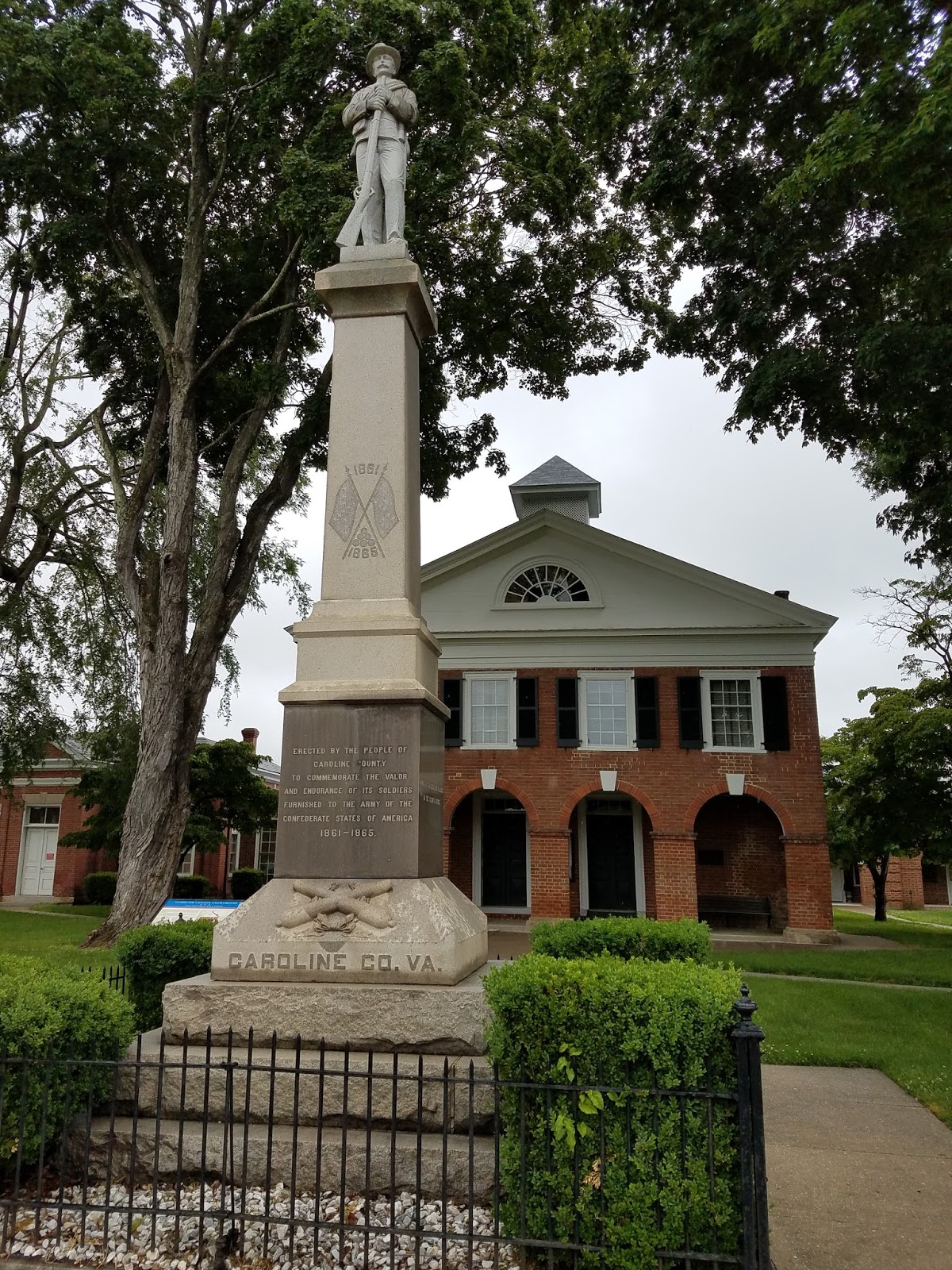
By lunch time I was in Bowling Green, a town about three blocks long and wide. I recognized the courthouse from the "Loving" movie, and there were many stately old homes on the few streets. I found a small brick shopping center with a chain drug store and an Italian restaurant. I treated myself to a chicken parmesan sub, fried (sinful!) and "unsweet" iced tea. The accents at neighboring tables were thicker than Peggy's. Someone was talking about neighboring King George County (Joe-urge). I spent most of an hour wandering around the town. There is a map of the town during the Civil War at the courthouse, mounted on a brick stand, with a caption in bold letters saying "Union Occupation of Bowling Green 1864." I couldn't help thinking "American Soldiers Quelling The Illegal Rebellion in Bowling Green." In front of the courthouse is a statue of a Confederate soldier. U.S. 1 is "Jefferson Davis Highway." I don't know how much people who live here notice these things. Since I also travel in Pennsylvania and Ohio, I see how different Virginia is. A house in Port Royal had a flag emblazoned with "Sic Semper Tyrannus," what John Wilkes Booth said after he shot Lincoln. Booth fled to Caroline County, and was shot running from the barn where he was hiding, near Bowling Green, after troops set it on fire.
I ended up in Port Royal, where Joe and I stopped for lunch on our way from my sister in Maryland to our friends in Virginia Beach two years ago, July 4 weekend. This is a small, pretty town on the Rappahannock, once a major port for tobacco, bypassed by the railroad and now quiet. I got back to my room by 4:30, slept for an hour and headed out to Golden Corral in one of the truck stops. Not everyone there was fat, the staff was friendly, and while I stuck to healthier food (salad, baked fish, spaghetti with marinara sauce, fruit, and, uh, chocolate pudding) I ate too much of everything. By 7 PM. it was 72 and sunny, the nicest it had been all day. I drove up U.S. 1 to Ladysmith, the most suburban part of the county, with a supermarket and some "real" restaurants off I-95. I bought marginally better food at the market for breakfast tomorrow.
I missed a political meeting yesterday, and I'll miss a dinner I was encouraged to attend tomorrow night, but as Joe says frequently "I am unrepentant." We'll see if I can get out next month. My term on Morgantown's City Council doesn't officially start until July 5.
 |
| The Grove, 1780-1800, north of Hanover |
 |
| Jericho School House, Ruther Glen, c. 1910, two-room school house for African-Americans |
 |
| Green Falls, c. 1710, south of Bowling Green |
 |
| wheat field south of Bowling Green |
 |
| "Old Mansion" c. 1741, Bowling Green |
 |
| Main St. Commercial District, Bowling Green |
 |
| Auburn, c. 1843, N. Main St., Bowling Green |
 |
| House in Bowling Green Historic District |
 |
| Baptist Church, late 19th Century, Bowling Green |
 |
| Stonewall Jackson Shrine, Guinea Station. This is the office for the plantation where Jackson died in 1863. The plantation house was demolished in the early 20th century |
 |
| Looking east on the Rappahannock River from the pier at Port Royal |
 |
| West on the Rappahannock at Port Royal. The bridge (under going repair) is from the 1930s and carries U.S. 301 |
 |
| Episcopal Church, 1830s. Port Royal |
 |
| Riverview, 1845, Port Royal |
 |
| Caroline County Courthouse, Bowling Green, 1830, with the statue dedicated to Confederate soldiers |