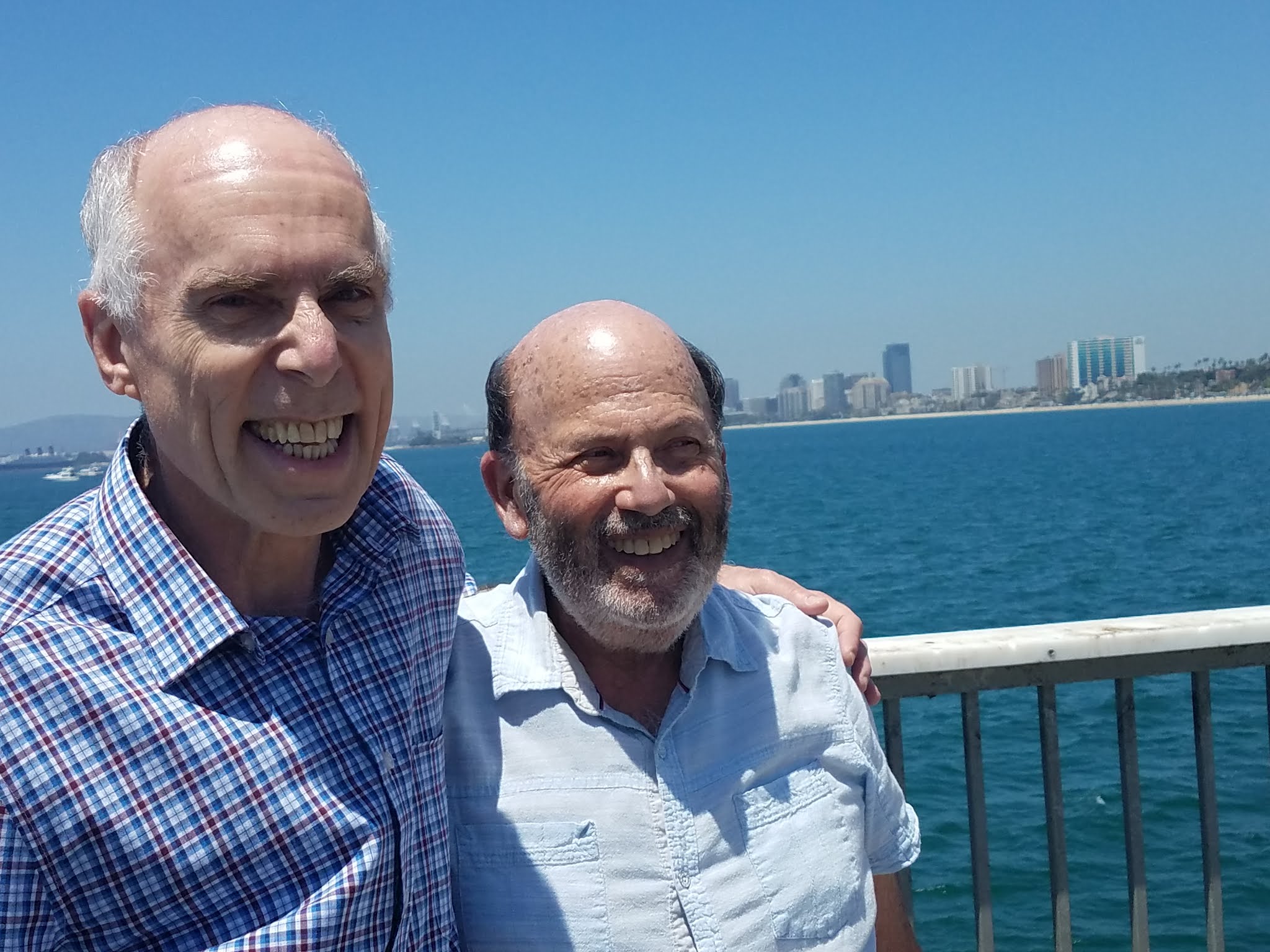
Thursday, November 25, 2021

Tick Tick Boom

 It's Thanksgiving, and my husband and I are visiting with my sister Robin in Greenbelt, Maryland. She has access online to everything out there on Hulu, HBO+, Netflix and I don't know what else. At home, I have a television that's not hooked up to anything except a DVD player. Robin suggested we watch "Tick Tick Boom," a new movie directed by Lin-Manuel Miranda about the life of Jonathan Larson, who wrote "Rent." 

Robin stopped the movie about five minutes in. Andrew Garfield, who portrays Larson, shows us around his cramped apartment in New York City, filled to the brim with records and tapes and bookshelves sagging under the weight of too many books. "That's just like Barry's house," Robin laughed. I didn't laugh. It's true; I have thousands of records, cassette tapes and CDs, and  sagging shelves full of books. 

I've never written a musical, and although I took two years of piano in my forties, and I have a piano at home, I don't play and can't play well at all. I have tried acting, and sang professionally in the Jewish community. It was a lot of work in professions where I wasn't greatly successful. 

That part of my life started in Miami, where I worked as a Spanish-bilingual SSI claims representative for Social Security. I went to career counseling through ORT, a Jewish social service organization. They said I was a pure artistic personality, and why was I working for the government? I had my reasons: steady pay, annual and sick leave, the promise of a pension. I decided to develop hobbies in the arts. I took up black and white photography at Miami-Dade Community College. 

When AIDS hit in 1982, I heard about it before many people because people who were ill applied for disability. At first, they were turned down if they weren't exhibiting symptoms, but then, some of them died before their appeals were completed. The agency started approving cases where a person alleged that they had AIDS. Some wouldn't admit to that because of the stigma.

In "Tick Tick Boom," Larson has gay friends who are ill with AIDS, and he is bereft and angry, like many of us were. I'm almost ten years older than Larson, and at thirty-three decided to give up being gay, marry a woman and have children. Just as Larson thinks he should have accomplished more by thirty, at thirty-three I thought I was too old to be gay, and it was too dangerous to continue to have the kind of random sexual experiences I was used to. The straight life didn't work out for me. I was lacking the knack for it, or maybe deep down I just couldn't sustain a relationship with a woman. 

I came back out of the closet in 1987. When testing became available, I took the test and turned up negative, and we learned what was safe and not safe. I was much more cautious about who I went with (I wanted a first and last name) and what we did. 

I read about how Jesse Helms (who has a cameo in the movie) and others demanded that creators of obscene art have their NEA grants rescinded. The NEA Four included Tim Miller, a performance artist based at Highways, a performance space in Santa Monica. California made up his grant on condition that he teach free classes in performance. I signed up right away. At forty, I was possibly the oldest one in Tim's gay men's class. I got to write stories and perform them with other men. There were people in the group who died from AIDS. I remember two in particular, one a gorgeous man in his early twenties who wrote poetry. We held a memorial for him where we each read one of his poems. The one I read was about having sex with a man who didn't speak to him, and he laments that he might have become the man's lover had the man been open to that. I visited another man in hospice care on Rosh Hashana. There was an older man visiting, my friend's father, a rancher in Wyoming, who hadn't spoken to his gay son in a few years. "You walked in on the big reunion scene," my friend joked from his bed. 

I saw Jonathan Larson's "Rent" when it came to Los Angeles. I spent weeks looking forward to seeing it. The play is about a performance art group. One of the characters has AIDS and dies. They wheel his gurney off stage, and everyone goes on with their life. I was furious, because you can't just go on with your life. Thirty years later, I still think about the men from the performance group who died from AIDS, as well as my other friends and acquaintances. It wasn't something that happened, then it was over. It colored the rest of our time in that group, just as my hurt and anger have remained with me all these years. 

"Tick Tick Boom" is a brave work of art. Jonathan Larson is not necessarily a sympathetic character. His music is good, but I wouldn't say it's great. The performers, the singers he uses for his showcase knocked me out. I guess I related to Larson the slob and the obsessive personality, and his gay friend who says "I was a mediocre actor in a town full of mediocre actors." That may not be an exact quote, but I can certainly relate after taking acting, singing and dancing lessons for years, studying music theory, piano, guitar and Hebrew at community college in my forties, and never being quite as good as I would have liked to be. 

I applaud Lin-Manuel Miranda for making "Tick Tick Boom" and all the excellent performers in it. I appreciate the look back at the good and the horror of 1990, when Larson was concerned about turning thirty and I was already forty and still struggling with what I would do when (if) I grew up.  I don't think this will be a hugely popular film, but it's important and for some of us an inspiration to keep going. It got me to stay up late to write this.

Wednesday, November 17, 2021

Indigenous Cities in Ohio

 I visited Columbus and Delaware in Ohio Sunday to Thursday. I don't expect anyone to change the name of these cities, but it's been suggested. Delaware is the name of both the city and county due north of Columbus and Columbus is the largest city in Franklin County, and the state capital of Ohio.

Columbus felt comfortable right away, a city that reminds me a little of my native Baltimore, with row houses and a large population of Black people and Jews. But Monday morning, listening to NPR in the car, the local news had a segment about how the Republican-dominated  legislature had divvied up the four Democratic-voting cities (Columbus, Cincinnati, Cleveland and Toledo) to keep Democrats from representing Democratic voters. Part of Columbus was thrown into a district with Trumpian traitor Jim Jordan. Mike DeWine, the supposedly-moderate Republican governor, was on the redistricting commission and approved this plan. Maybe I should stay in Morgantown. As a friend said "Count on America getting meaner and stupider over the next ten years."

The weather in Ohio was beautiful every day I was there, in the sixties and sunny, perfect for touring, but at least ten degrees above the average high, so not good for the planet. I looked around downtown Sunday afternoon. I found the state capitol building and a historic house. There were lots of signs saying "Downtown Columbus is open!" I'm sure the worst of the COVID pandemic was devastating to business. There are lots of restaurants downtown, most closed on Sunday. I liked that there are porta-potties scattered around downtown. 

                                                          Ohio Statehouse, 1839-1861
                                                          Benjamin Smith House, 1860
                                                        Ohio National Bank, 1912


U.S. 40, Broad Street east of downtown,  is the main east-west local road, and I found a synagogue near downtown on Broad. Their website said they would have an online weekday prayer service Sunday night at 5:30. I tuned in, and they were excited that I was the tenth person, because they need ten to do a complete service. More people came in after me. They counted women for the ten and used a Conservative movement prayerbook. The afternoon and evening services run together, and they followed Conservative movement customs. My name was on my Zoom pic, and although I was glad to be there, I was disappointed that no one asked who I was. 

The desk clerk when I checked in at The Usual Chain was a dark-skinned woman in a Muslim head covering. The motel was in an isolated spot, near The Ohio Expo Center, which hosts the state fair and, as their website says "five of the top 10 annual events in Columbus." It was idle when I was there, which made the motel cheap, but meant there was only a chain fast-food place within easy walking distance. The clerk recommended a place near Ohio State University, not all that far, but the directions were difficult. She and I got to talking, and I found out that she was a refugee from Somalia, got out to Kenya as a child with her family, and then to Prince George's County, Maryland, where my sister lives. She graduated from the same high school my nephew went to, probably ten years earlier. The restaurant was one of three similar places I visited around Columbus, large, with people mostly unmasked, televisions all around the walls tuned to sports events. At this one, this sport was football with the Los Angeles Chargers. Los Angeles Chargers? They were in San Diego. I looked it up. There is a new stadium where Hollywood Park Race Track used to be in Inglewood, where two football teams play. I had no idea. Los Angeles didn't have even one football team when I left, and I don't think most people cared. The Rose Bowl in Pasadena sold out for soccer games, but "fútbol americano" was never popular. 

I decided to spend a day in the city of Columbus, visiting ten historic places, a synagogue and a shopping center. I also had an address for a bookstore, and some record stores, where I had hoped to score some of the seven CDs left to find from my project of collecting the two hundred top-selling CDs from 2000-2009, according to Billboard magazine. We all have our obsessions. 

I started my day at Ohio State University, just west of my motel. It's a beautiful campus, lined with trees clothed in their fall finery. I found a paleontological museum in Orton Hall, with bones of dinosaurs and a description of how Central Ohio looked millions of years ago. I could have spent the whole day on campus.


                                                Hayes Hall, Ohio State University, 1893
                                   Orton Hall, Ohio State University, 1893, from across South Oval


Next, I headed to the south end of the city, looking for "Hartman Stock Farm Historic District." I wasn't sure I saw it. There were mines with ponds on the west side of U.S. 23, and what looked like empty land on the east side. There was one old building, a small brick house. I learned that this was once a 5,000 acre farm, and that what I saw was possibly a foreman's house, most of the other structures being torn down. I stopped at a Wal-Mart because I needed a bathroom, then headed back up into town,

I visited German Village, a beautiful restored neighborhood south of downtown. That's where the bookstore I looked up is located. I found The Midnight Library,  a book I thought was on last year's "Best Fiction of 2020" from The Washington Post (it wasn't) and bought that. Goodreads voters called it the best novel of 2020, which is where I might have seen it. I've finished twenty-one of the fifty novels on The Washington Post's list, but the new list for 2021 may be out tomorrow or next week. Should I continue reading from this list or move on to the new list?

I found a few places downtown, then headed east. The older upscale neighborhoods are east of downtown along Broad Street. Some parts  of the street  are rundown now, but on some parts, the mansions are well-kept. I took some pics, and although I planned to go back to the Arboretum and walk around some of the parks, I didn't. 

                                            Ohio Finance Building, 1910, now small apartments
                                                        Downtown YMCA, 1924


                                                 Jones Mansion, 1889, East Broad Street
                                                Tifereth Israel Congregation, East Broad Street
                                               Miller House, 1915, Wolfe Park Neighborhood


It took a long time to find Easton Town Center, my goal for lunch. I finally pulled over and looked at a map on my phone. There was a much easier way to go, so I caught up with that route. Easton is an enormous upscale center, somewhat like The Grove in Los Angeles, only much bigger, with upscale stores like Nordstrom, and also an indoor mall. It was close to one and I was hungry. I thought I would go into a Turkish restaurant, until I saw the prices on the menu outside. Around the corner was a fast food place, like Panera only fancier. I got a small chicken bowl with dressing and a grilled cheese sandwich. "Small" was inaccurate. Both the sandwich and salad were enormous, and they gave me a strawberry dipped in chocolate with my order. I walked down to the enclosed mall, where there is a Graeter's ice cream store. I was introduced to Graeter's in Cincinnati, when Joe and I visited that city for his rabbi convention in 2019. I only had a single scoop of pumpkin ice cream. I am unrepentant. 

                                                        At Easton Town Center

I noted the huge difference between Wal-Mart south of town,  German Village, and Easton Town Center. The people at Wal-Mart were getting by, barely, I could tell from the attitudes, the old Pontiacs in the parking lot, and the way the store is basically a warehouse. It's huge and sells everything, so I can see going there for one-stop shopping. German Village is an old neighborhood, restored, with smaller stores, non-chain places, and gift shops. Easton is also huge, but expensive and upscale. It's a place to buy new designer clothes retail (the horror!) and to be seen as well-to-do. I don't shop at Wal-Mart, but I could see where I might have had there been one in central Los Angeles thirty years ago, and I used to put on one of my two good outfits and take the bus to Century City where I had saved up to have lunch outdoors, in a place like Easton Town Center. German Village is the kind of place I like to visit, and as I did, go to the discount book store. 

I headed back to the neighborhood near Ohio State where two record stores were located. One didn't carry CDs at all, and the other had a few, but not what I was looking for. I can't buy more vinyl; I have no place to put more records, and barely room for CDs. I wonder sometimes what will become of my vast recorded music library when I'm gone, or how much I could sell or give away if we ever move.

I finally made it back to the motel around five and slept for an hour. I didn't want a big dinner, so I looked up where there was a chain subshop, or a chain donut place where I might get a bagel. The donut shop was a seven-minute drive, so I took that. It was in a convenience store which had both the subs and the donut place, which only had donuts, no bagels. I went for the sub. I tuned in at 6:30 to the Mon County Democratic Party monthly meeting. This is my natural peer group in Morgantown. 

I didn't go out again when the meeting was over after eight, but plotted out Tuesday, where I planned to visit five other places in Franklin County, two historic places per city. 

The places were Canal Winchester, Washington Township, Worthington, Dublin, and Westerville. These were the places with the most listings on the National Register of Historic Places. I could have picked one city or township and found ten or fifteen sites, but this seemed more interesting.

Barnhardt- Bolenbaugh House is from 1908 and on a quiet main street in Canal Winchester, at the southern end of Franklin County. Part of the town is in Fairfield County. The house looks like many of the house in South Park and Chancery Hill in Morgantown. I missed the second house, because I thought it was in Lithopolis, an even smaller, tourist-oriented town south of Canal Winchester. The address I had existed in both places.

                                         Barnhardt-Bolenbaugh House, 1908, Canal Winchester 

Canal Winchester is near US Route 33, as is Washington Township in the northwest corner of Franklin County. I followed US 33 north through downtown Columbus and along the Scioto River to Washington Township, just west of Dublin. Again, I only found one of the two places I was looking for, the J.L. Hamilton residence, built as a rural schoolhouse between 1860 and 1870. 

                          J.L. Hamilton House, 1860-1870, a school at one time, Washington Township


There was lots of new commercial development out there on the edge of Franklin County. I stopped in to a  chain Mexican place for lunch and a bathroom. Someone came out of the men's room, so I went in. The toilet was clogged with paper towels, so I walked out. They also had the system used by many places where they don't take your order at a counter, but  you have to use a touch-screen. Not my style. Across the parking lot was one of those fancier beer-and-big-screen TV sports bars. I ordered a chicken parmigiana sandwich with spaghetti as a side instead of fries. The sandwich  was enormous, and fried, but I ate all of it anyway. The booth had pictures of members of the Rock and Roll Hall of Fame. My booth had Fleetwood Mac, Led Zeppelin and Aerosmith. The pictures were all at least fifty years old. The young man who served me was surprised to hear that the members of Aerosmith are all close to my age. He had only heard of Led Zeppelin. I wrote on napkin that he should listen to "Gold Dust Woman" by Fleetwood Mac to get to know that group. The piped in music was from the 1980s, including covers of 1960s soul music. I also recommended earlier versions of the songs to him. I can't help it. 

Next to the restaurant was a store from our phone carrier. Joe and I have new phones that will work on 5G, whatever that is. My new phone never worked right, and I suspected it was because they had transferred everything over from our old phones, practically relics from the Paleolithic. I had done some things that were not helpful to my old phone. I can't explain it. The problem was that when I pulled up "camera" or "messages" instead of just giving me those, it asked a lot of questions that I couldn't answer. The first young man who looked at it couldn't figure it out. We waited for the boss, also under twenty-five, to finish with another customer to help out. The background music in this store was from the 1950s, pre-rock and roll, and it turned out that was the boss's idea. He had slicked back light brown hair and a little moustache, a wool scarf around his neck. He looked like a Parisian roué from a French Nouvelle Vague film of the late 1950s. We chatted a bit while he figured out what the problem was with the phone, which he eventually did, and since then everything has worked. He told me he lives in Delaware with a wife, and said it is the best place on Earth. Delaware County was Day Three of this trip, so I was anticipating great things. 

My next stop was Dublin, one of the larger suburban towns, which extends north into Delaware County. The Artz House was built about 1870 as a private home near the center of Dublin. It is now a restaurant. There is a beautiful modern branch of the Columbus library across the street with a café on the lower level. I'm jealous they we don't have something like it in Morgantown. I found the Asher Brand House, a large brick house with Victorian features, also from around 1870, on the edge of Dublin.

                                               Artz House, about 1870, now a restaurant
                                           Dublin Branch of Columbus  Library, opened 2019
                                                       Asher Brand House, about 1870

The Demas Adams House, from 1818, sits on the historic public square in the town of Worthington. The Aurora Buttles House seems to be off a Main Street and hard to find. Instead I walked down High St., an upscale commercial area in the center of Worthington and found Worthington Inn, part of the city's historic district. Built in 1810 as a home, there were additions and remodeling over the years. From the outside it looks late nineteenth century. There is a restaurant, condominiums and offices in the building now.

                                                      Demas-Adams House, 1818
                                      Worthington Inn, originally 1831, remodeled many times


Westerville is east of the other towns I visited in the north end of the county. I found the Akire House, now used as office space. It was built by Garrit Sharp, a local Methodist, who was active in the Underground Railroad, smuggling escaped slaves north through Ohio. I also visited Otterbein University in Westerville. I photographed the Carnegie Library at Otterbein, from about 1904, now used as the college admissions office.

                                               Akire House, 1849, now used as office space

        Carnegie Library, Westerville, 1904, now the admissions office for Otterbein University

I drove back through Columbus on Ohio Route 3, Cleveland Avenue, through some of the less affluent parts of Columbus. I'm always glad to see all of a city, even the parts you're not supposed to see. I napped briefly before my phone dinged me to tell me I had a meeting at 7. I visited our local chain supermarket, stocking up on cottage cheese, individual servings of less-sugary breakfast cereal, milk and an orange, and feasted on them as my meeting started. It was a campaign kick-off for a favorite state delegate. I got to sleep at a reasonable hour.

Wednesday was "Delaware County" today. This was the trip I canceled the second week in March 2020 as the first COVID-19 cases showed up. I picked 10 historic places from the National Register, plus the old county courthouse. I usually look for a synagogue, but in this county of over 200,000 people, there is no synagogue. Three places were in townships near the southern border, the part near Columbus, three were in the city of Delaware, three in Delaware Township, near Delaware City, and one in Ashley, a small town way in the northeastern part of the county. 

I found all of them, although I didn't always get a picture. Two houses in Delaware Township and one in Liberty Township were on a busy street with no place to pull over to snap a shot. I started from my motel in Columbus and drove to the southeastern part of Delaware County, to Harlem Township, where I found the John Cook Farmhouse. I traveled I-270, lined with shiny new office towers and garden apartment complexes, across the northern part of Franklin County, before crossing north into Delaware County. There are signs saying "Stop Overdevelopment" in Harlem Township, which is rural once you get a few miles into the county. I found the house at the intersection of two quiet country roads and took a picture with the car stopped in the middle of the street. 

                                                       John Cook Farm, 1863

Two townships west, on the border of Franklin County along US 23 was Highbanks Metro Park. The Register said "Highbanks Park Works." I had no idea what that was, so I drove through the park until I saw a historic marker for a mill along the Olentangy River.  That wasn't it, and I wanted to get to Delaware City before lunch. I found a brochure in the park, that showed earthworks left by a Native American tribe 1,000 years ago, down a trail, 2.3 miles of hiking round trip. I thought I would get back if I had time, which looked doubtful. 

Delaware is a pretty, old and old-fashioned town on North Sandusky Street, south of Marion and Sandusky. I scored two hours of free parking in front of the old courthouse, and snapped pics of the former court house, the historic library next door and the Jail and Sheriff's residence around the corner. I found a video game store that I hoped would have one of the seven music CDs I'm looking for to complete my collection. I spoke to the proprietor of the store, an unkempt man, who told me he was forty, although I would have guessed younger. We talked some about politics and he told me lived all over the world because his late father was a "black ops" contractor for the government. His mother died a year ago of COVID. He claimed to have every kind of video cartridge for games, and every device to play them back to the 1980s. I'm reading Ready Player One, and he said he had also read it, and was looking forward to Ready Player Two, which I told him was already out in hardback. Like Wade in Ready Player One, whose avatar is named Parzival, the man in the store has read lots of fantasy series, Harry Potter many times, others that I never heard of, and he's working on Tolkien. He suggested I try the store "Pat's Endangered Species" to find audio CDs. "It's across the street from a restaurant called 'Buns'," he said, "around the corner on W. Winter St." 

                                        Delaware County Sheriff's Office and County Jail, 1878
                                                 Old Delaware County Courthouse, 1868
                                                      Delaware Carnegie Library, 1906

I stopped for lunch at Buns. I sat in the back in an enclosed patio. It was crowded; no one was masked. I didn't see anyone masked in Delaware County. I had chicken kabob on a rice pilaf with a Greek salad, reasonably healthy and not too exotic. I fit in with the mostly elderly, all White crowd. The waitress was a young woman, skinny with tattoos on her arms, possibly dyed black hair, and lots of make up. I liked her right away. After lunch, I crossed the street to the record store. The proprietor there was an older man (my age) playing a jazz record, possibly John Coltrane, although I didn't recognize the specific tunes. I showed him my list. He said "These are things kids bought at Wal-Mart. I don't have them." Except he did have Macy Gray's CD "On How It Is," number 129 on my list, for three dollars. One down, six to go. 

Ohio Wesleyan University is a few blocks south of downtown Delaware, a pretty, wooded campus, the older part east of Sandusky Street, with some newer buildings on the west side. There's a pedestrian-controlled traffic light to facilitate student movement across the busy street. I took pics of Elliott Hall, from 1833, built as a resort hotel before the school was established, and a few other buildings. 


                                                                  Elliott Hall, 1833
                            Above three: older and newer  buildings at Ohio Wesleyan University
                                                  Selby Field, Ohio Wesleyan University

I headed south to the three places in Delaware Township. There are a series of mill worker houses along Stratford Rd., where I couldn't stop, and an 1859 farmhouse just down the street that I could see but I couldn't get a picture of either. Off U.S. 23 there's a stone church from 1842, that has a small parking lot where I could pull in and get a pic. Added bonus: an orange Porsche in the parking lot, probably from the early 1980s. The mill houses and the church, which is now an office building, were part of a town called Stratford. The surrounding area is increasingly suburban, with fast food places, big box stores, and office buildings, interspersed with new townhouse developments. A bit south, there is a stone house from 1850 in Liberty Township. I went by, but again, it was on a busy road and I couldn't pull off to take a picture.

            Former Stratford Methodist Episcopal Church, now offices, Delaware Township, 1840s

I had picked a house on the National Register in the far northeastern part of Delaware County, in a town called Ashley.It was an exuberant pink Victorian, worth the trip. 

                                          Self-portrait with house in Ashley from 1901

That left me with the Native American mounds in Highbanks Metropark, way at the other end of Delaware County. It was a warm and sunny afternoon, especially for November, but already 4:30 P.M. I wanted to take a nap at the hotel by 4, but decided to give this a go, even though the hike was listed as "strenuous" and would take until after dark. I had my map of the park, and there were people out walking. The route was quiet, with tall trees with orange, red and brown leaves. I followed the map I had. I crossed wooden bridges over steep gorges and little streams. I spoke to the trees, and having become one of those old mystics you read about, I felt that the trees appreciated it. I thanked them for their beauty. The mound is just a hill of dirt, possibly an ancient fortification, but it's awe-inspiring to realize that the people who built it were settled on this land before the Natives the Europeans found. The trail ends at an overlook on a surprisingly high cliff over the Olentangy River. I got a pic which I think my phone's camera lightened, since it was almost dark out. I came back through the park to the road, but not exactly where I thought I would be. I couldn't find my car, but calmed down and walked toward the entrance to the park. It was black out, and I found a parking lot that seemed like the right place. My car is black, and I couldn't see if there was a car there, so I hit the unlock button, the car blinked at me, and sure enough, I was in the right place. 

                                                     Highbank Park Works, 800-1300 C.E.
                                 Overlook in Highbanks MetroPark at the Olentangy River


I should have looked at the map, but I thought I knew how to get back to my motel in Columbus. I was wrong, but after some delay, I got back. I had stopped at a Kroger on U.S. 23 and bought a pear, and had that with the remaining milk, cereal and cottage cheese for dinner in the motel. I had prunes and pistachios for a snack later that I had brought with me.

Thursday was another too-warm day, not that I was complaining. I had breakfast provided by the motel, and was out by nine. Google Maps was correct that it is 204 miles from the motel to our house in Morgantown. I stopped for gas at the station nearest to our house, and was home before one P.M. for a late lunch. It was 78 F. in Morgantown, a record high for the date.

This was the biggest trip in Year Ten, July 2021 to June 2022. I've now covered 204 counties since I moved to Morgantown in July 2012, and I hope to have 220, including eight more that I missed because of the pandemic, by the end of June 2022.

I apologize for getting my finger in so many of the pictures. My only excuse is that I wasn't good at using my new phone/camera.


Thursday, November 4, 2021

The Great Hits and Albums of 1971

 You know how you envy people, especially when you're young? I'm well over that now.  I used to wish I could be as handsome as David Cassidy and as talented a musician as Karen Carpenter, both close to my age. They both died after years of unhappiness, Carpenter at 32 and Cassidy at 67. I'm still here, and despite the pandemic, the usual problems of being over 70, and not being rich or adequately famous, I have a good life. The last six weeks, I've taught a class called "The Great Hits and Albums of 1971," as a volunteer at Osher Life-Long Learning, through West Virginia University's School of Public Health. David Cassidy, as part of The Partridge Family, and Karen Carpenter, who formed Carpenters with her brother Richard, have been  featured in this class. 

I've gained an appreciation of the hard work and commitment of people in music who were also politically involved, people like Aretha Franklin, Isaac Hayes, Curtis Mayfield and Gladys Knight. I have more  respect for David Bowie and Elton John, and "Lola" by the Kinks, breaking  barriers around masculinity. While many people were blaming John or Paul for the breakup of The Beatles, videos from 1971 show Paul and Linda and John and Yoko in love. I have memories of young women I knew who swooned over Carole King's Tapestry  Joni Mitchell's Blue, and "Best New Artist" at the Grammys, Carly Simon. I still think of "So Far Away" from Carole King when I think of friends I miss in California. I played a video of Joni Mitchell accompanying herself on dulcimer, singing her song "California" that knocked me out. 

I was too old for The Partridge Family and The Osmonds, but I am still in awe of The Jackson Five, especially little Michael, who had a brilliant career as an adult, but an early and sad end to his life.

I look at The Bee Gees, three brothers, the younger two twins my age. Someone in class noted that their syrupy ballads, moving syrupy ballads, but still,  were nothing like Saturday Night Fever. Barry Gibb, the oldest brother, is still with us, but the twins died a few years apart some time ago. 

The Beach Boys also were three brothers, where the younger two have died, and the eldest is still here. This was a time of a lull in their career, but their albums from 1970, 71 and 72, Sunflower, Surf's Up  and Holland, have always been among my favorites. I played "Until I Die" from Surf's Up in class, and fifty years later, I still cried when I heard that song. 

I'm ending my class tomorrow with two songs from Gonna Take A Miracle by Laura Nyro, a songwriter who decided to do an album of covers of songs by other writers, and recruited Patti Labelle's new group, Labelle, to sing backup. Although the album never cracked the Top 40, had no singles, and was not on recommended lists from Rolling Stone or Spin, it is my favorite album from 1971. The Word magazine listed it as one of "The 60 Best Underrated Albums." There's a cult of Laura Nyro fans, and I'm in it, and it centers especially around this album. I could earn a PhD. from explicating it. The album is on YouTube. Check it out.

I don't know if I'll teach another OLLI class. I do a lot of research and these classes take way too much of my time. I've been doing this for more than eight years, and I've done a class for every year from 1960 to 1971. Still, I enjoy it, and I think people in my class do, too. I would like to do some other writing, maybe a book, and clean up the piles of trash in my office space left over from my time on Morgantown's City Council.

But just yesterday, I had a thought about classes I might teach. 1972 would bring us Jackson Browne, Bruce Springsteen and Steely Dan, and a new era for Stevie Wonder and Paul Simon. Or maybe six weeks of R&B heroes: Isaac Hayes and David Porter, Curtis Mayfield, Marvin Gaye, Smokey Robinson, Nikolas Ashford and Valerie Simpson and Holland, Dozier and Holland. Or six weeks of women artists: Aretha Franklin, Joni Mitchell, Carole King, Carly Simon, Janis Joplin, and Gladys Knight. How about women in country music from Patsy Cline to Loretta Lynn, June Carter, Dolly Parton, Lynn Anderson and Sammi Smith? Make me stop! I don't want to work this hard. But maybe I will. 


Sunday, October 3, 2021

Forest County, Pennsylvania

 After Yom Kippur, and after some time on antibiotics for bronchitis and a sinus infection, I needed to get away. I've been trying to visit two counties per month, to make up for the fourteen months I missed. I had doubts about traveling, but since West Virginia is now the worst state for COVID, I figured it couldn't hurt to visit Pennsylvania. Going alphabetically, Forest is my next county, and Fayette, the other county I visited, should have been in April, before I started traveling again.

It's 185 miles, courthouse to courthouse, up I-79 past Pittsburgh, then east a few exits on I-80, then U.S. 62, and a better road that parallels it. I decided to go Sunday, so that I could do Friday night services, which we did from our dining room, and I wanted to spend Saturday night with my husband. We had dinner out, which was pleasant.

The weather was beautiful the first few days. There was a detour on I-79 north of Pittsburgh, and the flashing signs said to take Route 51. Google maps said to go into town on I-376, then cut north on I-279. That sounded more logical, except that it went past the stadium where the Steelers were having their first home game with no attendance restrictions. I was stuck in traffic for over an hour. Once past the stadium, it was fine, and U.S. 62 goes through some pretty small towns.

I had booked the Mid-Town Motel, a small, non-chain family-owned place in the middle of Tionesta, the county seat of Forest County. There are fewer than 8,000 people in the county, and in the 2020 census only 419 in Tionesta. It's the third smallest county in population in Pennsylvania. I didn't care. I wanted a few days away. There is a state forest and a national forest, the town is on the Allegheny River and there is a lake. The motel was two houses, one building behind a house on Elm, the Main Street of Tionesta, with five rooms off a long hallway. Across the street was another building with three rooms facing a small parking lot. It wasn't much, but the room was clean, the cable television and internet worked, there was hot water and towels. I heard a woman's voice and a dog two rooms down, but I didn't see anyone, including the owners of the motel. I crashed in the room when I arrived about 4 for an hour, then walked up Elm. It looked like nothing was open, so I took the car up the road. Haller's General Store sells local jams and jellies, wood carvings and bric-a-brac, and next to that was a chain sub shop, so I ate there. It wasn't yet dark, so I visited the riverfront, only a block away, as most of the town is along two north-south streets, and I also found the unusual lighthouse along the river. 

I had all the next day to explore.  I found that Bear Claw Cafe just up the street was open, the clientele seemed to be old hippies (one with a MAGA hat, but not a red one) and a table of ten well-dressed men and women who looked like they were on a convention. I didn't ask. I had blueberry pancakes.

I drove south to Lake Tionesta, an Army Corps of engineers Project. I followed a short path around the lake on this warm morning, and ran into a group of young forest rangers, who said they were closing up for the season, as they didn't get a lot of visitors from late September to May. 

I visited Cook Forest State Park, and the historic Indian Cabins District. There is a B&B nearby. I hiked a little through the forest. 

I was in Marienville for lunch, the largest place in Forest County, unincorporated. Much of the population is in a state prison. I stopped at a roadside fruit stand for some healthy food, and the local library, which had a book sale with hundreds of books. An older couple walked in and the woman said " We're too old to be bringing home more books." It occurred to me that they were right. I didn't buy anything. I had lunch in an old-fashioned, dark, carpeted restaurant in an ancient hotel, which I think is no longer in business.

I came back to Tionesta on a back road through Allegheny National Forest. There were trails marked, but they seemed to be designated for ATVs.

After a nap, I went looking for something to eat. I ended up at a bar, Hickory Nut Inn, seven miles north of Tionesta in East Hickory. Jen, the bartender, was a young blonde with a few delicate tattoos. I sat next to a young guy and nodded  "hello" which was ignored. There were five older guys at the bar. One near me had a t-shirt that said "I'd tap that" and had a picture of a hole on a golf course, with a ball and club. The men next to me were talking about retirement. I had a fried fish sandwich, which was enormous. The young man nodded to me as I left. 

I had seen a drive-up ice cream place at the north end of Tionesta. I stopped on the way back. A man and woman were coming away, the woman excited about her chocolate sundae. I told the handsome high school-age man staffing the place that I wanted what she had. It was yummy. I stopped back at Haller's General Store for a fridge magnet made of wood that said "TIO" in gold letters as a present for Joe.

Tuesday morning I left for Uniontown, 138 miles due south, just north of Morgantown. That will be my next post. I enjoyed being out in the woods and exploring a new place.

                                                Forest County Courthouse, Tionesta
                                                     Historical Society, Tionesta
                                               Along the Allegheny River in Tionesta
                                           Lighthouse on the Allegheny River, Tionesta

                                                     Tionesta Lake
                                      Cabin in Indian Cabins Area ofCooks Forest StatePark, a WPA project
                                             Former train station, Marienville


Saturday, September 18, 2021

It's 5782!

 My last post was about our trip to Los Angeles. I haven't posted about San Francisco and my next trip, to Fluvanna and Essex Counties in Virginia, with a stop on the way back to visit with my sister in Greenbelt, Maryland. Maybe I'll post those soon...ish.

Meantime, time flies, and it's a new Jewish year. COVID-19 has come roaring back, especially in West Virginia, where Jim Justice, our Republican governor, won't put up any mask restrictions because he's afraid he'll start another Civil War. Monongalia County, where we live, has fared relatively well, mostly because people here are not afraid of getting vaccinated. Still, our two hospitals are nearly full, because people in the surrounding areas come here for medical care, and the counties around us have more "vaccine hesitancy." Still, at West Virginia University, the heart of Morgantown, there are no real restrictions, despite the students and faculty both overwhelmingly voting for a vaccine mandate. As I'm writing this, there is a football game, and there are few restrictions on attending, only a suggestion that unvaccinated people wear a mask. 

But I digress. Rabbi Joe wrote sermons for Tree of Life this summer about how great it was to be together after having pre-recorded services last year. Then, as the number of new cases rose, the synagogue committee, which includes several doctors, voted to cancel in-person services. Instead we did it over Zoom, with only the rabbi, a few singers, a tech person, and someone to watch the door, which is now locked.  I was asked to read haftarah on Rosh Hashana, and chant Torah on Yom Kippur. The haftarah is about Hannah asking for a son and pledging him to the temple. Her son Samuel is raised by the temple priest. The Torah on Yom Kippur is from Deuteronomy 29 and 30: "This day I call heaven and earth to witness regarding you: life and death I have set before you, blessing and curse. Choose life-so that you and your children may live." (Deuteronomy 30:19, translation in Mishkan Hanefesh, copyright 2015, Central Conference of American Rabbis). Heavy stuff. I couldn't help but think that getting a vaccine is choosing life, and not getting it is choosing death.

Meanwhile, I haven't been entirely well since our return from California. I had a little bronchial thing going, and I was concerned because we had been in crowds. I went to an urgent care center here on August 6, and they referred me to a central location for a COVID test. It was negative, so I wasn't too worried. I went back September 9, after Rosh Hashana, because I could barely speak and I was feeling pain in my chest from the congestion, where before it had only been in my throat and upper respiratory tract. They gave me a strong antibiotic and another COVID test, also negative, and suggested I see an ear, nose and throat doctor. I went the next day, and he looked in my nose and throat, and while not going "Ewww!," I could tell he was thinking that. He extended the antibiotic, and gave me a nasal antihistamine.  I wasn't sure I would make it to Yom Kippur.

I did drag myself out, having food with my antibiotic in the morning, and coming home for a snack and a nap in the afternoon, before returning for the Memorial (Yizkor) service, where I sang a Hebrew version of the 23rd Psalm, and the ending service. We finished after 7 P.M.  I managed my singing and chanting without difficulty. 

After more than a week on a strong antibiotic, I'm feeling better. The blood tests, which were to check my immune system, were normal except for the one that shows if you have allergies. That one was off the chart. No surprise.

Yom Kippur always makes me think of life and death. Each year, as I get older, I wonder if this is my last year. I've lived longer than my father and both of his parents. I don't get sick often, but when I do, it's bad, with a long recovery. I try to "choose life" by exercising, keeping my weight down, and getting enough sleep, and I'm grateful for my negative COVID tests. Just in today's paper, they announced that ant-COVID vaccination boosters are a good idea for older people. I'll be first in line when they announce it. 

I wish everyone a healthy 5782.

Tuesday, August 17, 2021

Los Angeles and Palm Springs

 I finished my second and last term on Morgantown's City Council June 30. Joe had a wedding in early July, a bar mitzvah July 17, and a bat mitzvah August 14. We were working on renegotiating our mortgage. We had a narrow time where we could get away. We were gone July 19 to August 2. 

The Centers For Disease Control said that, since we were fully vaccinated, we could go anywhere without masks and be safe. We discussed driving up to New England, but we both wanted to see our long-time friends in California. We decided on a week in Los Angeles and a week in San Francisco. Joe's credit card gives him points, and they have a travel agent on staff to help out. That took care of much of the plane fare. I booked hotels through "The Usual Chain" where I have points. We were able to rent an overpriced car in Los Angeles, but the agent couldn't find us one in San Francisco. I'll write a separate post about our week in San Francisco.

By the time we left, the Delta variant had shown up in the United States. Los Angeles County required everyone, vaccinated or not, to wear a mask indoors. We had to be more careful than we expected to be.

We drove to Pittsburgh to the airport early for a 9 A.M. flight. I picked up my carry-on bag, which was too heavy, and the strap slid across my arm, taking my paper-like skin with it. This was at 5 A.M. as we were trying to get out of the house. I bandaged it as best I could. We changed planes in Denver, where the airport was crowded with, to my eyes, more people than live in West Virginia. Both planes were full. "Social distancing" was a joke. They did ask everyone to wear a mask in the terminals and on the plane. Almost everyone complied in the terminals, and everyone on the planes. 

We got our car, supposedly mid-size, but actually a compact, which wasn't bad. Compacts are bigger than they used to be. I had booked a motel on Colorado Boulevard in the Eagle Rock neighborhood of Los Angeles, between Glendale and Pasadena. It's not a wealthy or Jewish neighborhood, but there's a mall with a Target and a Macy's and a Trader Joe's. It took an hour and ten minutes to get to the motel from the airport. The desk clerk said "You made good time."

The purpose of the trip was to see our friends, and we had mapped out a schedule for lunches and dinners for the week we were there. Many of my friends are from Beth Chayim Chadashim, the synagogue where most members are LGB or T and where I met Joe in 2005.  Joe was a popular student rabbi there from 2007-2009. I became a member in 1987, and maintain a membership. My closest friends from there are not Hollywood heavies, but teachers and librarians, mostly now retired. Joe's friends in Los Angeles are women who were in rabbinical school with him. 

Despite just getting in and being off by three time zones, we found out that the gay mens' hike in Griffith Park was back on (after being off for a year because of COVID), so we went. It was mostly the same people we knew years ago, maybe fewer of them. They don't go all the way to the top of the hill as they used to, and they rarely go out for dinner afterwards, although they agreed to go with us. We got behind when I saw my friend Meyer, known as Mike, an avid hiker and a Squirrel Hill, Pittsburgh native, and we stopped to talk. By the time we got back to the starting point, everyone had left. 

I was worried about my arm, and Tuesday morning I found Eagle Rock Urgent Care online, and we stopped by after breakfast. The motel typically provides breakfast, but all they had to offer was a bag with a microwaveable sandwich, a packaged pastry and juice. We ate that one or two days, otherwise we went out. I had told Joe I wanted to see someone who remembered when I was a substitute teacher in Los Angeles schools, or when I was a bar and bat mitzvah tutor at Temple Israel of Hollywood. 

The woman who checked me in at the clinic was named Karla, and I asked her if she was from around there. She was and had gone to Florence Nightingale and Luther Burbank for middle school and Benjamin Franklin High School, before her parents pulled her out to go to Catholic schools. I told her she was probably too young to remember me, but then she said "I'm forty-two and I thought you looked familiar." She told me some personal stuff which I don't want to share here. I was happy that someone remembered me from my work.

We arranged to be in Long Beach by 11, maybe thirty miles from where we were staying, We met up with two of my favorite couples, Jonathan and George, and Stephen and Thomas. I was friends with Jonathan and Stephen when we were all single, but by the time I met Joe, Jonathan had paired up with George and they had adopted a child, now a rising high school senior, and Stephen and Thomas were together. We walked along the ocean in Long Beach while catching up, and stopped for lunch. Later on, Joe and I went out for coffee with my friend Ted, also in Long Beach, leaving at 5 P.M. in the usual traffic to get back to our motel. Tuesday night we were in Alhambra with my friend Greg, who I used to hike with in Griffith Park, when our group did a much longer and more complicated hike. 

I went back to the clinic Wednesday, then we headed to South Bay, near the airport, for lunch with Deborah, one of Joe's rabbinic colleagues, and her husband and two children. We saw Dahlia, another rabbinic colleague, Saturday night in Woodland Hills, in the far western part of the San Fernando Valley. Joe was close with her in school, and one of my first dates with Joe was to Dahlia's wedding. Their two daughters are thirteen and eleven now, and learning to talk back to their parents.

We spent Wednesday late afternoon and evening with Rabbi Lisa Edwards and her wife, Tracy Moore (not the L.A. writer whose work we've seen recently). Lisa was the rabbi at Beth Chayim Chadashim for twenty-five years before retiring recently. She picked Joe to be her student rabbi for two years (after we were a couple, or else it would have been against the rules for us to get together) and she performed our wedding. We sat by their pool and snacked. I would have gone in the pool but for my bandaged arm. Our friends Jim and Michelle came by. Jim and I were L.A.'s version of Akbar and Jeff, "brothers or lovers, whichever offends you most." We're not brothers and we were never lovers. I sang at his wedding to Michelle. He's still active in BCC. We visited at their home Sunday for lunch.

We took a side trip to Palm Springs, a place where many gay men retire. Two couples, Joe's friends from San Francisco, moved there in recent years, and my friend Richard, a now-retired college-level ESL teacher, also moved there. We spent one night with Dan and Jerry in their mid-century modern house, remodeled. They claim they have more stuff to move in, but I liked it uncluttered and clean looking. We also met with Paul and Deek, longtime pals of Joe from San Francisco. They live in Cathedral City, next to Palm Springs. Friday, we saw Richard, who lives in a large complex that reminds me of where I lived in Florida forty years ago. We all went out Friday night to an early service at a synagogue in Palm Desert (past Palm Springs and Cathedral City). The rabbi there graduated a year or two before Joe, but I met him when I first moved to Los Angeles in 1984, when he was probably just out of college. It was a nice reunion, as Richard also knew him, and he was in school with Joe. We stayed over at Richard's and came back into Los Angeles Saturday.

Joe loved Palm Springs, and suggested we move there when he retires, possibly in three years when his contract at Tree of Life in Morgantown expires and he will be almost 68. I have my doubts. It was 109 F. there and had been 120. I've been to Palm Springs a few times (twice before with Joe) and it's nice, I guess, but I would like a more "real" city and not a collection of resort-style suburbs. 

 I loved seeing everyone, and we're sorry we didn't get to see everyone we wanted to see. BCC had services Friday, but it was only open to board members; they were hoping to have the full congregation back the week after. We didn't get to the West Side and missed Israeli dancing on the beach in Santa Monica with my former dance partner, Reva. We missed Jerry, Gordon and Neal, and friends from Morgantown and Fairmont who live in Los Angeles now. For old times sake, we drove Sunday night to the Farmers Market on Fairfax, near where we lived together, and had dinner outside with hundreds of people. We put at least 700 miles on our little car in a week. I slid right into freeway driving, and I felt "at home."

I want to mention also the "ghosts" who inhabit Los Angeles, friends who died while I lived there and after. I still fell the presence of Sue, Sherry, Art, Fred, Avram and others who are no longer with us. I went through lots of changes in Los Angeles, and everywhere reminds me of something. I pointed out an apartment building to Joe where I rehearsed scenes for an acting class with someone I can't picture, an apartment building in Los Feliz where a wall crumbled in the Northridge earthquake, and I remembered the two young men whose names I can't recall that were in the performance art workshop I attended in the 1990s, and died of AIDS. 

I understand why we are strangers after nine years in Morgantown. We were 62 and 55 when we moved here, and people our age had lifetime friends. I was thirty-four when I came to Los Angeles and sixty when I left. From our temple, I had a community of gay men and lesbian women, singles and couples. That doesn't exist in Morgantown. I'm not criticizing our little town. I understand that people had their long-time friends before we got here, just as my long-term friends are in Los Angeles. 

I don't feel a need to go somewhere else to live, not even to Southern California. I grew up only 200 miles from Morgantown, and there is a familiarity (and familiar allergies) to what I knew in Baltimore. I guess my persona is split these days, and I can cope with that. I'm glad we got away and saw our friends, and I hope the world doesn't shut down again. 

                                             With our hiking group, Great Outdoors, in Griffith Park
                                             The view from Griffith Park across Glendale
          With our crew in Long Beach, l.to r.: Joe, Jonathan, Thomas, Stephen, Barry and George
                                                        On the ocean in Long Beach


             At Lisa and Tracy's pool. Lisa has the glasses. With Jim. The red on my arm is a bandage
                        Bagels and lox and fruit with Jim and Michelle in their garden in Altadena.

Tuesday, July 13, 2021

Floyd County, Kentucky and Gallia County, Ohio

 July is heavily booked, with a wedding, a bar mitzvah and a trip to California, and I wanted to get to another two-county trip, so I did my July trip  in June, from the 28th - 30th. I left after lunch on the 28th, because I was having my eyes checked in the morning. For insurance purposes, I needed to go in June, and my regular guy wasn't available until mid-August, so instead of the homey, single practitioner guy in downtown Morgantown, I went to the multi-doctor, factory-like place just outside city limits, not far from home. 

It's 271 miles from Morgantown To Prestonsburg, Kentucky, mostly freeway, ending on US 52, a four-lane unbusy highway. I looked around a little bit in town, then checked into the motel, from The Usual Chain, just outside Prestonsburg. I asked the clerk, a young man with those horrible rings in his ears that make your  lobes bigger and tattoos, where to eat, not McDonald's, but not fancy. He laughed and said "There isn't anything fancy here", and suggested a place I had seen downtown. Just east of the motel, before the US 52 bypass, I found a little shopping center. There was a sign for a Chinese buffet, my favorite kind of place to eat on the road. The buffet was open, the first I've seen since the pandemic. I ate my fill. The center also had an independent bookstore, closed by that time.  Prestonsburg is in the heart of Eastern Kentucky's Appalachian area, and I had no expectation there would be anything there, so I was already impressed. Back at the room, I plotted the next day's exploration of Floyd County, a 114 mile, two hour drive to Gallia County, Ohio, along the Ohio River, and an exploration there. My plan was ambitious. 

I started with Middle Creek Battle Field, a National Historic Landmark west of the motel outside of Prestonsburg. There was a battle in 1862 between Confederate forces and Union troops under James A. Garfield, who pushed the Confederates back to Virginia. His competence as a commander led to Garfield's presidential campaign in later years.

Archer Park is on the edge of town, with a paved trail leading to the historic bridge, a symbol of the town, from West Flemingsburg, where the trail ends, over Levisa Fork of Big Sandy River into downtown Flemingsburg. I walked it. The bridge is fenced off (although someone broke the fencing) and out of use. It was starting to warm up.

I had a list of historic places in Prestonsburg. I couldn't find most of them. I think the owners didn't want them to be found and changed the addresses on Wikipedia. I can't prove that. I asked in the (modern, nice) library where the clerk had no idea, but suggested that the print shop next door had old pictures on the wall. The clerk there also knew nothing, but I learned from the pictures of a terrible flood in the 1930s, and a school bus that plunged into an icy river in 1958, killing the driver and twenty-six children. I headed out of town to a dam and reservoir built by the Army Corps of Engineers. I came back into town to try to find a few more places and a branch community college. At 11:30, I stopped at a Taco Bell, because I needed to pee. The restroom was locked, but the kind young man at the cash register unlocked it for me. I looked in the mirror and decided to get lunch right there. I was a sweaty, exhausted mess. It was 92 F. outside and I had been walking around under the southern sun for a few hours. I never eat at Taco Bell, but I got a chicken "power" bowl. It didn't look that big, but it was plenty, with chicken, rice, black beans, dollops of guacamole and sour cream, lettuce and tomato. I washed it down with mango lemonade from the fountain. 

Thus fortified, I found the community college, the modern court house (too bad about the Victorian one I saw a picture of in the print office), and the 1817 Samuel Mays House. Mays' wife was born in Morgantown. He was a prominent guy who went to California during the Gold Rush and died there.


Marker at Middle Creek Battlefield
Statue of Lincoln at Middle Creek


West Prestonsburg Bridge


The trail between Archer Park and West Prestonsburg


Archer Park


First United Methodist Church, 1917


Front Street Historic District, Prestonsburg


Former Harkins Law Office, 1914


B.F. Combs House,, 1922


Marker in memory of Confederate soldiers from Kentucky, downtown Prestonsburg

Former Post office, now a salon, 1931


Floyd County Court House, 1965


Downtown Prestonsburg theater, not open

Old house, downtown Prestonsburg


May-Fitzpatrick House, 1905


Dewey Lake, north of Prestonsburg


Big Sandy Community and Technical College


Samuel May House, now a museum, 1817

It was 1:30 when I left Prestonsburg, drove back up U.S. 52 to I-64 to Huntington, West Virginia, then crossed into Ohio and drove up OH-7, which follows the river. It's a beautiful drive, except for the detour in southern Gallia County that took me well out-of-the way on back roads through the hilly countryside. I drove through Gallipolis, a pretty old town, one of the oldest in Ohio. The motel is north of town, past a seemingly endless row of fast-food places. The temperature was up to 97 F. when I got to the motel around four. I had a "suite" and the clerk warned me that the couch wasn't real good. I napped for about an hour, then showered and changed At the desk, they told me that I could eat at the motel restaurant, but I decided to head back into town. The temperature had gone down to 92.  I saw a sports bar- restaurant, but on looking around the corner, I found "Zack and Scotty's," which I thought sounded gayish. The decor was all military stuff with plaques from all of the wars. I ordered a pizza sub on homemade bread. It was just cheese and tomato sauce on a slightly sweet, crunchy roll with a salad on the side. I ate three-quarters of it before giving up. The workers there were friendly and kind, a high school girl, and a woman who looked at me taking pills with my meal, and said " I do that too." 

I walked out to the square, open on one side to the Ohio River, walked around the historic part of town, snapping pictures. It was still hot, but the sun was less intense. Although the town is up on a bluff, there was a stele with a flood level marked about ten feet above ground level. They also had a plaque about Welsh settlers who came to Baltimore, then went overland to Pittsburgh and by boat to Gallipolis. Another plaque talked about a ship from Pittsburgh where the crew was infected with yellow fever, which spread through the town. Every place has its tragedies. 

On the way back to the motel, I stopped at a Dairy Queen, drive-through only, and got a "Blizzard" with M&Ms and ate that back in the room. It's the most sugar I've had in month. 

At breakfast, they served you in the motel, a choice of three items. I had pancakes, yoghurt and a fruit cup. I left early, had an uneventful trip back up Route 7 to US 50 through Parkersburg and Clarksburg to I-79. I noted two coal-fired power plants north of Gallipolis in Gallia County. I was home for lunch Wednesday. It was quite a lot for two and a half days. I wouldn't have minded spending an extra day in Gallia County.

I wanted to get home because my sister was planning to visit on Thursday for the July 4 holiday. There were storms predicted all day and an accident on the Capital Beltway that would have delayed her several hours, so she didn't come. We'll see her again soon, I hope.


Second Avenue (OH-7) from City Park, Gallipolis


House facing City Park, Gallipolis Historic District


Our House Tavern, 1819, First Street, Gallipolis


Looking across the Ohio River to West Virginia from City Park


2nd St., with two theaters, one restored. Is the mid-century modern building old enough to be in 
the historic district?


Gallia County Court House