Wednesday, May 23, 2018

Chesterfield County, Virginia

I have to drive home tomorrow, possibly in time for a 4:30 meeting and a 6:30 showing of the film "RBG," about Ruth Bader Ginsburg. Still, I want to do this now, because I haven't (yet) written about my April journey to Chester County, Pennsylvania.

This month, I visited Chesterfield County, Virginia. It is to Richmond what Chester County is to Philadelphia, both a suburb and a different place. Google Maps suggested driving to the Washington Beltway, then west and south to pick up 95 through Richmond, south to Chesterfield Court House, the name of a place, and the location of, um, the courthouse. That route was 327 miles, which is too far in my algorithm. They suggested a shorter route, through Cumberland, Maryland and zigzagging southeast, that was six minutes longer and only 293 miles. I had other ideas. The direct route looks like US 119 from downtown Morgantown through Grafton and onto US 250, which runs from Lake Erie to Norfolk, across the covered bridge in Philippi, then on to Elkins and across the mountains into Virginia. I figured I would pick up I-64 in Staunton, Virginia, a pretty town I have visited, and it would be easy from there.

The reason Google doesn't suggest 250 is that it is mostly a two-lane road which twists and turns over a number of mountains. It is somewhat treacherous and a slow drive. It's also gorgeous. It being May, I assumed snow would not block my route, which can happen in winter.

The drive was fun, and beautiful, the temperature dropping from 82 to 69 in the mountains, with pouring rain added as a challenge. For the first time, I wished our 2012 Suzuki were a performance vehicle, with more power and better handling. It did take me more than seven hours to drive, even though I didn't stop much. I went from Monongalia County's courthouse to Chesterfield County's shiny new government complex in 293 miles.

The motel, a branch of "The Usual Chain," is in Bellwood, mainly a jumble of cheap motels and gas stations off I-95 in an industrial area south of Richmond in Chesterfield County. It was close to 7 P.M. when I showed up, so no nap. I asked the desk clerk where to eat besides McDonald's and Burger King (both visible from the motel), and she suggested a Chinese place, a few blocks away. She didn't recommend walking, but I did. It wasn't far, on combined US 1 and 301. No sidewalk. I had chicken lo mein and egg drop soup, hot water with an egg dropped in and a plate of greasy noodles and chicken with a paper sack of fried crispy noodles. On the way back I stopped at a gas station/convenience store, where i bought an orange. The clerk, a young Arab guy, not bad looking, with a few extra buttons open on his shirt, scowled at me. How could he not be angry? I smiled and batted my eyelashes at him as a friendly gesture. At least he knew I wasn't a hostile white guy.

I tried to watch television a bit in the room. I saw the finale of "Dancing With The Stars." I was glad Adam Rippon won, although I gave a lot of points to Tonya Harding just for doing it. Of course, the two figure skaters made the finals. And the football player, whose name I didn't catch, was sexy enough. Still, the commercials annoyed me. I tuned them out while catching up on Facebook.

Richmond is an independent city, and most of the city south of the James River was annexed out of Chesterfield County. Manchester, the original county seat, became an independent city, then asked to be annexed to Richmond. I figured I would visit that part of Richmond this trip. I picked five historic places from The National Register in Chesterfield County and five in South  Richmond. I also, typically, looked up a big park, a Reform synagogue, a college, a shopping mall and an independent bookstore. I found all of these in Chesterfield County and more. I left the motel at 9:15 this morning and started with the south end of the county.

Virginia State University, the nation's first post-Civil War college for African-Americans (Negroes in the usage at the time) is at the far south end of the county, near Petersburg. It was farther away than I wanted to go. I visited instead the Chester campus of John Tyler College, a two-year institution with two campuses in the county. First, I looked for Point of Rocks, a plantation house on the James River. It's on private property and a sign at the entrance says you have to make an appointment in advance to see it. I moved on to the college campus, pretty, small. I noted magnolia trees and others I didn't recognize.

Chester is the largest place in Chesterfield County. Like Baltimore County, there are no incorporated towns, so everywhere is a "Census-Defined Place." Chester has a new, old-looking development with stores and apartments above. It didn't look like it was flourishing, although it seems like a good idea.

I had seen the old court house on my way in, but i went back today and visited the museum in the replica of the original courthouse, from 1754, torn down for the new old courthouse, constructed in 1917. I learned about the native tribes, the English settlers who came from Jamestown early in the 17th century, the story of Pocahontas, who lived nearby, and the massacre carried out by Powhatan tribe members against the English in 1622. There was a lot about tobacco, too. I found out that the monument to Confederate soldiers is from 1907. Conventional wisdom is that these were built in the time when "Jim Crow" laws, mandating segregation, were coming into place, and were intended to intimidate African-Americans. I would suggest that forty-two years after the end of the Civil War, the Confederate Veterans were in their sixties, and wanted to be remembered after they were gone.

West of the Courthouse is Pocahontas Park, a Civilian Conservation Corps project from the 1930s and early 1940s. This is a major park, now surrounded by suburbs, with well-marked trails, an amphitheater and two lakes. It comes from the same inspiration as Coopers Rock in West Virginia, only on relatively flat turf.

Kingsland is listed as a historic house across I-95 on the street where my motel is located. Wikipedia says it was moved in 1994 and reconstructed. It's apparently not at the address listed.

I looked also for a road marker on US 1 and 301 at Falling Creek. This is where the first North American Iron Works was built around 1620 and the United Daughters of the Confederacy put up a plaque at the first American wayside pull-off early in the last century. There is a park along the creek, fast-flowing and full after quite a bit of heavy rain. The Powhatan massacred all the workers at the mill in 1622. It was rebuilt later for metal and later grain, but only a few ruins remain. There is also the remains of a 19th century bridge, the last in Virginia, partially destroyed by flooding after Tropical Storm Gaston in 2004.

By this time, it was 12:30, and I was hungry. I saw online that there was a Wegman's on US 60, west of Richmond, near Midlothian, and thought about lunch there. Route 150 is an expressway around the south and west  sides of Richmond, and I took that from US 1 ( Jefferson Davis Highway, still) to US 60. I headed west on US 60, clogged with cars, and lined with auto parts stores, fast food joints, and a hundred little shopping centers. I stopped at 1 P.M. at Chesterfield Towne (sic) Center, the big enclosed mall. It's one floor, has a Macy's and a food court. I  was going to visit there anyway, so I thought I would just eat in the food court. I didn't want to make Wegman's an extra stop. I went for a chicken gyro, figuring it at least had lettuce and tomato on it. It was huge, and came with fries, which I ate, drowned in ketchup, which is not a vegetable. At least I didn't have sugar in my iced tea.

I couldn't find my lightweight jacket when I left the house yesterday, and that jacket dates from 2011, so it could easily be replaced. There is an H & M for men in the mall and they had a lightweight jacket I liked for $34.99. I thought I might get it after lunch and checking out Macy's, where I found Kenneth Cole and Calvin Klein dress slacks on sale, regularly $85 and $95, respectively. I tried them on in my usual size, and they were too small. I could wear the Coles, but not the Kleins. Turning into my mother, I said "I'll lose ten pounds and they'll fit," and bought them anyway. The clerk who took my credit card was a short guy about my age, bald and with a mustache and wearing slightly dressy jeans, so dressed as I dress. His name tag said "Sonny" so I assume he is Filipino, as they have names like that. They don't have the Kenneth Cole jeans I found at Macy's in New York in December 2016, and have pretty much worn out.

I returned to H&M and looked at that jacket and some shirts I liked. I know I'm 68 and fat, but I like to dress hipster. People often say I look "dapper." Two young women were working in the front of the store, chatting with each other. I tried to catch their eyes, but they studiously ignored me. Just to see if there was anyone else working in the store, I walked to the back. Sure enough, there was another woman at the cash register. I looked right at her, but she wouldn't acknowledge I was there. I walked out. I guess maybe it's the policy of H&M not to wait on people they don't think should wear their clothes.

I had one more place on the National Register, a pretty brick Gothic-style Baptist church from the 1820s out US 60 through Midlothian almost past the exhausting parade of colonial-style shopping centers. From there I headed back near the mall, then north to find the nearby Reform synagogue. It is set in a woodsy neighborhood of colonial-style houses and shopping centers, a relatively modest modern building.

My last stop in Chesterfield County was a bookstore, specializing in old books. I arrived there at 3:45 to find that they closed at 3 P.M. It was only fifteen minutes back to the motel. I fell asleep at 4:25, woke up once and went back to sleep until 5:30.

I heard thunder when I woke up and saw a torrential downpour out the window. I turned on the TV news and found that there was a "Severe thunderstorm watch" until 9 P.M. But the weatherman's map showed that the storms were passing through, and after a few minutes, it had stooped raining. I decided to head up US 1 to historic Manchester, in the City of Richmond, but once the county seat of Chesterfield County, and also some of the old tobacco factories and riverfront neighborhoods in South Richmond. The weather had cleared up where I was, but north on US 1 the sky was deep black. As I entered Richmond, it started to rain, then pour. It got so bad, I pulled into the parking lot of an auto repair shop to wait it out. Meanwhile, I could see water up over the curb on the street. After about fifteen minutes, I decided to head back south. It was like in those public service ads that say "Don't Drive Into Standing Water." I did anyway, as did the few other cars on the road. It was probably two feet deep in spots and still raining. The radio said there was flooding on the roads. No kidding. But once I left the city, it all cleared up again. I continued south on Route 1, past where I was staying back to Chester, figuring I could get a bagel and a cup of yogurt at a grocery store, or maybe find a salad bar. There was nothing but auto shops, Mexican places and the worst of the fast food chains. I finally stopped and asked Google maps to find me a Kroger. There was one nearby, near the old courthouse, but it was 7:20 and they had just finished cleaning out the salad bar, and the bagels were gone. I bought a banana and a pear for later, and figured I'd eat at McDonald's. Then I saw a Shoney's across the street. I drove there. People were looking dazed on the parking lot, and seemed to not know what to do with their cars. I chalked this up to the age of people who eat at Shoney's.
Then I saw the sign "Tuesday $6.99 Senior buffet." Oh.

Long story not as long as it could be, I embraced my senior citizenship, and although I told myself I wouldn't eat too much, I just had a little piece of fried chicken, and some bread pudding and banana pudding and chocolate pudding, and two kinds of pasta. Still, I had baked fish and salad and fruit. And "unsweet" iced tea. I'm not losing any weight. It was starting to rain and it was getting dark (15 minutes earlier than in Morgantown) when I left, stuffed. It occurred to me that the old people at Shoney's are not any older than I am, nor any more dysfunctional in their cognitive abilities.

I noticed I was wary here, as I often am in The South, including in my native Maryland. Although I didn't get into Richmond as planned, Chesterfield is fairly cosmopolitan, despite the sprawl and the apparent lack of public transportation. There has always been a large African-American presence here, and now there are many Latin-Americans and Middle Eastern people. I tried to be relaxed and jokey with the few people I met; they weren't having it. I didn't see recycling or much bicycling infrastructure. Lots of churches, and colonial-style shopping centers, fast-food places and car washes. West of Richmond, it's a bigger suburb and  on Midlothian Pike (US 60),  just an annoying parade of retail with no thought to planning at all.

Still, I give the county a "good" rating. The President beat Hillary Clinton by a few points, but didn't get a majority. Many voters went third-party and the Democrat won in the last Governor election. Other than the "minority" people, I think the well-off suburbanites (a large chunk of the population) can see through the demagoguery and the lies and, even if they usually vote Republican, are done with this guy.

There's incredible history here, going back to the earliest English settlements, through the Civil War (Lee stopped here between Richmond and Appomattox), and of course, I didn't see Richmond, which is right here adjacent. A woman I asked about sunscreen in Macy's raved about a particular neighborhood in Richmond, where I could get non-allergenic sunscreen, and was disappointed when I said I wouldn't get there this trip. If I lived around here, I would more likely be in the city than out in Chesterfield County.

Home tomorrow (Wednesday). I still have to figure a route.

Old House Picnic Area, Monongalia National Forest, Pocahontas County, West Virginia, where I stopped for lunch Tuesday on US 250

Monument to Confederate Soldiers, 1907, Chesterfield Court House

Chester Campus, John Tyler Community College

New mixed-use development, Chester

1917 Chesterfield County Courthouse

Replica of the 1754 Courthouse, used as a museum

Amphitheater in Pocahontas State Park
Beaver Lake, Pocahontas State Park

Civilian Conservation Corps Museum, Pocahontas State Park

Water lily on Beaver Lake, Pocahontas State Park

Roadside Monument on US 1, placed by the United Daughters of the Confederacy

Partially destroyed 1828 bridge over Falls Creek

Bethel Baptist Church, early 19th century, Midlothian

Temple Or Ami, near Bon Air

Saturday, April 28, 2018

Evan's Wedding / Key West

Arriving at Key West airport

A performer on the pier before sunset

Sunset in Key West

Dusk from the pier

Near our hotel with the lighthouse

Hemingway House

Robin and Joe at Hemingway House Friday. It was cool for there.

The Butterfly Museum

Self-portrait with a mural near our hotel

March For Our Lives- Key West

The rally at the end of the March For Our Lives

March For Our Lives- somewhat manipulated photo

At the Botanical Garden

A memorial at The African Cemetery at Higgs Beach. Africans from captured slave ships, after importing slaves was banned, were brought to Key West, before being resettled in Liberia. Many of them died and were buried near the beach.

The Key West AIDS Memorial

Key West City Hall, with a rainbow flag flying

Eduardo Gato House. Gato was a Cuban immigrant who got rich in the cigar business, 1890s

The Armory, 1903

Evan and Kellie at the wedding

Right to left, my sister Robin, cousins Valerie and Marjorie

L to R, cousins Cindy, Terry, Jim, Sue

U.S. Coast Guard Cutter Samuel Ingham, 1934, Monday morning
Key West is an island in the Caribbean between Everglades National Park in Florida and the coast of Cuba. It's 120 miles southwest of Miami along the southern end of US Route 1, through a whole chain of islands. Sometime in the 1980s, the 8-Mile Bridge, a former railroad bridge used for cars, and narrow enough that driving it while passing another car coming the other way made you catch your breath and fear for your life, was replaced with a modern highway. There used to be a boat from Flamingo, at the end of Everglades Park, and some kind of plane from some little town on the west coast of Florida.

My friend Alan used to fly from Baltimore to Miami, where I lived from 1978 to 1984, for Veteran's Day, before "season," and we would drive down to Key West and stay in a gay guest house. One year there were four gay guest houses, another year, there were sixteen. In my mind we went all six Novembers I was in Miami, but I know we didn't go in 1983, my last year in Florida.

Joe and I were there the last weekend in March for my nephew Evan's wedding. Evan and Kellie asked Joe to perform the ceremony, and Evan's mother, my sister Robin, paid for our plane fare and hotel. I hadn't been in Key West in probably thirty-six years. We drove from Morgantown to Pittsburgh on Thursday the 23rd, flew to Atlanta, then Key West. That all went smoothly. Robin's flight from Washington was canceled because of a snowstorm, but she managed to get to Key West, somehow, Thursday night. Joe and I saw the sunset with most of the tourists on the island before Robin arrived. We had dinner later that night with Robin and Susie, Robin's traveling companion, and the mother of Robert, one of Evan's closest friends, outdoors in relatively cool weather.
L to R: Me, Robin, Joe, Susie


We stayed at Lighthouse Court, a guest house made up of little cottages around a pool and outdoor bar. There was a booklet in the office with the history of the place. It had been a gay venue, but was now a "family" hotel. The cab driver and the clerks at the hotel, to our surprise, were Russian-born. Less surprising was that the maids and janitors were Jamaican, and once they found out we were gay, the maids flirted with me. The original Key Westers, called "Conchs" (pronounced "Conks") were Black people from The Bahamas. There are still some of them there, but the island is gentrifying, and even small houses have become expensive to buy, and can rent for  five or six thousand monthly in the winter.

Key West is completely different now from the early 1980s. There are flights from Miami, Ft. Lauderdale, Tampa and Atlanta, a speedy boat from Naples (a much larger city than it was c. 1980) and the road from Miami has been rebuilt.  There was still a sign in the airport for a "clothing optional " gay resort (probably where Alan and I stayed), and there is an intersection in the middle of town with faded rainbow crosswalks. Nowadays, Jimmy Buffett is the local hero; there are lots of bars and restaurants, and although I don't drink, we had delicious food everywhere we ate. The streets were jammed with tourists, mostly families,which was not true in my previous visits.


The wedding was at five Sunday at Ernest Hemingway's House, now a museum. We toured there Friday, and also visited the Butterfly Museum, which was beautiful. Kellie's parents and grandparents came in Friday, and Robin took us all out to dinner Friday night.

Standing: Joe, Linda (Kellie's Mom), me, Robin. Seated: Mike (Kellie's father) and Kellie's grandparents

Saturday was the "March For Life" in Washington, organized by students from Marjory Stoneman Douglas High School in Parkland, Florida, in response to the murders of their fellow students by a gunman on February 14. As a supporter of a ban on assault-type weapons, I felt guilty vacationing when I could be part of this mass movement. We had brunch with Evan and Kellie and their friends and our families, then joined Key West's "March For Life," several hundred people marching from one end of Duval Street, the main street of town, to the other. We dined Saturday with Robin and our cousins Marjorie and Valerie, daughters of my mother's late brother.

L to R: me, Joe, Robin,  Valerie and Marjorie


We were free Sunday early, so I looked up five places on the National Register, and the town's Reform synagogue, which we had glimpsed on the cab ride from the airport to the hotel. We found the synagogue and an old-fashioned luxury hotel, a beach and a traditional residential neighborhood. Nearby was a Civil War-era fort, largely in ruins with many of the bricks carried off for other building projects. The Union controlled Key West during the war, we learned, and there is now a botanical garden there. The guide told us that there had been a broad canopy of trees, which were blown away by Hurricane Irma last year. Near the fort, we also found a memorial to the African Cemetery, where people rescued from slave ships and brought to Key West, who were ill and died, were buried in unmarked graves. Next to that is the AIDS Memorial. Many names were inscribed on marble slabs on the ground, not just locals, but people who visited Key West in its gay heyday. We recognized some of the names, like Michael Bennett, the choreographer behind "A Chorus Line." The beginning of the AIDS crisis helps explain the end of Key West as a wide-open gay resort.

I don't remember what I did there in the old days, but I know Alan and I didn't go in November of 1983, because we wanted to take ourselves out of the risk pool. I was living in Los Angeles by November of 1984. Seeing that memorial reminded me, and Joe too, of our many friends we lost to AIDS.

We walked quite a bit that morning, but came back to the hotel in time for lunch nearby and a nap. I took a dip in the heated pool at the hotel.

The wedding was beautiful. I've watched "Say Yes To The Dress" with my sister at her house, and when Kellie walked down the aisle in the perfect dress for her, I knew it would be a great wedding. Joe was in full Rabbi mode, and had everyone laughing and Evan and Kellie's friends asking" Where did you find this rabbi?" The weather was sunny and warm, and still warm after the sun went down. I hadn't seen my paternal cousins, Susan and Terry, in many years, so I was glad they were able to come with their spouses and meet Joe. Evan has had many of the same friends since early childhood, like Susie's son Robert, and his two sisters, and Brian, a neighbor growing up. Brian's parents were also there. Kellie's mom Linda, young-looking and vivacious, was there with Kellie's dad, Mike, and I met Kellie's two sisters and brother, and immediately felt close to them. Kellie's grandma Nancy attended with her husband, and we got along well. I hadn't seen Evan's dad, Jimmy, in a while, but we hung out in our hotel room before the wedding and caught up. I thought about my parents, Evan's grandparents, and how they would have loved to be there, as well as Jimmy's parents, Bill and Betty, who loved Evan dearly. All four of Evan's grandparents lived in Florida at one time.

The wedding was over at 10, per the rules of Hemingway House, and although Mr. and Mrs. Olson invited us out for drinks with their crew later, we declined, and were fast asleep by 11.

Joe and I had a little time Monday before our flight, so we walked a bit more, and saw more sites before heading back to the airport.

We loved being in Key West. March weather had been dreadful in Morgantown, and having lived in Miami for six years, and having visited Key West, I remembered how much I loved the feel of the place. Joe had never been to Key West, and he was charmed by it. Most of all, I was delighted to see my nephew, who I met at his bris when he was a week old, marry the love of his life, accompanied by family and his big friends who used to be little kids. The icing on the wedding cake was to have my own Joe perform the ceremony, as clergy and part of our family.

Update: Robin corrected me on who was at which dinner, and had pics, which I posted in the text, to prove it!


Saturday, March 10, 2018

Chautauqua County, New York


This was different. On most of my monthly trips to a new county, and this was the sixty-ninth, I've picked the week when the weather was going to be at its best. Now that I'm on City Council in Morgantown, I don't have that luxury. Also, Joe and I are going to Key West at the end of the month to my nephew's wedding, and I thought it would be good to leave a week to be back in Morgantown before heading off again. The forecast for Chautauqua County, in far western New York on Lake Erie, the United States' border with Canada, was for snow. A lot of snow. Still, the roads are all Interstate and there are no mountains to cross, unlike driving to Virginia, for instance, so I figured it wouldn't be hard to go 230 or so miles. And generally, it wasn't.

My first stop was a rest stop on Chautauqua Lake near Mayville, the village that is the county seat. I  met David and Joanne, an older couple staffing the tourist center there, and they told me about the Luci and Desi Museum and Chautauqua Institution, closed for the winter, but a gathering place for intellectuals. Lucille Ball is from Jamestown, the largest city in the county. I told them I look for synagogues, and they told me that Chautauqua, when it's open, has two Jewish centers, and they found a synagogue online in Dunkirk, the second largest city, on Lake Erie, with twelve members. I had found a Reform synagogue in Jamestown with thirty members. There is also a mall, a Wegman's (but no Whole Foods) and forty-nine places on The National Register. So I had enough to do.

View of Lake Chautauqua from the rest stop on I-86, which is also Old Route 17, Wednesday, afternoon

My motel was located just outside the city limits of Jamestown. I got to town about three and went downtown to check out what was there.


The Wellman Building, Jamestown, 1897


Downtown Commercial Historic District, Jamestown. This is the Jamestown Hotel, from 1924
Main St., Route 60, Jamestown

Luci and Desi Museum, Jamestown


I drove back to the motel and crashed for at least an hour. Leafing through the motel's notebook, I found an ad for a Chinese buffet, located just south of the Erie Railroad overpass on Main St. Just a block south of downtown, in what looks like a flood plain, there are newish stores: a chain restaurant, drug store, and a medical walk-in office. The food at the Chinese place was good, but both the hot and cold foods were room temperature, except the hot tea and the cold ice cream. It was snowing when I left the restaurant.

I stayed up arranging my day for Thursday. The National Weather Service posted a "Winter Weather Warning" for Thursday, starting at three P.M. and extending to Saturday evening. I thought about going home the next morning, but decided to stick it out.

Thursday was cold, ranging from 21 to 31 F. and there were snow squalls alternating with bright sunshine most of the day. I had six places on The National Register to find in Jamestown, plus the synagogue, before heading off to the rest of the county. I skipped my alternate day water pill. I knew it would be too hard to have to pee every twenty minutes.
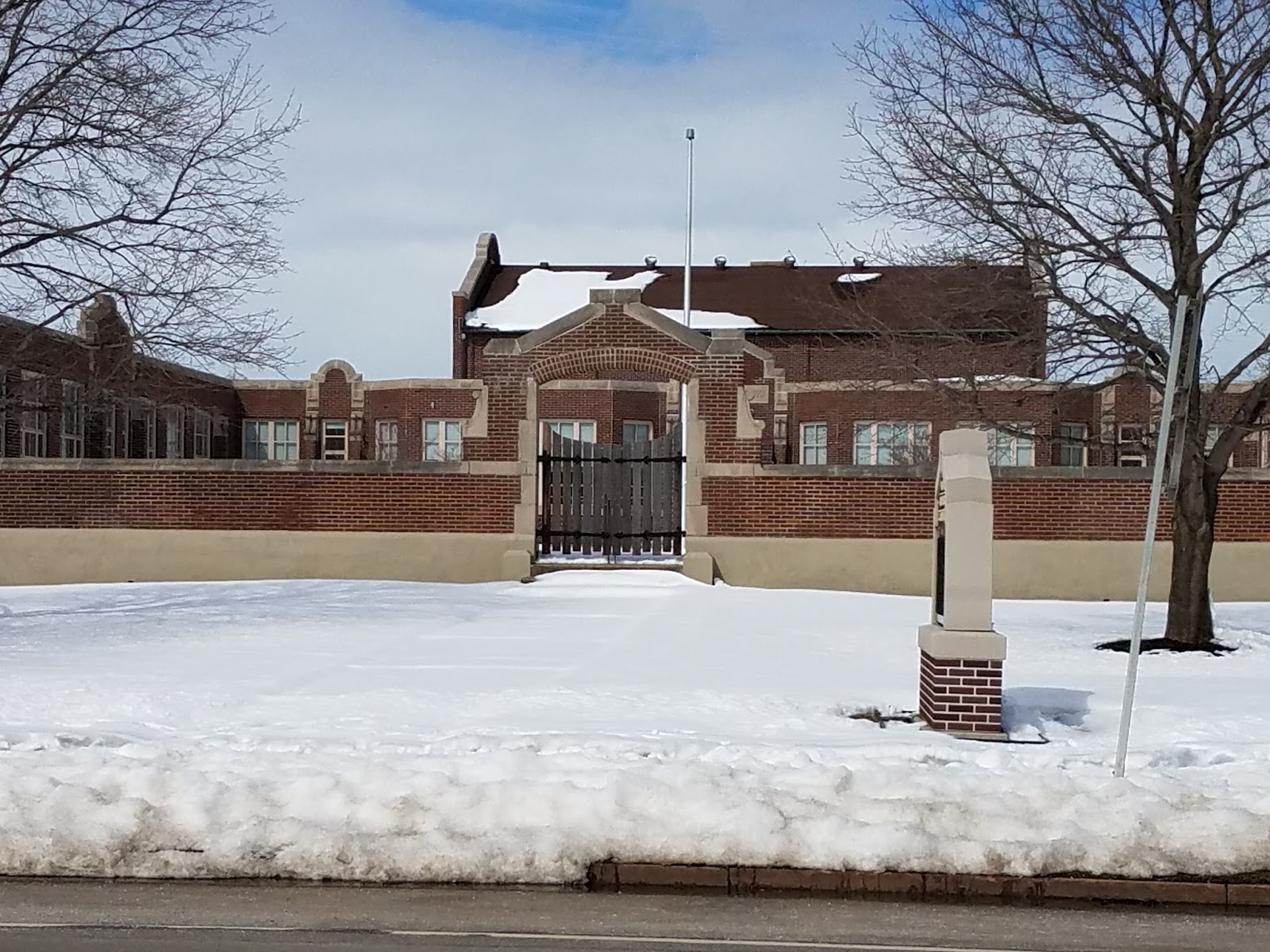
Euclid Avenue School, Jamestown, 1911, enlarged 1920

Lakeview Avenue Historic District, mostly 1890s

Jamestown National Guard Armory, 1932

My search for Jamestown's synagogue was fruitless. The building, behind the armory, is now a church. It's possible that the synagogue still meets elsewhere. The future of Jewish life in small towns is not good.
Erie Railroad Station, Jamestown, 1931. Wikipedia says the last passenger train was in 1970. It is used as a bus hub and, according to a sign outside, will be renovated as a performing arts center.

Partridge-Sheldon House, Jamestown, 1850-67, enlarged 1880. Porter Sheldon was a US Representative after the Civil War

A view of downtown Jamestown from the south, near the Partridge-Sheldon House

Governor Reuben Fenton Mansion (1863) now Fenton History Center, Jamestown
It's 26.5 miles up NY Route 60 from Jamestown, at the south end of Lake Chautauqua, to Fredonia, near Lake Erie. The Commons is a two-square block park along Main Street (US 20) in the middle of town. North of there is a campus of the State University of New York. Fredonia is one of the more prosperous looking towns in the area.
Fredonia Commons, Fredonia

Fredonia Post Office, on the Commons, 1935-36, a Works Progress Administration Project

Fredonia Town Hall and Opera House and the United Methodist Church, Fredonia Commons

On campus at SUNY (State University of New York at Fredonia)
Dunkirk, the second-largest town in Chautauqua County, is just up the road from Fredonia on the border of Lake Erie. Much of the lake is inaccessible, with industrial uses, businesses and parking lots. There is a city park on the lake. I used to work at Social Security in Miami with a young man of Polish heritage who was from Dunkirk. I saw some buildings with words in Polish  and a polish community center in Dunkirk.
Temple Beth-El , Washington St., Dunkirk. They have a webpage on meetup.com, not updated since at least last summer, that shows eleven members

School Number 7, Dunkirk, probably 1920
Coming back down Route 5 along the lake I spotted a combined Tim Horton's and Cold Stone Creamery. Joe and I breakfasted at Tim Horton's in French-speaking Canada, and so I was surprised that the young woman at the register spoke English and said "What can I get for you, Honey." I'm not used to being called "Honey." I had a gooey chicken fajita wrap, with bad fries in a cup (edible drowned in ketchup) and a Diet Coke. I hear that Diet Coke rots your brain, but it goes well with fast food.

Point Gratiot Lighthouse. As you can see, the grounds were closed. This is the office with the lighthouse, still in use, behind it, 1875, on Lake Erie in Dunkirk.

Lake Erie from Point Gratiot Park in Dunkirk
The road into Lake Erie State Park, Brocton, with the bathhouse on the right

Brocton "Welcome" Arch, 1913
It started to snow on the way from Brocton to Westfield, adjacent towns along Lake Erie.
Barcelona Lighthouse and keeper's cottage, 1829, Westfield, now owned by New York State
Coming back to the center of Westfield, which is along U.S. 20, from Barcelona Lighthouse, the snow was coming down "fast and furious." I parked behind Main St. and ducked into the café pictured here with the "open" flag. I had a cannoli and herbal tea. I didn't realize they closed at two. I got there at five of. The snow stopped for awhile, or at least slowed down enough for me to walk around. Westfield has more National Register listings than anyplace else in Chautauqua County. It was once called "Portland" and was an early port and grape-growing region. If it had not already been so late, and the weather threatening, I might have explored more of the town.
E.Main St. Historic District, Westfield

One-time headquarters of Welch's, Westfield. Lake Erie is a major grape-growing area

Town Square, Westfield, part of the French Portage Road Historical District

an early 20th Century block on East Main St., in Westfield

The McClurg Museum, an 1818 mansion, Home of the Chautauqua Historical Society, Westfield
I headed south east from Westfield back in the direction of Jamestown, to Mayville, a village, and the county seat. By this time, it was 3 P.M. and the promised snowstorm showed up.
Chautauqua County Courthouse, 1907, Mayville

Sign bragging about how much snow they get, across the street from the Courthouse, Mayville

I thought I would check out the Chautauqua Community, a resort that has concerts and lectures throughout the summer. It is just south of Mayville and has many historic structures. Although the road by there is along Lake Chautauqua, the snow was coming down so hard that it was impossible to get a clear view of the lake. I passed it by on the way to Lakeview, the western suburb of Jamestown, where there is a traditional enclosed mall. I stopped in to see what was there, and to get out of the weather. They have a Bon-Ton (same company as Elder-Beerman in Morgantown), Penny's and Sear's. There an Office Depot with an outside entrance, and some restaurants that can be entered from inside or outside the mall. Many storefronts in the mall are empty. I stopped in FYE, where I (still) buy CDs in Morgantown, and I bought the new Grammy CD, a collection of songs nominated for Grammys. This gives me an opportunity to see what the latest (last year) music is, and I usually upload it to my antique IPod shuffle to listen at the gym.

I noted the location of Wegman's near the mall and went back to my motel to nap for an hour. I went back out to Wegman's for dinner, where it is now $9.99 a pound for the food bar. I spent $!5 on greens, broccoli, a little piece of salmon, and fruit, trying to eat healthier than I did for lunch. I was back in the room early to catch up on email and social media. There was a party in the next room, which kept me up a bit. I tried to watch some of MSNBC and CNN, thinking I would get smart commentary, but on one of them was an interview with a steelworker and his father, both inarticulate, praising the President's tariffs on imported steel. There were also commercials for medication and cars. I confirmed for myself why I don't watch television at home.

I was out before nine Friday morning in near white-out conditions, drove back to the courthouse in Mayville, then to Morgantown. The weather cleared up at the Pennsylvania line near Erie, and there was less and less snow on the ground as I headed south. I was in Frankin Park, at the north end of Allegheny County, not far from Pittsburgh just past noon. I know there is an Eat 'n' Park there, and my friend Matthew, who I met in New Orleans in 1973, lives nearby. I called him, and since he is unemployed, he came and met me for lunch. It was good to see him again. Schools in Monongalia were closed because of snow Friday. It didn't seem so bad when I got there around three in the afternoon.

Like most of the smaller places I visit, it seems the best days of the area are in the past. The little old towns are pretty, and some have upscale stores, but most don't. Chautauqua Institute is famous, and I know people from all over go there for a week or so in the summer. I'm sure it's beautiful outdoors by the lake in the summer. I perversely enjoyed navigating around in the snow. Go figure!