Sunday, August 27, 2017

Carter and Bath Counties, Kentucky


You might think I was too exhausted from travel to Canada to leave again six days after our return for my sixty-second county within three hundred miles of Morgantown, in this case Carter County, Kentucky. You would be wrong.

This project has become more than an obsession, as Zack Hample, my (half) bother-in-law said recently about his catching baseballs. I have to do this, and I like it.

Carter County didn't seem promising. Grayson, the county seat, is small,  2.700 people, just really an exit off I-64 two counties west of West Virginia, and only thirty miles from Huntington. There aren't a lot of historic places, no Jewish community, no mall. It's 234 miles, downtown Morgantown to downtown Grayson, which means two nights.

Looking at the map, I realized that Bath County, two more counties to the west, was still within three hundred miles of Morgantown. Alphabetically, I should have been there in August, 2014, when I visited Bath County, Virginia. I figured I could spend an afternoon there. It had a few more historic places, at least.

I left later than I planned Sunday, not unusual, and arrived in Grayson about four. After a nap, I went out to buy a swimsuit at K-Mart, just down the road, and dined at one of those seemingly ubiquitous Chinese buffet restaurants.

The main street connecting I-64 to Main Street (U.S. 60), about a mile apart,  is Carol Malone Boulevard, a jumble of fast food restaurants, gas stations and motels. I had to research to find out that Carol Malone was an opera singer from Grayson. Kentucky Christian University is along Carol Malone Boulevard. Wikipedia says they had a great choral program, but deleted the music department to focus on athletics.  Ouch. I drove a bit of Main Street, and walked two blocks west of Carol Malone to find the 1907 County Court House.
Kentucky Christian University, just off Carol Malone Boulevard

Carter County Courthouse, 1907, West Main St. (U.S.60) They are reworking the landscaping.

Statue of a World War I soldier, Courthouse lawn, Grayson

West Main St., Grayson


Monday, I tried out my new swimsuit in the motel pool, then headed out to explore Olive Hill, the other town in Carter County, fifteen miles west of Grayson, and then I planned to visit Owingsville, the county seat of Bath County, fifty-three miles west of Grayson, across Daniel Boone National Forest.

Monday, August 21, was a red-letter day, the day of the solar eclipse, 93% in Grayson at 2:33 P.M. I figured to be at Grayson Lake State Park, south of town, to see the eclipse through the trees.

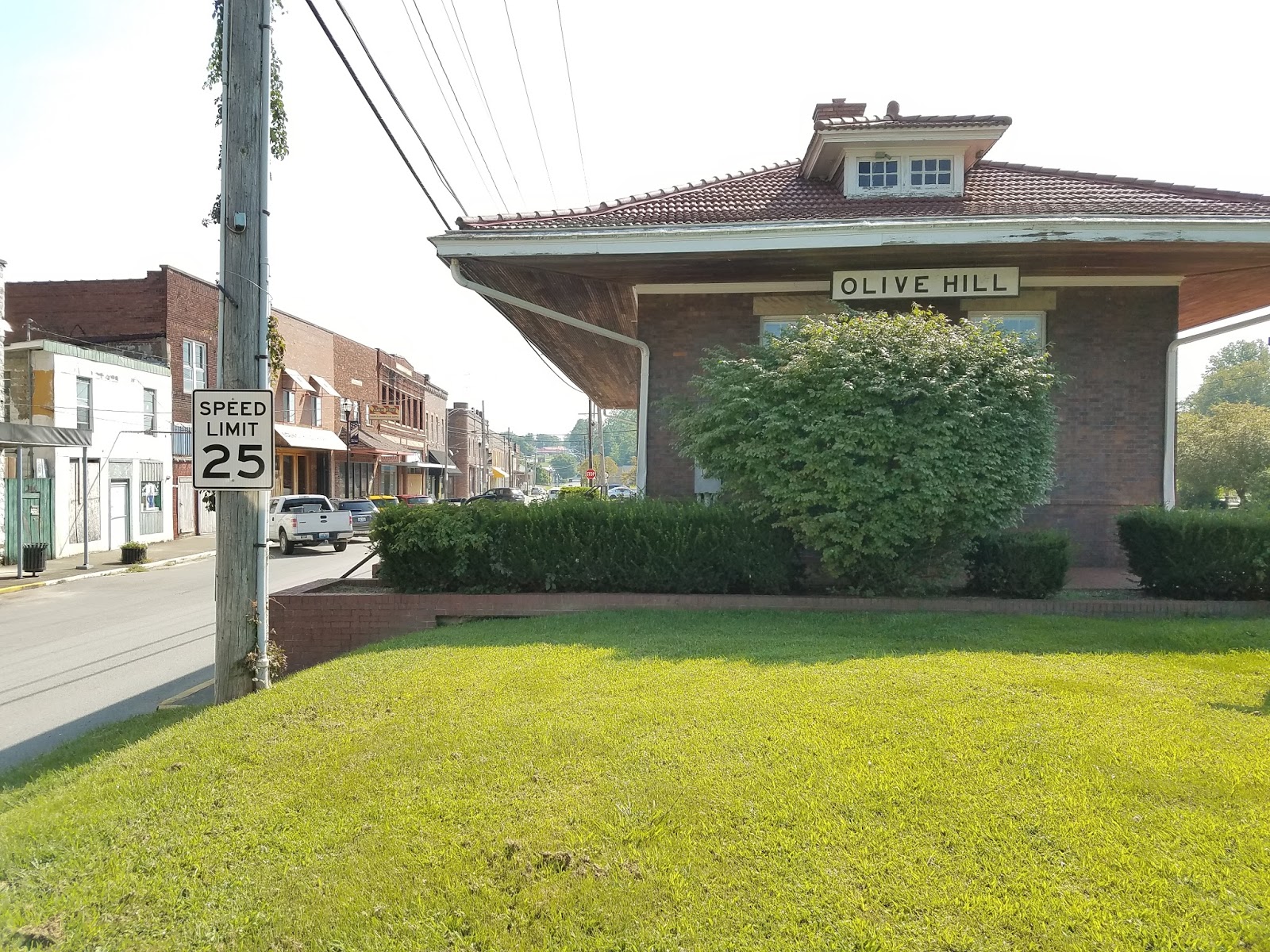
Olive Hill looked like more of a town than Grayson, only half vacant. There is a rail trail along a creek, and a historic railroad station, not used by the railroad.

"Downtown" Olive Hill

Historic train station, Olive Hill
Owingsville, two counties west, and the county seat of Bath County, was founded by Thomas Dye Owings. The plaque in front of his house states he came from Maryland, so possibly from Owings Mills, near where I grew up in Baltimore County. This is an older town than Grayson, and is more picturesque, even though it only has 1,500 or so people. It lies 43 miles east of Lexington.
Bath County Court House, Owingsville
The center of this block is the original Owings House, c.1800


Downtown Owingsville Historic District
Monument to Confederate soldiers from Kentucky, 1907, Owingsville

J.J. Nesbitt House, 1878, Owingsville

I ate lunch at a family-owned pizza place, just off I-64, and thought I found a shortcut to the lake to get me there in time for the peak eclipse. As I was driving, I thought something was wrong with my eyes, as the light dimmed on a bright sunny day.

My shortcut wasn't, typically, and I was about seven minutes late to the lake. The temperature had dropped from 89 to 81 F. in the middle of the afternoon and the light was still dim when I snapped a pic of the marina.

The marina at Grayson Lake. The light is slightly dimmed; this was seven or eight minutes after the peak of the eclipse

I drove back to my motel for a nap, then ate at Shoney's a not-favorite coffee shop place. There is a supermarket in town, and I thought I could get a plate there, but all they had was fried chicken, with two sides. The sides were mac and cheese, mashed potatoes, baked beans and green beans, the latter two both with pork in them. Shoney's has a salad bar at  least.

I was happy to get away, but it didn't seem like much of a place to visit. Before dark Monday, I walked from my motel across I-64, and the mile or so down to Main St. There is a little park with a playground, a new, old-looking log house, which is home to the tourist agency for the county, a covered space with picnic tables and benches under a few trees. The street behind Carol Malone Boulevard is lined with some older homes. There were kids on the playground, two women chatting and eating carry-out from styrofoam boxes at one picnic table, a woman looking at a cell phone at the other picnic table, a man stopped on a motorcycle talking to a friend on the street behind the park. It was still warm out, the temperature having gone back up after the eclipse passed. I could hear and smell diesel trucks passing by. It wasn't much, just a scene, comforting, somehow, of a small-town in America.

I sat on a bench for a few minutes, then walked back to the motel, stopping for a frozen "treat" at McDonald's.

Thursday, August 24, 2017

Charlottesville

I was in Canada the weekend of the Fascist marches and demonstration in Charlottesville.We didn't watch most of it, and didn't see what a big deal it turned out to be.

We came home, and I watched the HBO video, read the comments from the president of the Jewish congregation in downtown Charlottesville, and read as much as I could.

At the Morgantown City Council meeting on August 15, and previously on Facebook, I had asked for a meeting with members of City Council, the Monongalia County Commission and West Virginia University, and their respective police departments to firm up plans in case there was a similar march here in Morgantown.

I was out last Thursday downtown for an event at WVU, the Human Relations Commission and a social gathering. I took the PRT, WVU's ingenious driverless mass transit system, to get downtown and walked between the venues. I didn't stay long at any of them. Joe had a meeting, and I thought I would catch up with him at temple to get a ride home. Our signals were crossed on that, and the PRT had an emergency shut down. I got home much later than I expected, and way tired. That's when I lost it.

There was an op-ed piece in our local paper that day from Michelle Malkin, a truly horrible person, IMHO. Her response to criticism of the President over Charlottesville was "What about Black Lives Matter?" I also got a response from Morgantown's mayor, someone I like and consider a friend, who brushed off my concerns by saying he was sure the Morgantown police could take care of anything that might come up.

I get Black Lives Matter now, and "intersectionality." I will admit to (generally) being white and "passing" for straight, at least when I'm alone and not with Joe. My parents made choices for me in housing and schools that were not available to African-Americans. I had financial help from my family that a vast majority of Americans of any race could not imagine. I expect to be taken seriously. That's how I was brought up, as a White Male in the South.

And yet, when I was concerned about heavily armed young men with Nazi flags standing outside a Reform synagogue in a liberal college town, I was told to worry about African-Americans instead, or to not worry, it wasn't a big deal. That hurt, not so much the former from Malkin. I wrote a scathing letter to the editor about her, which was published this past Saturday. I was more hurt by the Mayor's response. I accused him in my response of not being worried because he is "straight, white and Christian." "Clueless" might have been a better adjective. My husband is the rabbi at the Reform synagogue in a college town 235 miles from Charlottesville, according to Google maps. And my family had relatives in Poland in 1939, who were murdered by the Nazis. That Nazis marching in America did not upset the Mayor, or the President for that matter, meant to me that my life doesn't matter. And Black lives matter even less.

This past Sunday, there was an article in Morgantown's Dominion-Post about preparations for events like those in Charlottesville. The reporter, Alex Lang, quoted me, but also sought out the local police and WVU officials. Apparently, they have thought about this issue, and there are plans in place.

Tonight, I attended a panel discussion about Charlottesville put on by the History Department at WVU. The speakers were good about putting events into perspective. They explained that many of the monuments to Robert E. Lee and others were placed in the early part of the twentieth century, to emphasize white supremacy, and that schools named for Confederate heroes were often built in the 1950s and '60s during the battles over school integration.

Ultimately, the issue is not about statues. It's about white people, almost always young white men, feeling threatened by Blacks, Jews, gays and women, and feeling left behind, like it's someone else's fault. I asked the panel tonight where the hatred of Jews comes from, and the embrace of Nazi flags and admiration of Hitler. The panelists said that young people have no knowledge of what Nazism really meant, no idea about Jim Crow or the Civil Rights Era.

Some of this is prejudice handed down. I know what Baltimore, where I grew up, was like in the 1950s and 1960s. People don't believe me when I say it was totally segregated, not just by race, but also by religion, and not just between Jews and Christians, but socially between Catholics and Protestants, between German Jews and Russian Jews. The Civil War was still an issue in Maryland 100 years after it was over, and to an extent, still today.

It's late and I'm rambling. The talk tonight put things into a historical perspective, and the failing Trump regime, which encouraged outbursts from Nazis and Ku Klux Klan people, will not last. As to racism, anti-Semitism, and our fear-based culture, our only hope is to be open with everyone about who we are, present everyone with a friendly face, and demand much better from our politicians. I'm working on being a good politician, writing letters to the editor (another went out today) and being open, in our city at least, about who I am.

Friday, August 11, 2017

What I Learned In Canada

It's been nine days since we left Morgantown for thirteen days in three of Canada's largest cities. Joe and I both needed to get away after a  busy year (so far), and we wanted to go someplace we didn't know much about, someplace different, and frankly, someplace  away from the trauma of living in the United States today. We decided on an ambitious trip to Montréal with side trips to Ottawa and Québec City. We knew that Montréal and Québec are in French-speaking Quebec Province, and that Ottawa, Canada's capital and fourth-largest city, is in English-speaking Ontario Province, but on the border of Quebec. We decided to be "green" this trip, and ride by train between the cities, and walk and use mass transit in the towns instead of having a car.

The weather ranged from the mid-fifties to upper seventies, averaging 65 to 75. There were periods of rain everywhere. I expected it to be cooler.

We visited all the tourist places. Quebec and Montreal (I'm not using accents from here on) are among the oldest cities in North America. Parts of Montreal could pass for Paris, and Quebec looks medieval in places. Ottawa is much newer with great piles of stone buildings and beautiful parks, as befits a national capital. Tourists came from all over to Montreal and Ottawa, women in Muslim or Indian garb, African families, busloads from Korea and Japan. I couldn't help feeling that many of these people were not comfortable with the idea of traveling in the United States this summer, and chose Canada instead.

It's Canada's 150th birthday, and there were celebrations, festivals and parades everywhere. It seemed welcoming to everyone. I saw no one treated rudely or excluded by race or religion. We were early for Gay Pride celebrations in Ottawa and Montreal. We heard that there was a history of anti-gay actions by the government in Montreal at the time of the World's Fair in 1967 and the Olympics in 1976, but now there is a gay neighborhood with decorations and street signs. At the synagogue in Quebec,  people told us that many in the community had left because of virulent anti-Semitism. They are starting over with a new rabbi and are themselves taking on a more welcoming stance.We saw a festival of First-People's culture, and a parade with indigenous people of other countries, to say the Canadian First People welcomed them. In Quebec, there were signs about celebrating "our common heritage as Canadians," I'm guessing to put aside the rancor  from the Quebec separatists.

In Quebec City, few people speak English at all. We were fine in the tourist areas, and Joe and I, having both studied French in high school and college, and priding ourselves on our linguistic abilities, did our best to get by speaking French. I think people appreciated our attempts.

What I learned in Canada is how a country can try to be welcoming and open, understand that the future is multi-cultural, make amends and include its First Nations people, accept French culture as equal to English, and try to forge a real national identity across a vast amount of miles.

I learned that the United States could use Canada, at least what I saw, as an example. We could be less afraid and more embracing of change, of other races and cultures. We could protect the environment from further degradation, and make amends to our Native population for the horrors our government has inflicted on them.

The United States could have a brighter future than we are heading for. Canada has that future. I'll write more and put up some pictures...soon.

Friday, July 28, 2017

The Writers' Conference

The West Virginia Writers' Workshop has been going on for twenty years. Since we moved here, just five years ago,I've been meaning to go. Two years ago, I signed up for one of the four days of the conference; this year I managed get them a check in time to be a full participant.

I signed up for "non-fiction." They asked me to send ten pages to go over in our workshop, where others would make notes. I had to go back into the archives to find things to send. They got ten pages, but from four different pieces.

When I stopped working full time in 2004, at my fifty-fifth birthday, I signed up for writing classes at UCLA Extension. I would get up in the morning, take a bus from Fairfax Avenue in Park LaBrea to UCLA, then have lunch at Falafel King in Westwood, before catching the bus home.  Looking through the stuff I wrote then, I found a piece  about my life in New Orleans, written at the time of Hurricane Katrina, and  a short story I had forgotten, about a Mexican-American high school student who lived in North Hollywood with her mother, who ran a Spanish CD store, and her grandmother. I thought both of these pieces were great. I didn't use them because they were more than ten years old, and I wanted to submit something newer.

The highlight of the conference was meeting people who actually write and teach writing for a living. I try not to express my emotions; it's how I was raised. I saw people who could talk about their passion for language. If they weren't already attractive (most of them were) speaking with passion made them even more interesting.

I saw a few people I knew there, and made some new friends. There was a woman who lives in New Orleans at the conference. She is a nurse with more advanced degrees and has written award-winning articles for medical journals. I was pleased that she agreed to read my piece about the city, and she thought I captured it with my feelings about my life then, and my grief about Katrina.

One of the instructors was David Haslick, who talked about opening your heart instead of letting it break. He couldn't write well until, at age forty, he faced a trauma from his early life.

The people in our non-fiction group had fascinating stories. One woman shared her history of abusive parents and an abusive spouse, another woman visited Southeast Asia for the first time to meet her mother's family, and a young man from Africa, who learned English as a second language, wrote beautifully about life in a West African village..

I tried to figure why my writing is not as good as it was ten years ago, and why it seems flat to me now. I think part of it was the trauma of my heart attack and mother's death in 2003, which inflamed all of my emotions. I'm older now, and married. Things are calmer than they were (but stay tuned for fireworks from City Council). Writing mostly on this blog, I write something, check it for errors and post it without a lot of revising, or even thinking too much.

It occurs to me that maybe I don't think hard enough. I asked myself during the workshop what I'm hiding. Mark Brazaitis, a fellow Morgantown city councilor and writing professor, wrote a book of stories about depression, which I bought two years ago at the conference. I put it down after the first story, frightened to my core. Now I think maybe I need to face my own issues about depression. I also noted that everyone's work had interesting characters, except mine. My stuff is all about me. I know I write partly so I can have my say without being interrupted.

In 2005, I started to write stories about the unique time and place where I grew up. Some of the stories are humorous enough, but I stopped after maybe three of them, because I realized I had never mentioned my parents. That scared me.

I started a novel, several times, about my life in Miami from 1978 to 1984, a fascinating time and place, and a big part of my history. I took pieces of it to a novel class at UCLA. Only the teacher knew the story was autobiographical. A typical comment was "Your lead character is so unlikable. Does he grow over the course of the novel?" The Jewish grandmother was praised as a brilliant character study. "Pure gold," one woman said. I couldn't take it, and I was less than generous in my evaluation of the work of others.

I got some ideas from this conference about what I need to do. First, I need to spend more time sitting down and writing, even if it is just this narcissistic blog.

Then I need to really open my heart and not continue to let it break. I need to deal with depression, a family history that's only normal on the surface, and what I really think and feel, always a frightening proposition.

And craft. I could learn better ways to express myself. I need characters that have a full life apart from mine. I've said that i can't write poetry, but I have, and I could.

I got a lot from this workshop. Making friends with unexpected people, learning about poetry, about healing, about opening up and letting the words flow. I have work to do now.

Sunday, July 16, 2017

Carroll County, and Galax, Virginia

This trip, July 12 to 14, could have been very different. This is the beginning of the sixth year of these explorations. I thought maybe I would skip places that voted for our current President, but the whole point was to get to know what it is like in this part of the world. Then I thought maybe I would stay in the closest Democratic place, and visit from there, like in this case, Blacksburg, Virginia or Winston-Salem, North Carolina, each about an hour from Hillsville, the county seat of Carroll County. That seemed pointless when I thought about it.

I ended up booking one of the cheap brands of my usual motel chain at the exit on I-77 between Hillsville and the independent city of Galax, about seven miles from each of them, three counties south of Princeton, West Virginia, and on the border of North Carolina. I could have done this differently by staying in a campground or renting a cabin along Blue Ridge Parkway or in New River State Park. My custom is to stay in anonymous chain hotels. It's boring, but there it is.

I drove the 270 miles from Morgantown to Hillsville, napped, then checked out Hillsville. It's a pretty town with a historic court house, and a newer fake colonial county office complex nearby. There  are two blocks of commercial buildings, also historic, and a small residential area north on Main Street. The real commercial district is at the I-77 interchange with US 58, a few miles west of Main St. I walked a bit downtown and visited the library, which has a collection of dolls, mostly International Barbies. I didn't ask why. I did ask the librarian where to visit. She suggested the old courthouse, which has a museum centered around a shooting that occurred there in 1912.
Carroll County Courthouse, 1870s, with a monument to Confederate soldiers

Doll collection, Carroll County Library, Hillsville


Main St. Historic District, Hillsville

I didn't see a lot of Confederate stuff in Hillsville, although the old courthouse has a statue dedicated to Confederate soldiers. This area was out of most of the Civil War action, isolated in the Blue Ridge and west of Virginia's main cities. The railroad didn't arrive until after the Civil War. Wikipedia says that Carroll County has been Republican since the Civil War because it was a haven for deserters from the Confederate Army.

I realized there wasn't going to be much "city" in this area, so before dark Wednesday I drove a piece of Blue Ridge Parkway, which runs west to east through the southern part of Carroll County. I drove west to Galax, which straddles the line between Carroll County and Grayson County, then south to Blue Ridge Parkway. I noticed the beginning of a rail trail in Galax, a bike store that rents, and a movie theater outside of downtown Galax, showing the new Spiderman movie.
Vista along Blue Ridge Parkway, Carroll County

Farmland along Blue Ridge Parkway

Sidna Allen House, 1910. The county historical society is trying to raise money to complete the restoration. The Allens were implicated in the courthouse massacre in 1912


I decided to go to Galax Thursday morning, rent a bike to ride on the rail trail in New River Park, then see "Spiderman." It was supposed to be cool in the morning, then warming up with thunderstorms in the afternoon, clearing later.

I accomplished those things. It was cool, but humid in the morning, and I rode the trail from 9:30 to 11:30 along New River and some other streams, in a park, adjacent to some semi-rural residential areas. I ate lunch at a diner-type place, nicer looking than I expected and busy, in downtown Galax. I ordered a grilled chicken sandwich, hold the mayo, and, uh, onion rings. I was impressed that the server knew without my asking that I would want ketchup for my onion rings.

At the movies at 12:45, the young man with a top knot staffing the concession stand asked me if I had seen this movie before. He had seen it three times and wanted to see it again. Admission was only $4.00. I feared the picture and sound would be awful in this dinky theater, but actually it was fine. We can thank digital projection and sound for the demise of bad movie theaters.

The movie was well done. You could see how much money was spent on special effects, blowing up cars, crashing airplanes, splitting a Staten Island ferry in half. The movie was filmed in a half dozen places, all of which gave the filmmakers tax credits. Tom Holland, the 21-year old star, was adorable. I didn't believe he was fifteen, unless a fifteen-year old boy has his hair styled and colored and has a trainer come to his house three times a week to work him out. Still, it was a break-out part for a young actor, who is in every scene, and gives off the sincerity that's written into the script. My favorites were Robert Downey, Jr., as Spiderman's mentor, Marisa Tomei as a hipster Aunt May, and especially Michael Keaton, balls out as the villain of the piece. Kudos to the producers for the multi-racial high school, realistic for New York, and the men and women of all races who portray the faculty. Nice touch. So I liked it, even though it is very much a "boy" movie.The female actors don't have a lot to do.
Galax Commercial District

Empty factory, Galax

Falls along the rail trail, New River State Park

New River State Park

Felts House, 1930, Galax


I went back to the hotel to nap, missing, the late afternoon thunder storm, dined on a bowl of pasta and a salad near the motel, and set off to find the remaining historic places on my list before turning in. It was a wild goose chase for most of them, down rural roads, looking for streets that were unsigned. I only took a pic of a house in downtown Galax.

Galax particularly is a nice little town, with a real central business district. There was once a railroad and a furniture factory, now a rail trail and a decaying building for sale. It's a center for bluegrass music and the furniture company still has a showroom in town. Yes, most of the people voted for the current President in both Carroll County and Galax, and I still saw some of his signs around. The people I spoke to were unfailingly polite and respectful. No funny looks or racial innuendos, which happen in some places.

The scenery is lovely out there in the Blue Ridge. The trees were not exactly the ones in Morgantown. I would need to read up to find out what does grow there. This was a fun trip for me. I was home by 4 P.M. Friday, held up by construction on I-79 near Clarksburg, most of the way home.

Update: Vaughan-Bassett Furniture is, in fact, still manufactured in Galax.

Sunday, July 9, 2017

The Wedding, The Fourth of July, and City Council

I normally just do what I have to do, make plans and carry them out. I understand that I am not young and I have to be a little careful. No one else sees that.

Last weekend, my sister Robin came in from Maryland. Part of it was to spend the holiday with us, but also she wanted to see me installed in City Council on July 5. Joe and I were asked to do a wedding July 2 in Pittsburgh. The groom is from Morgantown, and we did his brother's wedding three years ago in Charleston. I used to sing for Jewish prayer services. I stopped after the major holidays in 2003. I had been ill that year, and found doing the services too hard for me. People know I sing, but I am rarely asked. Joe does his own singing at synagogue, and I don't want to compete with him. I have a book of cantor music for life-cycle events. At the wedding, I sang the sheva b'rachot, the traditional seven wedding blessings, a benediction, and a selection from Song  of Songs. I worked on my voice for the week before and rehearsed the music at home with the piano we almost never use.

Saturday, we drove the seventy-five miles to the Strip District in Pittsburgh, in time for a late afternoon rehearsal and then dinner at a seafood restaurant. The buffet did not include any "forbidden species," to my relief. We went back to our hotel after dinner; the couple and their friends stayed later to drink and party.
Joe at the restaurant where the rehearsal dinner was held, Strip District, Pittsburgh

It was warm in Pittsburgh Sunday. We left our hotel, dressed for the wedding just after noon, and found a restaurant for lunch. We had looked around the area earlier. We were in suits while everyone else was in summer wear. A nap would have been nice. Instead, we sat in the air conditioning at the  Heinz Museum where the wedding was to be.

The wedding went off without a hitch. The groom was handsome, the bride beautiful in a gorgeous dress, Joe was charming and entertaining, and I sang better than I thought I would. We stayed for dinner and left after 8:30 to drive home, just as the bride and groom were lifted on chairs while everyone danced around them.

The bride and groom are graduates of WVU, and we met many of their thirtyish friends who had gone to school with them, some from West Virginia, all living in Pittsburgh. A typical comment was "We didn't see a future for ourselves anywhere in West Virginia. We learned to do high-tech jobs, which don't exist in West Virginia, and we also wanted to be in a more urban and sophisticated environment." We have work to do here if we hope to attract or retain bright, educated young people.

We got home around ten, and I just wanted to sleep. Robin and Joe played Scrabble before going to bed.

It was my idea to have City Council members ride bikes with the kids in Morgantown's Fourth of July parade. I was already exhausted. We had been out Monday night in Fairmont with friends, who had fireworks, and cooked the kind of vegetarian food we don't normally eat. I take a "water" pill every other day, and I was on the last day of antibiotics for a cut on my arm that was infected. I wanted to stay home, take care of my stressed digestive system and rest up before the parade. The bikes were to meet at five. Instead, we went out late in the morning to walk around Cheat Lake, one of the prettiest recreation areas around here. It was already too hot. Joe and Robin wanted to go out for lunch; we settled on a "fast casual " chain restaurant near our house, so I could nap for an hour before going out to ride my bike the three miles from our house to downtown. It was 86 F. at 5 P.M. Four of us from Council showed up to ride. We rode from the meeting spot to the head of the parade, then waited close to an hour to step off. I was dizzy and had to sit on the curb. The parade went well, and although people offered me a ride home, I opted to ride back. I had used up the one bottle of water I brought, and I had one of those plastic envelopes of juice-like drink, courtesy of one of the organizers for the kids.
At Cheat Lake, July 4, photo by Kevin of Woodburn Shanks Barbecue, who happened to be there
Three councilors on bikes, plus our pal Evan Hansen, July 4 I'm not sure who snapped this photo

I got home close to 8 P.M., overheated and dehydrated. I drank three bottles of water, and Robin put a wet towel on my head, as I was burning up.I managed to swallow some food after 9.

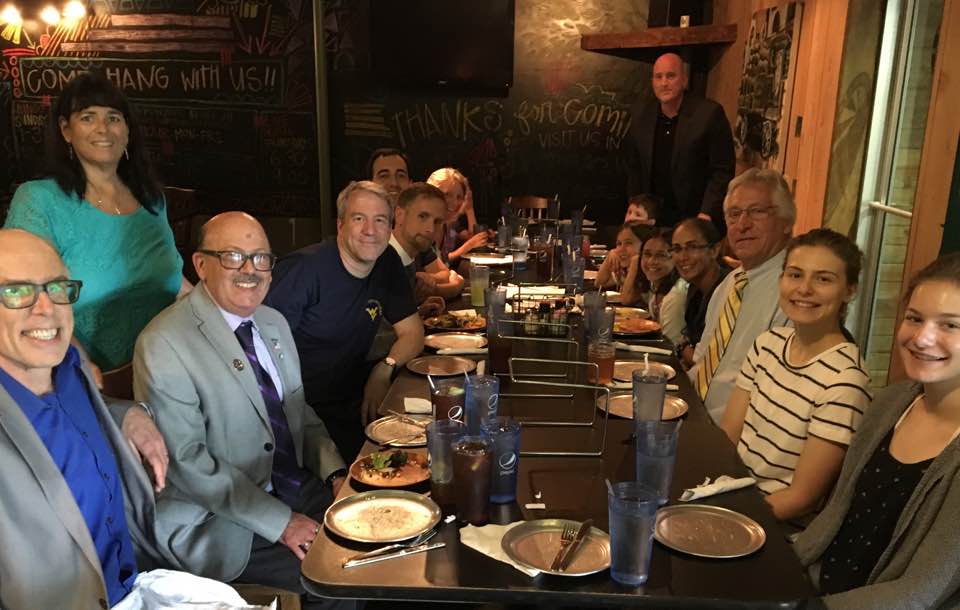
Our first Council meeting was Wednesday, and I had suggested we all meet at a flatbread-pizza-and- salad brew pub in Morgantown's Wharf District for dinner. I knew they could accommodate a crowd. I barely got out of bed most of the day. Twenty people showed up for dinner: the seven Councilors, spouses, some children and friends. I was happy that we could all relax together without the rancor that plagued the last council.


Dinner July 5 with Councilors and family, taken by a server at the restaurant


Our installation on council only took ten minutes, as I expected. There was some business and we each had a chance to say something at the end. My ward is possibly the most politically conservative in the city. I explained my being there by comparing myself to Christoper Isherwood, the author whose story "Goodbye to Berlin" became the musical "Cabaret." Isherwood once wrote that his Catholic British mother wanted him to be patriotic, religious, and married. He said he had become that, only American, a Hindu, and married to another man. As someone who is religious, married, and a homeowner, I said felt that I am  exactly in the right neighborhood.

I'm elated to be on the City Council, and I was happy to be at that first meeting. I've been to City Council meetings before, but it's different being on the Council. It's an awesome responsibility.
Our official portrait from the City's photographer


It's now Sunday night, and I have stayed as close to home as possible the last few days. I'm still out more than most men my age, but sleeping more during the day, and feeling like I had the wind knocked out of me. I did bicycle an hour and a half this afternoon in cooler than average weather, but I skipped seeing Bernie Sanders, whom we saw in Charleston two weeks ago, and also the Morgantown Interfaith Council this afternoon, where Joe was explaining Jewish practices to the group. Tappuz, our cat, has also been staying close to home, instead of spending most of her time outside, as she had been doing since the weather warmed up. Maybe she reflects my diminished energy, or perhaps she was frightened by fireworks last week.

Tuesday will mark five years since our arrival in Morgantown. My original goal here was only to be a spouse for Joe, and to support him in his new career. Now I have my own career as a representative of my city, and last week I enjoyed performing at a wedding (it helped that the couple was so sweet). I've also signed up for a writing workshop at the end of the month, so hopefully, I will be doing more writing than the disjointed pieces I put up on this blog.

I only hope I can muster the energy to continue these endeavors, pacing myself physically, especially, but also emotionally, so I don't crash and burn.

Tuesday, June 27, 2017

Wonder Woman, Gal Gadot and Israel

The news from Israel has been bad. Benjamin Netanyahu, the Prime Minister, has aligned himself with the odious U.S. President. Netanyahu is beholden to the right-wing Jewish religious parties, just as Trump is under the sway of right-wing Christians in the United States. This week, Netanyahu backed out on a deal to create a space at the Western Wall where men and women can pray together, and reaffirmed that only conversions by Orthodox rabbis are valid in Israel. On Rosh Hodesh, the beginning of the Hebrew month last week, Nashot HaKotel (Women of the Wall) brought a Torah scroll to the women's prayer section, and were harassed by Orthodox men. Rick Jacobs, the head of The Union For Reform Judaism, canceled a meeting with Netanyahu. For liberal American Jews, it is hard to continue to support Israel.

There are some who would boycott the new movie, Wonder Woman, because the star, Gal Gadot, is Israeli, and like most Israelis, an Army veteran. I read that the movie was banned in Lebanon because of its Israeli star.

I'm not one for boycotts, and the film got terrific reviews. Normally I don't see movies where there are car or airplane chases, stunts or things blowing up. I don't care for war movies. I like hipster foreign films, movies with a lot of talking, and romance. A gay or Jewish theme helps. I like films by Woody Allen, Pedro Almodóvar and Lars Von Trier. Wonder Woman is not my kind of movie.

I went tonight, I think the first time this year that I've been to a movie in a theater in Morgantown.
I loved this movie. And what I liked most was Gal Gadot. She is terrific, but the part I love is that she reminds me of everything I like about people from Israel. She is strong, smart, knows who she is, and carries the history of her people with her. She is sexy, vulnerable, funny, charming, and headstrong. I don't mean to stereotype  a whole people (although I suppose that is what I am doing), but that is how I see Israelis. She sees how hopeless peace is, but she still wants to work for it. It took an Israeli actress to be able to portray all of those qualities.

Kudos to director Patty Jenkins for having the wisdom of a woman to have the only actor partially nude in the movie be Chris Pine.

I guess I'm saying that if Wonder Woman can find a redeeming value in mankind, then, through Gal Gadot's depiction of her, I can find hope for Israel, and maybe, by extension, for the United States.