Monday, December 9, 2019

Cuyahoga County

This was my eighty-ninth county, the last of the forty-two counties that start with "C." It's also, according to the latest U.S. Census estimates, the largest county I've visited on these trips since we moved East in July 2012. Cleveland is the main city in Cuyahoga County, and only the second (after Athens County, home of Ohio University) of nineteen I've visited in Ohio, that didn't vote for the current President in 2016.

I allotted four days, Friday to Tuesday over Veteran's Day weekend, to do justice to the county. Between Council meetings, my last class at OLLI, and our planned trip to Memphis, I couldn't find other times to go. I thought I would stay downtown, but The Usual Chain charged twice as much as a suburban branch, plus an extra fee for parking. I had figured I could drive the 200 miles to Cleveland from Morgantown before lunch. I left late, as usual, so stopped for lunch on the Ohio Turnpike at Panera at a rest stop. I don't know if the kids who work there don't listen, but this was probably the third time, at different locations, that my order was taken wrong. This time, I caught it before they made up the order and got it straightened out.

I pulled into Cleveland's Public Square about two, found a parking garage, and started looking for a bathroom. I walked into a fancy branch of a big chain hotel looking for one. This is a time when I use the privilege of being white and unscruffy, looking like I might being staying at the hotel, to find a bathroom off the lobby. No luck! It was locked and one needed a guest key to get in. There was a coffee place next door. I thought I would order tea, and use their facility, but a sign on the door said there was no public restroom. I ducked into the iconic Terminal Building, figuring it might still be a railroad terminal and thus have a restroom. The lobby area and several floors of the building are now an indoor mall, with some upscale stores and many vacancies. I found the food court in the back, with an adjacent restroom, open to the public. It was crowded with the locals, mainly African-American men, looking for a bathroom and a warm space to hang out. This seemed to be the only spot on the Square to do that.

I did check out the Civil War monument, the Soldiers and Sailors Monument, much fancier than the obelisks honoring Confederate soldiers in every county in Virginia. It's quite elegant, with a museum inside with brass bas reliefs of scenes from the war. From there, I went back to the car, and drove out of town to the hotel, eight miles south in Independence. Wikipedia says the Rockside Road corridor, where my hotel was located, is the "Silicon Valley" of Metropolitan Cleveland. After a nap, I walked to a fast-casual Middle Eastern restaurant. It was cold out and it wasn't a great place to walk, with only intermittent sidewalks.

I picked twenty historic places in Cleveland to visit, out of several hundred on the National Register, and planned to visit the most eastern ten Saturday and the western ten Sunday, leaving most of the suburbs for Monday. I planned on seeing the Maltz Museum of Jewish Heritage in Beachwood on Saturday. Sunday I figured to go to Cuyahoga Valley National Park.

Saturday, the temperature ranged from 29 F. to 37, overcast and windy. I started at Cleveland State University just east of downtown, saw some old buildings along the "green necklace" park system along Martin Luther King, Jr. Drive. I stopped  at Case-Western Reserve University, then passed the museums (some of which Joe and I visited with my sister Robin in 2018), then out to the far eastern end of the city, to find a historic theater on East 185th St. I ate at Gus's Diner on the same street, an old-fashioned kind of place, like the diner in the movie that we used to visit in Baltimore. From there, I checked out Wildwood Park along Lake Erie. This was my third trip to the lake, after Ashtabula County, Ohio  in February 2014, and Chautauqua County, New York in March, 2018. On both of those trips, the lake was frozen over. Not this time. There is a strip of small shops on Waterloo Road, parallel to I-90, out that way, and I stopped at a record store. I bought a 1969 Warner Brothers teaser, a two-record set of up-and-coming artists from 1969, like Sweetwater, and The Fugs.

I visited the Maltz Museum in suburban Beachwood, the current fashionable Jewish suburb, after close-in Cleveland Heights, where there is still an Orthodox community in that walkable inner suburb, and past Shaker Heights, Cleveland's answer to Baltimore's  Pikesville, where Jews lived fifty years ago. Beachwood is past there, and the houses are larger than Shaker Heights and on bigger lots. The museum is next to a sprawling synagogue complex.

The museum featured a traveling show from Philadelphia's Jewish Museum about Leonard Bernstein. There was a lot about his family history, an explanation about the music, and his life as alternatively an openly gay man, and a husband and father of three children. What moved me, was his political advocacy for humanistic causes, and his abiding love for Israel. Politics today are so much coarser, and Israel has made itself much harder to love since those days.

I stopped in the gift shop and bought a new kippa for Joe, and a copy of Roz Chast's 2013 graphic memoir, both funny and sad, about her parents in their old age, Can't We Talk About Something More Pleasant?" I noted to the woman working there that they had a hardcover version of Parts One and Two of Art Spiegelman's Maus. She had never heard of it, and I told her she had to read it. That may have been my one good deed on this trip. I asked her why the trees were bare in Beachwood and there was snow on the ground, when that didn't seem to be the case in most of Cleveland, where there were plenty of colorful leaves out and no snow. She told me that this was the beginning of the "snow belt" more west than south of Lake Erie, extending up to Buffalo, and that it was colder and snowier than central Cleveland. Who knew?

I got back to the hotel, not close, around sunset, napped for a time, and found, online, a diner to the west of where I was staying in another suburb. I thought about finding a movie or something, but crashed back in the room.

Sunday was warmer, but more difficult. I thought I was cool, missing a home football game in Morgantown. I didn't note that the Cleveland Browns were playing Sunday afternoon. I explored some of the old industrial areas west of downtown, saw some little coffee places popping up, and nearer downtown, a neighborhood of new apartment buildings and some factories renovated into loft-type apartments. I saw young people walking their little dogs, electric scooters for rent littering the sidewalks and other signs of young up-and-coming inhabitants. Thee was even an LGBT Center. I snapped a few shots, but as I crossed the Cuyahoga River into the city center, it became difficult to navigate and impossible to park, because of the impending football game. I gave up and headed back to the'burbs.

I couldn't find anyplace to eat that interested me, and finally lunched in a Subway in an old treeless shopping center. I stopped into a grocery store for fresh fruit. Cuyahoga Valley National Park, as the name implies, follows the river, but there is also a canal from the days before the railroad came, with a few old inns and remnants of the canal. Although the area is flat, the river is in fact in a valley, and although just over the hills there are factories, warehouses, and houses, the valley itself is remarkably preserved. I walked the trail along the canal about 1.5 miles each way. I came back to the hotel and slept, then went to dinner at the Ohio-based chain restaurant near the hotel. It was better than that chain usually is.

The weather forecast for Monday was dire, although it was relatively warm (40 F.) and sunny in the morning. It was supposed to hit 50, then start raining, and, by 3 P.M., snowing, a lot, with possibly a foot of accumulation and temperatures falling to 15 F. overnight. The hotel let me check out a day early. I went looking for a few historic houses in Independence and Parma, where I also found Sheetz, where I got gas for the trip home. There was a historic house listed at an address on a lake in the far southwest corner of Cleveland, so I went there and found two late nineteenth century mansions ( I never did see the lake). It was starting to rain by then, and I headed to Westlake, a suburb on Lake Erie almost in the next county. I went there because there was a Nordstrom Rack, and I am a sucker for bargains on clothes. It was in a development like The Grove in Los Angeles, kind of Disney-looking, only with three and four-stories of apartments upstairs, parking on the streets and much larger. The layout was confusing, as was parking in the garages, but I made my way to Nordstrom and bought a shirt, pants, underwear, socks and a belt. There were some fancier brands than other stores, but I think T.J. Maxx is as good, and cheaper. I went looking for a place to eat. I picked a noodle place (closed) and then a Chinese place (also closed). There was a chicken place, but it was all spicy, which I didn't' want, and a pizza place, where I said to the greeter that I couldn't eat a whole pizza and she snapped back "Well, we don't sell it by the slice," and walked away. By now it was getting colder and raining, and I wondered why this outdoor shopping area was built in a cold, snowy place. It would make sense in Southern California, but not here. I stepped into that ubiquitous coffee chain and had a bagel and hot tea. Next door was Graeter's ice cream from Cincinnati, deserted. I stopped in for a scoop. The proprietor told me there were now two branches in Cleveland, the other in a development like this one in Beachwood, and that, while it was mobbed in summer, it was slow November to March. I asked him if he thought all the apartments were rented and he said that in this part of the development, more expensive than some of the others, he didn't think so.

By now, it was approaching 2 P.M. and the snow was to start at 3. I was at the northwest end of Cuyahoga County, heading south and east to get home. It was pouring down rain. I got through town, and soon the weather cleared and, by the time I got to Morgantown, it was 60 F. and sunny. I was home for dinner. It snowed a bit overnight Morgantown, and the temperature dropped suddenly down to 30, but unlike in Cleveland, there was no accumulation. I enjoyed being in a large metropolis with a diverse population, and I would like to go back and see more.

Mall inside the Terminal Building, downtown Cleveland
Civil War Monument, Public Square

Bronze relief of nurses in the Civil War, inside the monument


Lincoln Freeing The Slaves, Civil War Monument
Former May Company Building, Public Square
University Hall, Cleveland State University

Masonic Hall, 1921


Cook Building, now apartments

Woodland Cemetery

East Boulevard Apartments

former Armory at Case-Western Reserve University

At Case-Western Reserve

Glidden House

Hay-McKinney House, now part of the Cleveland History Museum, 1916-1919

La Salle Theater, 1927


Wildwood Park on. Lake Erie

Blue Arrow Records

The Temple-Tifereth Israel, Beachwood

Maltz Museum of Jewish Heritage, Beachwood

South Brooklyn Historic District

Temple-Bradley Company (now apartments)

American-Roumanian Daily News

new apartments west of downtown

warehouses becoming apartments and rental electric scooters, west of downtown

Richman Brothers Building

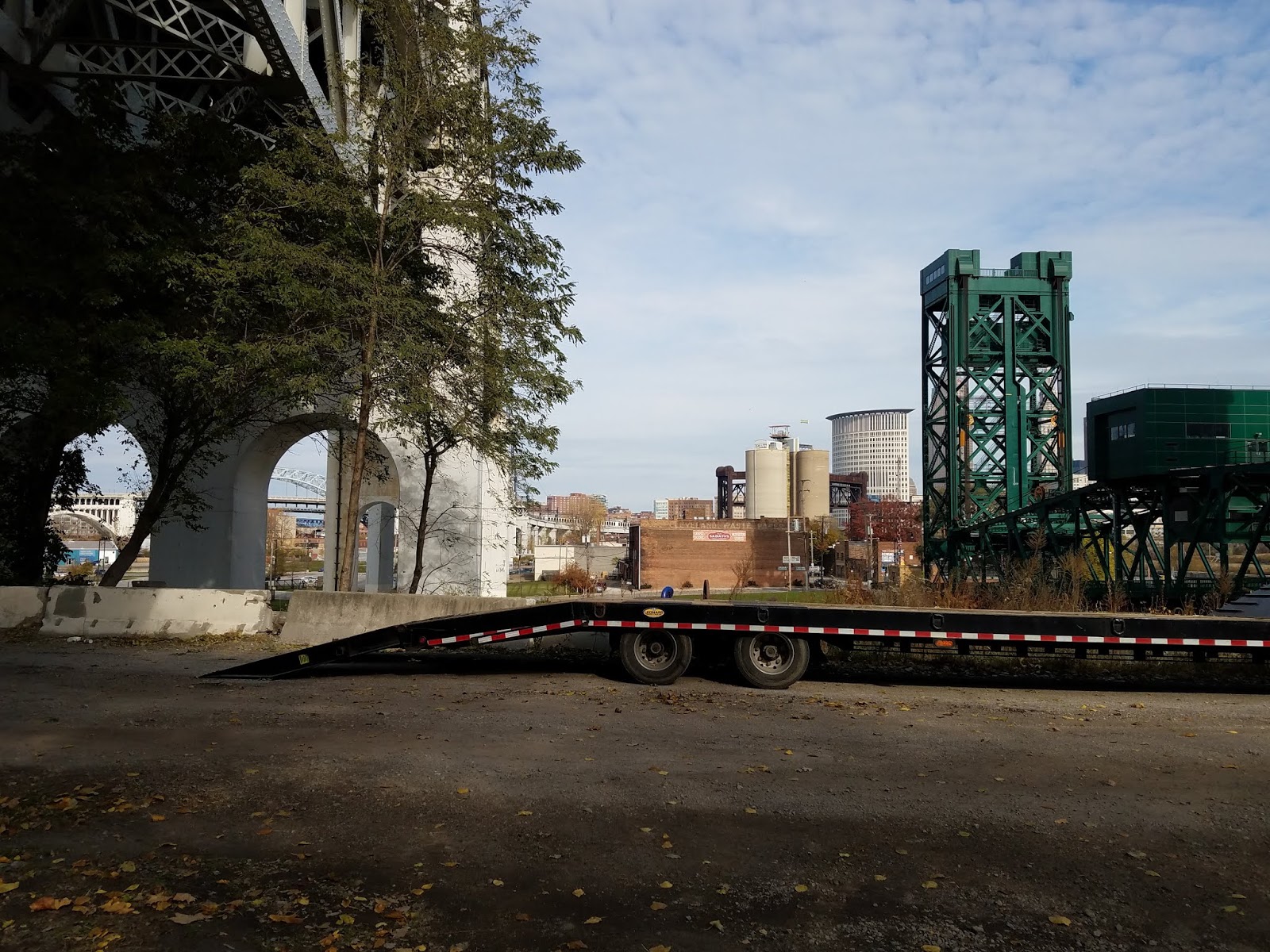
bridges across the Cuyahoga near downtown

crowds waiting for the football game

Cleveland State University


Cuyahoga River in Cuyahoga Valley National Park

Canal Exploration Center, Cuyahoga Valley National Park

Ohio and Erie Canal, 1820s and 30s Cuyahoga Valley National Park

Wilson Feed Mill, Cuyahoga Valley National Park

Fuller-Bramley House, Independence, 1856

Henninger House, Parma 1849

House next to the Whitney House, Berea

Whitney House, Berea, 1870


Sunday, November 17, 2019

Cumberland County, Virginia

It's been my practice since we moved to Morgantown in July of 2012 to hit a county within three hundred miles of Morgantown every month. October was nuts, with the Jewish holidays and my OLLI class, but I thought I could visit Cumberland County, Virginia, with a population of about 10,000 people, Saturday to Monday, the 26th to the 28th. I had to miss an unveiling Sunday and a meeting of City Councilors with visiting dignitaries from Ukraine. I was worried about visiting the county when I heard that their conservative Republican congressman, Denver Riggleman, was censured by the Cumberland County Republican Party for officiating at a same-gender wedding. Of course, I'm not so obviously gay when traveling alone (and dressing down), so it's not much of a problem. I understand that I have the privilege of "passing" that others don't have.

Then I was exhausted Thursday and Friday, and didn't sleep well Friday night after the cat woke me at 3:30 My stomach was rumbling, and I kept thinking about what I said to a group of pharmacy students Thursday. I was supposed to tell them about "Jewish culture," but I'm not sure what that means in America today. I probably should have said "We are a tribe, with a country most Jews have never visited and many don't like, a language most don't understand, holy books most have never read, and a Deity most Jews don't believe in. Still, whether it's food our grandparents made that we no longer eat (too fat and salty), an immigrant narrative, a race memory of the Holocaust, or a deep distrust of our non-Jewish neighbors, most Jews will tell you how proud they are of their heritage." That would have baffled them. I think they were left with the impression that Jews (me, anyway) talk fast and loud, wave their hands around, and are highly opinionated. There is some truth to that stereotype.

I got up at six that Saturday, made breakfast and got out around 9:30. I was still sleepy, and thought I should pull over and nap. I took the back way, across the covered bridge in Phillipi, and over the mountains. Suddenly, I felt better. I ate a banana and a protein bar along the way, but waited until about 2 P.M., when I got to Staunton, in the Shenandoah Valley, to actually eat a stale bagel at a coffee house. That's part of being Jewish, too, complaining about the bagels outside of New York City. I got to Cumberland Court House, the county seat, containing just the county offices, some old  houses and a restaurant,  around four, took a few pics and was asleep at my hotel in Farmville, a few miles south in Prince Edward County by five. On awaking, I bought gas and a sandwich at Sheetz, the Pennsylvania-based convenience store and gas station, checked the internet, and slept through the night, until late.

There are sixteen historic places on the National Register throughout Cumberland County. My intent was to visit all of them. Unfortunately, it was pouring down rain when I left the motel, but it stopped after a half hour, cleared up, and most of the day was warm and sunny. I was back in Cumberland Court House by 11 and stopped at the one local restaurant for lunch, beating the after-church crowd. I had the special: pot roast and gravy, with carrots and potatoes and I picked candied yams and apple sauce for my sides, and cornbread. The waitress, Shirley, was fiftyish, with gold cross earrings. I remember that my grandmother used to say "It's a pity on an old lady, she should have to work", and tipped heavily. I felt sorry for her for having to work on Sunday, and left a generous but not extravagant tip. Except for the cornbread, my grandmother in New York City cooked all of those foods. I just about never eat beef anymore, and nothing on my plate was technically diet-approved.

I visited Bear Creek Lake State Park, and walked a "moderate" hike of 1.75 miles, but actually longer because of a few wrong turns. The temperature had risen above 80. I worked off the pot roast.

I ended the day in Cartersville, a tiny historic village at the north end of the county along the James River. There are just a few homes, one previously an inn, and a bridge over the James River to the north and the next county. The old bridge is on the National Register, and pieces of it remain.

I didn't think a heavily Republican county of 10,000 people out in the middle of nowhere would be interesting. Still, with beautiful weather and great scenery, I enjoyed myself. At home, I wouldn't take a whole day to just go out and explore. That's the point of going away.

I came back Monday the way Google Maps suggested, state roads to Interstate 64 near Charlottesville, then north on Interstate 81, through back roads in Hardy and Grant Counties, West Virginia, to unfinished (and therefore rarely traveled) four lane, divided U.S. 48, then through Garrett County, Maryland to I-68 back home. It's not as scenic as two-lane U.S. 250, but still over  the mountains. The roads are less winding, and the leaves were at peak color, making for a beautiful ride.

Along U.S. 250 0ver the mountains

Along U.S. 250

County Clerk's Office, 1818

County Courthouse, 1818. The design follows Thomas Jefferson's ideas.

Obligatory Civil War monument, honoring all soldiers in the war, 1901

Derelict house from about 1810, Cumberland Court House. A sign says it will be a museum of local history

Railroad bridge over the Appomatox River from Prince Edward to Cumberland County, now a rail-trail. There is a "High Bridge," which I didn't find.


Grace Church, 1843, Ca Ira, a community that no longer exists

I looked for a mansion house in Cumberland State Forest, but it was down a long driveway with "No Trespassing" signs. This is in the state forest.

Houses in Cumberland Historic District

House in Cumberland Historic District

Lunch at Cumberland Restaurant
The beach at Bear Creek Lake Stat Park


Floor Cedar, a tree that spreads along the forest floor when young

Bear Creek Lake State Park
along the trail in Bear Creek Lake State Park. In some places all the leaves were still green.


Campground, Bear Creek Lake State Park, built by the Civilian Conservation Corps, 1938


Muddy Creek Mill, Tamworth, 1785-1792
Former Hamilton High School, near Cartersville, 1910
Former inn, Cartersville Historic District

Cartersville Historic District

new bridge and part of the old bridge over the James River, Cartersville

remains of the old bridge over the James River

self-portrait on the rail trail bridge from Prince Edward to Cumberland County in Farmville


Monday, October 21, 2019

High Holidays 5780: How Terribly Strange To be Seventy

"How terribly strange to be seventy" is a lyric from Paul Simon, who turned seventy-eight last week. I wonder what he thinks about that now. I can tell you, it's not strange at all. It's just what happens when you just get up every morning, as I did this morning, on your seventieth birthday. I didn't just sit on a park bench, with nothing left but my memories. I ran/walked (ran downhill, walked uphill) through my neighborhood in beautiful, slightly-warmer-than-average fall weather.

The past month of Jewish holidays has taken a toll on both me and Joe. I chanted haftarah (prophets) the first day of Rosh Hashana, and Torah the second day, and Torah the morning and afternoon of Yom Kippur. In the Reform movement, today is Atzeret-Simchat Torah, the last day of the holiday period. In between everything else, Joe and I are teaching classes at Osher Life-Long Learning through West Virginia University. He is teaching "Old Testament Rituals-Don't Try These At Home," and I'm teaching "The Great Hits and Albums of 1967," fun for me, but a lot of work. We attended a wedding on the Saturday between Rosh Hashana and Yom Kippur in Alpine Lake, 40 miles east of here, near the Maryland line, and a bat mitzvah in Pittsburgh two days ago. Yesterday, we combined Simchat Torah with the Sunday school, then Joe had an unveiling near Uniontown, Pennsylvania, and spoke on a  panel later in the afternoon, followed by a dinner, through Greater Morgantown Interfaith Association. I spoke on a panel at WVU for counseling students Thursday morning, with a priest, a Dakota elder and our local Imam, then grabbed lunch before my own class. We attended a mourning prayer service Thursday night, for the mother and grandmother of congregants. This is in addition to Joe's regular services and my City Council responsibilities. I didn't expect to be so busy in retirement, and I'm sure it's not what Paul Simon envisioned oldness would be.

The kids at WVU asked about my history, and how I came to be religious and believe in God. I told them my story of coincidences in my favor piling up over time, and how I thought Someone had a plan for me of which I was not aware. I got kind of emotional about it all. At the evening service for Rosh Hashana, my attention wandered, and I saw myself as a child with my parents and at Passover seders with my grandparents, aunts and uncles, in Hebrew School and at high school dances, with my first boyfriend in New Orleans, and that time there was snow on the palm trees. I thought about how my grandmother loved me and worried about me when I lived in Miami, and the times I was sick there, about how I came to Los Angeles, my job issues and many career changes. I remembered again all the friends I helped bury during the worst years of the AIDS crisis: Fred and Art, Hal and the others whose names I can't bring up now, all these years later. I remembered how I wanted to meet someone and leave Los Angeles after I suffered a heart attack and my mother died a few weeks later. And then I saw Joe on the bimah leading services and said a quiet "Thank you, God." No one could have predicted fifty years ago that my life would be what it is now.

I still worry plenty about the climate, refugees, Israel, the United States, Morgantown, how long I'm going to live. I don't have any big, immediate worries. Physically, I'm as healthy as can be expected. I've started running, slowly and not far, after thirty-five years of not running. It's  a testament to the heart and asthma medication I'm on every day. Still, there are times when I am just exhausted, and no matter the time of day, I need to stop and go to bed. That happened Saturday, when we came back from the bat mitzvah in Pittsburgh, with a stop at Apple Butter Day at friends' farm in Mt. Morris, near here in Pennsylvania. 

When the kids asked me Thursday about my spiritual practice I told them the main thing is to say "Thank you, God." I do that when I wake up and when I start a meal, and at random times during the day. I extend that practice to being kind and compassionate to people around me (still working on that), charitable and generous in spirit. 

Joe bought me two t-shirts with funny things about cats for my birthday, and we'll have dinner out tonight. I'm speaking to another panel Thursday morning and my class continues in the afternoon.  At seventy, having lived longer than my father, grandfather and great-grandfather in my paternal line, I give thanks for my life today.
This is what 70 looks like

Saturday, September 21, 2019

Cumberland County, Pennsylvania

I visited Carlisle, the county seat of Cumberland County, and several smaller places in the county September 4 and 5. I feel like I've been crazy busy and more-than-usually distracted since then. I stayed home today with the intent of working on my projects, including this one.

According to the algorithm I invented, Cumberland County was worth a 24-hour trip: it's less than 200 miles from Morgantown to Carlisle, and fewer than 450,000 people live in the county. Still, this is one of the larger and most historic counties near here, 192 miles away. I covered what I could in 24-hours.

It would have been easier if I had left home at 9, as I planned, but it was 10:20 when I finally left. I stopped for lunch at a semi-fast food noodle place that shares a footprint with a coffee place on the parking lot of the mall in Halfway, near Hagerstown, in Washington County, Maryland. Cumberland County is just across the Susquehanna river from Harrisburg, Pennsylvania's state capital. Like Hagerstown, it lies along I-81.

The Usual Chain has an unusual branch in the center of Carlisle. I was there about 2:30 and parked on High Street, as in Morgantown, the major artery in town. The meters give you fifteen minutes free, after that you have to pay. There was an open-air market starting at three right in the center of town. I was there just before, and co-eds from Dickinson College, a few blocks away, were about to make pizza and sell veggie-flavored popsicles. Meanwhile it was 90 F. out, and I was exhausted. I checked into the hotel, and moved my car to a city garage behind the motel. With a sticker, I only had  to pay $4.50 to park for a day.

After a nap, I dined at a café on High Street with signs welcoming everyone, specifically LGBT people. A nice touch. I had a decent sandwich, and continued on my way west to Dickinson College. The campus is lovely, wooded, with benches and hammocks scattered about. On a warm, windless night, lots of students were out, congregating in small groups around campus.

I learned that most of Carlisle is in a historic district, and that it was occupied by Confederate soldiers in 1863, who soon moved on to Gettysburg. I was jealous that High Street in Carlisle has a movie theater and an independent bookstore.

I overplanned Thursday. I was supposed to go home after visiting several places in the county, and taking a detour 90 miles to Owings Mills, Maryland, outside of Baltimore. It being Elul, the month before Rosh Hashana and Yom Kippur on the Jewish calendar, I thought I would visit my parents at the Maryland Veteran's Cemetery. It occurred to me that this would be more than 300 miles driving, and that I wouldn't get home until 8 P.M. I considered stopping at my sister's in Maryland, then leaving for home the next morning. I decided not to risk morning and evening rush hour traffic around Washington and go ahead and bomb home.

I drove first to Shippensburg, at the southwestern end of the county. I missed the college there, but found Widow Piper's Tavern from 1735, and the Shippen House from 1750, added to and remodeled since then.

I headed south and east to Pine Grove Iron Works, in Dickinson Township. The furnace dates from around 1770. It is now in a park, and the Appalachian Trail runs through there on a rare flat stretch next to a stream. I walked a bit, and then drove back to Carlisle Barracks, just outside of Carlisle, and still a Federal installation after more than 200 years. I needed a pass to get in. They called
somewhere, copied my driver's license, and looked me up on a computer before they decided I was okay to visit. This was the site of the Indian School where Jim Thorpe was educated, probably why he is buried now in the northeast Pennsylvania town that bears his name. The Barracks is a sprawling post, and one can only take pictures along The Quad, the green space in the center of the installation.

I stopped for lunch in Mechanicsburg, more what I expect of a small town in Pennsylvania, pretty and  historic, but not trendy or touristy. I had a pizza and diet cola (not bad) at a neighborhood place before heading to my last stop, Capital City Mall in Camp Hill, along the Susquehanna. I never did get to the river, but I was jealous that the mall has a gigantic branch of that (formerly) ubiquitous upscale department store. I walked a loop through the mall and headed out, eventually onto I-83 south, a poor excuse for a highway. I left the county at 2:20, about the time I entered the day before. I drove past York and into Maryland.

By 3:45, I was at the Maryland Veteran's Cemetery. I didn't have much to say to my parents this year. I took some pics of the grounds, and two groundskeepers stopped by and asked if they could do anything for me. I told them why I was there, and asked why my parents' stone was so much darker than many of the others. They said they had flooding this year, and there are geese who poop on the stones. Great. They offered to clean up the stone, and maybe they will. I don't expect to be back there until next year.

I left the cemetery about 4:30, hit lots of traffic on the Baltimore Beltway and I-70 west, thinking how close I was to where I grew up and to the schools I attended so many years ago. I know there were back roads I could have figured out that might have saved time. Still, I took the Interstates and got home close to eight P.M.
The Town Square, before 3 P.M.

Entrance to Dickinson College

City library, with a much larger modern addition not shown

Dickinson College Jewish Student Center

The square about 7 P.M.

On campus at dusk

Carlisle Theater, High Street. They have movies and live performances.


Modern building on Dickinson's campus

Old East, Dickinson College

Flyer for an LGBT group at Dickinson

Cumberland County Courthouse after dark
Widow Piper's Tavern, Shippensburg
Shippen House, Shippensburg

Pine Grove Furnace, Dickinson Township

Mountain Creek, Pine Grove Furnace State Park, adjacent to the Appalachian Trail


Hessian Powder Magazine, 1777, part of Carlisle Barracks, now a museum


Part of the former Indian School at Carlisle Barracks. The rear part is the gym where Jim Thorpe trained.

Part of Carlisle Barracks, now used as a residence

Downtown Mechanicsburg Historic Disrict
My parents' burial spot, with stones I left to show others that someone had visited

Maryland Veterans Cemetery, Owings Mills, Baltimore County