Tuesday, September 6, 2016

My Sister, Calvert County and The Millennials.

This should be three posts, but it will be one.

My fiftieth monthly county is Calvert County, Maryland, south of Annapolis between  Chesapeake Bay and the Patuxent River estuary. The county is adjacent to Prince Georges County, where my sister Robin has lived since attending the University of Maryland a few decades ago. My plan was to combine trips, as I try to see my sister over the summer.

Robin and I get along well generally. She is careful and meticulous, I am sloppy and more reckless. Since she has lived in her house, I've lived in three different cities and eight different homes. She is the only one who really understands what our parents were like and who remembers our grandparents. We both nap in the afternoon, take medication before we can eat breakfast, and watch our weight.

I try to visit the Garrison Forest Veteran's Cemetery in Owings Mills, where our parents are buried, every year before Rosh Hashana (this year in early October). Robin and I  visited in the morning, then had lunch at Suburban House, an old-fashioned Jewish deli in Pikesville, near where we grew up, and a place we hung out in our younger years. The restaurant moved to a new shopping center a few years ago. We asked the waitress where she went to high school. She attended Milford Mill a few years after my sister. The manager (City College '68) came over to chat us up. He wants things to stop changing, and lamented that the 1960s in Jewish Baltimore are gone. There was a tight-knit community that no longer exists. Robin and I both fled for our lives when we had the chance. We thought we saw our parents' friends at the restaurant, but we soon realized the people we saw were our age.

I visited two millennial couples in the Washington area, my nephew Evan and his fiancĂ©e Kellie in Arlington, and my friend Neal, who I met here in Morgantown, and his new wife Natasha, in Silver Spring. I've read about how millennials are likely to be urban dwellers, use transit instead of driving, and worry about making a living. Evan and Kellie have a small apartment in a newer building with a fitness center and pool. They share a car, live a block from Arlington's courthouse, take the subway to work and use Uber when they need  an extra car.

Neal and Natasha live in an older building, which means their apartment is slightly larger than Evan and Kellie's, but parking is outside the building and there are no amenities. They are near the center of Silver Spring, a location with shops and restaurants and the American Film Institute.  The proximity to AFI alone makes me envious. Still, I would be uncomfortable in a cramped apartment like theirs.

Both couples are paying off student loans, and find money tight. I feel their frustration. I lived in central Baltimore in my 20s, had a small student loan from grad school, paid about 20% of my earnings for rent and didn't own a car. I didn't make a lot of money, but I was able to live comfortably on what I had. Young people today can't do that.

I brought a light jacket with me, because I remember that evenings are usually cool in Maryland the last week of August. Apparently, that is no longer true. Temperatures remained well above average the entire time I was there. Perhaps this is the "new normal."

Sunday was my day to visit Calvert County. Pennsylvania Avenue in Washington becomes State Road 4 in Maryland. It is joined by State Road 2 heading south from Baltimore and Annapolis. SR 2-4 is the main road in Calvert County.

I have a college friend who grew up in Calvert when it was a sleepy agricultural area. There are towns that were destroyed by the British in the War of 1812, and for a long time, Calvert County did not seem to recover, as Baltimore and Washington became major cities. Recently, the northern part of the county has become an expensive suburb, with faux colonial mansions on acres and half-acres. To the credit of the county, they have limited commercial development to "town centres" near Prince Frederick, the county seat, Huntingtown near the center of the county, Solomons, at the south end of the county, and a few other locations. The stores were the usual grocery stores, pharmacy chains, and mattress shops.

I picked ten of the twenty places listed on the National Register to visit. Some were houses from the late eighteenth and early nineteenth centuries. I used to drive up long driveways to catch a glimpse of an old country house, but I'm over that now. I saw some of the houses from a distance and didn't photograph them. I found some old houses near the ones on the National Register. There were also old churches, generally Episcopal. Maryland was founded by Catholics, and was called The Free State, because any Christian was allowed to settle there.

There isn't a lot to Prince Frederick. More interesting were Solomons and Solomons Island, at the southern end of the county and on the waterfront at the Patuxent River estuary just before it flows into Chesapeake Bay. It's a resort area with restaurants and a Tiki bar. It was crowded on a warm sunny Sunday the weekend before Labor Day. The plant life is different in the southern end of the county- more crepe myrtle than the poplars and oaks to the north. There were even palm trees in Solomons Island, much to my surprise. I asked the two young women at The University of Maryland Chesapeake Biological Laboratory at the tip of Solomons Island about the palm trees, and they said they are taken out in winter and replaced in the spring. No, palm trees cannot survive the winter, even in this relatively warm part of Maryland. The laboratory is investigating changes to Chesapeake Bay: stream runoff from mountaintop removal in West Virginia, pollution from agricultural runoff, and how to restore crab and oyster beds. They told me the water is not necessarily higher than in previous times, but it is warmer, and that affects the bay's ecology.

Isaac Solomon was a businessman from Baltimore who opened a cannery for oysters in the mid-19th century. I've looked for something that says he was Jewish, but I couldn't find any written account. I assume he was Jewish.

I hadn't been everywhere i wanted to be when I got to Solomons Island, separated by a barely noticeable creek from the mainland.  I decided to take the rest of the day off, walk around and have a chocolate ice cream cone, in the way many men would have a beer. It was about 70 miles back to my sister's house from Solomons Island, with heavy traffic despite it being a late Sunday afternoon. I imagine rush hour is not pretty.

I came back to Morgantown Monday in time for Joe's birthday Tuesday, and had to explain my dark tan to my dermatologist, who has warned me about being out in the sun, Wednesday afternoon.

Here are the pictures:

All Saints' Church, Sunderland, founded in the 1600s. The present building is from 1774

Lower Marlboro ( along the Patuxent River (formerly Marlborough). Called "Lower" because Upper Marlboro is the county seat of Prince Georges County, to the north and west.

"Harbormaster's House" Lower Marlboro

Linden, Prince Frederick,  1868 with later additions, now Calvert County  Historical Society


Calvert County Court House, Prince Frederick. Probably early 20th century.  The statue is a 1920s monument to World War I soldiers.

Christ Church, Port Republic. 18th century, but remodeled in the 19th and early 20th centuries.


Cove Point Lighthouse, near Lusby. The beach in Cove Point is private.


Natural gas loading facility, Chesapeake Bay near Lusby. From Cove Point. Dominion wants a pipeline, people are fighting it.

Calvert Cliffs. Many fossils have been found there. From Cove Point


Solomon House, Solomons Island, 18th, 19th and 20th century.Visitor center for University of Maryland's Environmental Research Center

Tiki Bar, Solomon's Island. The palm trees are taken out in winter


Tourists with a perfect 1957 Chevrolet Bel-Air convertible, Solomons Island

Boating on the Patuxent River near Solomons


Looking out from Solomons Island to Chesapeake Bay


Wednesday, August 17, 2016

Los Angeles- August 2016

We are on a plane from Los Angeles to Washington, likely about to miss our connection to Pittsburgh tonight. We’ve seen lots of friends, eaten most of our meals at restaurants, gone hiking twice in Griffith Park, been to an evening of Israeli dancing, and worshipped at two nights of services at Beth Chayim Chadashim, the temple where Joe and I met in 2005 and were married in 2008, now in a new building.

The people at the places I used to go are pretty much the same people who were there six years ago when we left, and mostly, they are doing the same things. Some people we wanted to see were on vacation, others, those who wanted their lives to be different, left town for better opportunities in the hinterlands between the Rockies and the Appalachians, much as Joe and I did. Other friends died in the years we’ve been gone, and I feel some guilt about not attending their funerals, not mourning them properly.

It took me a few days to get used to checking the traffic report, not the weather report, before going out. Every day we were there was warm and sunny, the temperature changing by what part of town we were in: cooler by the ocean, warmer in the valleys.

Maybe it is because we stayed near Beverly Hills that I noticed how many tourists were out and how few of them spoke English. Griffith Park, too, the province of gay men out looking for sex in the eighties, was now full of French, German, Chinese and Japanese tourists snapping pictures of the Hollywood sign. Years ago, the back roads in the park were closed to traffic, and there was a disastrous fire sometime between 2007 and 2009, years blending together in my mind. The only help to my memory is which of the eight apartments I lived  in when something happened during my twenty-five years in Los Angeles.

We had breakfast yesterday morning at Brooklyn Bagels, on Beverly Drive in Beverly Hills, then went shopping on that street for gifts for our catsitter in Morgantown and for Reva, my dance partner, who lent us a bedroom and bathroom for all but the first night of our stay. Beverly Hills is what I call “Mythological Los Angeles.” The people are all thin and beautiful, everyone drives a Porsche, Lamborghini or an exotic BMW you haven’t seen before. The women wear gorgeous clothes, jewelry and shoes, and the men are muscular with clear, unlined faces and perfect hair. Celebrities line the streets daring you to look at them, or smiling at you in the hope you will recognize them. We saw 82-year-old Larry King at Brooklyn Bagels and scores of glamorous people and cars.

All of our friends who own homes say they could not afford to buy their homes now. And those with jobs spoke of companies trimming their health-care benefits. These are problems across the country, but particularly in San Francisco, Silicon Valley and Los Angeles. Homeowners are secure. For renters, it’s more difficult, even though there is rent control in Los Angeles and West Hollywood.

The more “real “ Los Angeles is the Spanish-speaking and African-American town, where people work in restaurants or at the airport, and kids go to public school. The people who teach in those schools also struggle to maintain some semblance of a middle-class life.

Our friends are outrageous by the standards of Middle America. One, from an Orthodox Jewish family in Toronto, works hard, then goes out dancing every night of the week. Our gay friends from Great Outdoors, the hiking group, reminded us of how stiff and careful we’ve become in public.

Despite all these complaints, I am comfortable in Los Angeles. It seems  home-like to me. Being Jewish is certainly not an issue, slightly darker than Northern European is the norm, gay is not a big deal. And of course, our friends.  We have made friends in Morgantown, but they don’t go back decades.

I loved being out with my people, soaking up unhealthy amounts of sunshine, mingling with Orthodox Jews, spiritual and mostly more open gay people. We ate twice at The Farmers’ Market, a collection of restaurants outdoors in the Fairfax District. I used to eat lunch there every Tuesday when I lived nearby. Years later,t he same Armenian women work at Moishe’s, a stand with Lebanese- Armenian food, despite the Yiddish name. We also ate at the Brazilian barbecue, a place so good that I dream about the fried plantains. Speaking of dreams, I often spend my sleeping hours somewhere along Wilshire Boulevard, between downtown and the ocean, looking for my apartment and not remembering where it is. We drove much of Wilshire Boulevard last night, from Koreatown to Beverly Hills.

Maybe that is what Los Angeles is to me now, a dream. Hollywood and Beverly Hills are that to lots of people, but I’ve been there and done that. I don’t imagine us going back there to live, nor are we likely to live in that other dream city, San Francisco. I hope we can get back to California again. Until that time, we have remade our lives, like so many other refugees, in a new place, in our case, Morgantown.
Great Outdoors, gay mens' hiking group, Griffith Park

To ask for an interpreter, you point at your language

Brazilian barbecue at the Farmers' Market with Larry Nathenson

At Israeli dancing with our host and my dance partner, Reva Sober

The new Broad Museum of Art, downtown Los Angeles

With Rabbi Dalia Samansky, a classmate of Joe, and her husband Jason, Woodland Hills

Gregory Miller, at home in Alhambra with St. Francis (Greg is Jewish)

Factor's Deli. Pico Boulevard, with husbands Stephen Klein and Thomas Moore

Michelle Huneven and Jim Potter, in their kitchen in Altadena, which they are about to rebuild

At Ta'eem (Tasty) a Kosher Israeli restaurant on Melrose Avenue

In Griffith PArk, past the Observatory to downtown Los Angeles
Left to right: Tracy Moore, me, Rabbi Lisa Edwards, Rabbi Joe Hample at Lisa and Tracy's Wilshire Center home

Touristy picture at dusk with Joe from Griffith Observatory parking lot to the Hollywood sign

Kabob and Chinese Food A kosher restaurant with signs in English, Hebrew and Farsi (Persian), Pico Blvd.


Update: We made it to the flight from Washington to Pittsburgh and arrived home, after an 80 mile drive from the airport, at 1:20 A.M. EDT.

Sunday, August 14, 2016

Tisha B'Av 5776 The Refugee Problem

I am in Los Angeles as I write this, at the home of my former Israeli dance partner,  Reva Sober. Joe and I have been visiting friends in San Francisco and Los Angeles since July 31. Last night began the fast day of Tisha B'Av, a day commemorating the destruction of the first and second temples in Jerusalem, and many other tragedies for the Jewish people, like the expulsion from Spain in August 1492, or the destruction of the Warsaw Ghetto during The Holocaust. Joe fasts; I don't.

We attended services last night at Beth Chayim Chadashim, a mile down Pico Boulevard from where we are staying, and the place where we met just eleven years ago. We were asked during the service to write about something that made us sad - perhaps a news article we had read, or something personal. A few people read these out loud. My friend Ilene Cohen said she was worried about refugees, people who can't stay where they are, but may not have a place to go. We were supposed to add something personal to that, and Ilene did. I had also written about refugees as something that made me sad. Not just sad, but frightened.

My ancestors left Czarist Russia between 1886 and 1906. My father's parents, second cousins, came from Belchatow, now in Poland. My mother's family lived in present-day Poland, Belarus and Ukraine. There were pogroms at the times they came, where Jews were beaten and robbed, at least, often with the cooperation of the local police. Jews who stayed in Europe, including family members, were murdered by the Germans in the decade before I was born. I don't know of any relatives in Europe.

I lived here in Los Angeles between 1984 and 2010. Refugees from Mexico, Guatemala, El Salvador and Nicaragua came into Los Angeles in droves. People came from The Philipines, Jews from Russia and Iran, Armenians, Chinese and Vietnamese. I knew illegal aliens, but they were middle- class Jewish people from Israel, South Africa and Argentina. There were backlashes against the poorer, darker refugees, and the border was shut, until employers complained that they couldn't find workers. What they meant, of course, was that they couldn't find workers to work for low wages..

I felt like I was seeing New York, where my ancestors arrived a hundred years earlier. People would complain about "short, dark people with eight children" crowding Los Angeles, and I wondered if people in New York a century earlier had talked about my great-grandmother, also short and dark and with eight children. I would see people lined up at Virgil Junior High to take English at night and remember that my mother's father's parents met in an English night school class.  I still hear people say "Why don't these people learn English?" and I remember that my mother told me that her grandmother lived here sixty years and never learned English. Bubbie Glekel was married at sixteen, had two boys, and at twenty-four took them (ages three and six) to the boat to America to meet her husband, who came here first. That great-grandmother died when I was five, and I have only dim memories of her.

I've been hearing for the last year about a backlash in America against refugees coming here, particularly from Syria. Congress won't pass a reform of immigration laws, and people can be sent back to dangerous places in Mexico and Central America, separating them from their families.
Imagine living in a country where ISIS, Al-Queda and your own corrupt government are fighting, where Iran and Saudi Arabia are trying to exert control, as well as the United States and Russia. The cruelty of what goes on there is horrifying, and we in the United States have no power but to accept refugees from the war-torn Middle East.

Of course, we are not the only country that needs to be more compassionate. I am always loathe to criticize Israel, but there are African refugees locked up there, and foreigners, if they lose their jobs, can be deported. And I read this week about asylum-seekers trying to reach Australia, who are locked away in camps in Pacific Island nations.

This is our seventh day in Los Angeles on this trip. We are in a neighborhood where many Orthodox Jews live, American-born but also from Israel and Iran. We have eaten twice at my favorite venue in Los Angeles, The Farmers' Marrket in the Fairfax District. One hears Spanish and French, Chinese and Vietnamese, Hebrew, Arabic, Armenian and Farsi there.

I know that Los Angeles is not necessarily an ideal society. In my years working in public schools here, there were often clashes between ethnic groups, and income inequality is possibly worse here than anywhere in the United States. Still, I believe this town is less racist, more accepting of differences, than other places I have lived in or visited.

We have a spacious country. We can help people who are desperate, and still work to bring about more just and stable societies, including our own.

My prayer for Tisha B'Av is that refugees throughout the world will find a place where they can live peacefully and prosper, as my ancestors were able to do in the United States. May it come to pass, speedily and in our time.

For my grandparents, Issachar Wenglinsky and Feigie Sadowsky (Sam and Anna Wendell) and Y'hoshua Poliakoff and Chaika Glekel (Samuel Joseph and Irma Polk). 10 Av 5776- 14 August 2016


Wednesday, August 10, 2016

San Francisco - July 31- August 8, 2016

People were asking if we were planning a party for Joe's sixtieth birthday at the end of August. I didn't want to do that, so I suggested to Joe that we return to our adult roots (Joe from twenty-four; I from thirty-four) in California. He readily agreed and here we are. Joe lived in San Francisco from 1984-2004, and then in Los Angeles from 2005 to 2010. I lived in Los Angeles from 1984 to 2010.

We thought we would be adults and stay in motels instead of crashing with friends, until we looked at the cost. Joe's friend Nathan offered to put us up in his flat in Haight-Ashbury. He is remarkably generous. Joe arranged lunch and dinner dates with a dozen friends; I contacted my friend Art, whose parents and mine were friends in Baltimore before we were born. We traveled in Europe together in the summer of 1971.

What I noticed in San Francisco is what tourists always see: it's cold in August. Most of the clothes I brought were not warm enough to handle the low temperatures in the fifties at night. I've always loved San Francisco, and I saw again how beautiful it is, with its greenery, its architecture, the vistas from the parks and hillsides.

There were plans for San Francisco in the 1970s. No new freeways (indeed, two were torn down and not replaced after the 1989 earthquake), no big parking lots, preservation of most of the old  city. The vision was of a city where people would bicycle or take transit to work, where the old neighborhoods would be restored to their former glory.

This has worked, to a large extent. The problem here, as in other beautiful cities, is that the cost of housing has skyrocketed, pushing out those of meager means who helped transform the city. The rise of Silicon Valley, not far south, and full of highly-paid, highly-educated young people, has made San Francisco a go-to place to live.

We heard from friends in rent-controlled apartments that they fear their landlords will try to displace them. People we know complained about how "arrogant" the young are, how out of touch with local values. Those who own houses talk of cashing out and moving to Palm Springs, or other less expensive cities.

One of Joe's friends, who has done well selling real estate, said "Change is inevitable." And that's what I most agree with. The young people do ride bicycles or take transit to work They have fixed up, or caused to be fixed up, blighted neighborhoods.

There is an element of subverting the new San Francisco. We rented a car at the airport, and often during our stay had to park a mile from Nathan's home to find a legal space. With the lack of parking, people now take Uber and Lyft to work, so people don't park (nearly impossible and expensive if you can find it) but cars still crowd the streets. The city streets where the freeways used to be are jammed.

There are still people sleeping on the streets in Haight-Ashbury, and our friends took us to both expensive and cheap restaurants in town, or cooked for us. The Castro neighborhood is still the gayest place in the United States, although while there I noticed the older men on the street were still twenty years younger than I.

And that is what made me saddest. San Francisco was an epicenter of the AIDS crisis in the 80s and 90s. We are survivors of that epidemic. Some of Joe's friends are HIV positive, but coping well. Still, I felt the presence of ghosts all around me saying "Don't forget us." And I won't.

I posted pictures on Facebook of our visits with friends, and two people said they had never seen me look so happy. One friend in Morgantown answered "He's home." Spiritually, yes. I huffed and puffed more than I used to walking up the hills, and I didn't rent a bike or see Radiohead in Golden Gate Park, which I would have liked. Joe would not have liked either of those, and we stayed busy anyway.

I loved seeing Joe's friends (one of his best friends was in Europe, so we missed him). They are quirky in that old San Francisco way, very openly gay in their lives, and free to live how they want. It was only after I first met them that I thought I could stay with Joe. Still, I agree that the city has been "taken over" by young people. That happened in 1967 also, as I remember. And will probably continue to happen as long as there is a city.

We left Monday for Los Angeles, where we are now.
On a street above The Castro

Looking east to downtown from Buena Vista Park

At The Embarcadero, with the new San Francisco-Oakland Bay Bridge behind Joe

With my friends Art Siegel and Carol Gould at their home. The Oriental rug was in Art's parents home when we lived on the same street in Baltimore

With Joe's friend Randy, out to dinner. They met at Harvard

An apartment window in The Castro

A mural in Haight-Ashbury

Weller Street house in Haight-Ashbury

Joe and our host, Nathan, in his new kitchen

Anarchist Bookstore, Haight Street

Thursday, July 21, 2016

Open letter to John Raese

John Raese owns Greer Industries, a major industry in Morgantown. His companies also own the Dominion-Post, the only daily newspaper in town, and most of the local radio stations. He wrote a full-page letter in the newspaper to E. Gordon Gee, the president of West Virginia University, decrying the Morgantown City Council's failed attempt to block big trucks (typically working with Greer's gravel mining operations) from the city's streets. He also blames the council for banning (or trying to ban) fracking in the city limits. Apparently a WVU law professor helped with the lawsuits.

Here's my response to John Raese:

Dear Mr. Raese:

I read your letter in The Dominion-Post July 19. You raise some interesting points about Morgantown's City Council, the use of WVU employees as outside counsel, and the nature of freedom, capitalism and liberty.

No one is denying the contribution of your companies and your family to the economy and life of this city. Where I differ with you is the idea that capitalism is the only thing that matters, and that corporations have a final say in how things go.

People want their city to be clean and healthful. Yes, the truck ban was heavy-handed, and the courts ruled it illegal. Still, pollution levels from diesel trucks are too high along Beechurst Avenue and in the center city. The noise along Brockway Avenue from trucks makes it difficult to live there. Driving out Earl Core Rd. is harrowing in a car on a narrow road with giant trucks coming at you or behind you.

This is not the Morgantown of fifty years ago, or even ten years ago. We are now a bustling small metropolis, and people want to live in a clean and safe environment in their city. No one is attacking your liberty or the capitalist system. We, because I include myself, want to live in a more people-friendly environment. Perhaps we could come to a compromise. Trucks could be retrofitted to produce less toxic fumes. There are proposals to upgrade Greenbag Road as a bypass around the center city for trucks. I know weight limits are an issue, especially when carrying stone, but perhaps smaller trucks or less loaded trucks could be used that would be acceptable on the Interstates. Maybe new U.S. routes 19, 119 and State Road 7 routes could be built around the city, and the local streets could revert to the City of Morgantown.

As to fracking, in the Dominion-Post  on the same day your full-page letter appeared, there was an article on the front page from the Associated Press about a study in JAMA Internal Medicine, showing that people living near fracking sites were four times as likely as those living farther away to have asthma. Noise and light pollution are a problem with fracking sites, and water wells are at risk. Acceptable ways to dispose of waste from fracking are not in place. We in Morgantown have a right to worry about pollution and our health and that of our children. Our liberty and our freedom are at stake.

My point is that capitalism in our society does not have the final say. Of course it is important, the basis of our economy, but people everywhere generally, including in Morgantown, have a right to regulate capitalism, to make sure our physical environment and quality of life are not sacrificed so some can make money.


Barry Wendell
1319 Heritage Pl.
Morgantown, WV 26505-2426

Tuesday, July 12, 2016

Calhoun County, West Virginia

Today, Tuesday, July 12, will mark four years that Joe and I have lived in Morgantown. I set out to visit one county per month within three hundred miles of us, and last month I visited Cabell County, West Virginia, my forty-eighth county. This month's county is Calhoun, West Virginia. The county seat, Grantsville, is 115 miles southwest of Morgantown, far enough that I might stay overnight. Our budget being what it is, and with summer's late sunset, I thought I would go and come back. The county's population is only about 7,500 and Grantsville, the county seat and largest town, has fewer than 600 souls living there. I visited Monday, which looked to be the best weather of the week.

Calhoun is what people think of as the "real" West Virginia, off major roads, the smaller state roads following rivers and creeks with tiny villages along them backing up to the mountains. Most of West Virginia is more urban than this. Calhoun County is fifty-second of fifty-five counties in West Virginia in population.

I left home at 9 A.M., and I was in Grantsville by 11:30. I like how obvious small towns are. There is the courthouse, the post office and the library, all within a block of each other, and a Main Street, with whatever stores there are. I started at the library, and asked the pleasant young woman what she would do with a day in Calhoun County? She seemed flummoxed by the question, but she suggested getting a sandwich at the market across the river (the Little Kanawha, as it turns out), then going to Calhoun County Park and sitting out in the nice weather on a picnic bench. There were two chain fast-food restaurants in town and a little local restaurant, where I would have eaten had the librarian recommended it. I walked two blocks up Main, and found a dollar store and a chain drug store. There was also a locally-owned drug store, and a chain auto parts place. While there is no historic district, there are a few historic homes. Named for U.S. Grant, the town didn't exist before the Civil War. I did notice thriving mimosa trees in peoples' yards, like my father planted on the front lawn of our house in Baltimore. These trees are native to Asia, and while there are a few in Morgantown, they are damaged or die back if the weather gets too cold here. There were also flowering bushes that I rarely see in Morgantown. My impression is that the winters are unlikely to be as cold as Morgantown's.

The people I saw were pretty much West Virginia stereotypes. I didn't see anyone who was not Caucasian. There were a lot of overweight people, tattoos, pick-up trucks. The used car lots featured Pontiacs and Saturns from the 1990s. I saw maybe five Confederate flags displayed throughout the county. People lived in old bungalows, mobile homes, and a few suburban-style comfortable-looking houses. There were abandoned buildings including an imposing stone former school building along the river, and vacant barns. This is not a wealthy area. The few people I spoke to were polite and kind.

I took the librarian's advice. On State Road 16, the main north-south road in the county, just over the bridge from Grantsville, is a Foodland Market, crowded, with a deli counter. They sell a brand of fried chicken, make sandwiches, and had some prepared lunches. The lady at the counter was concerned about my indecision and asked if I needed help. I picked up a complete lunch box and a peach, wanting something fresh, and headed for the park.

I took a side road before the market and found a boat ramp and fishing spot down the river. I snapped a pic of the river and headed back down 16 to the park. I parked off the gravel road by a shelter with benches where I ate lunch. It was getting warm and humid by then. Much of the park looks like reclaimed mine land, a hillside with grass and no trees, and a barren playground. Closer to the river there is a forest, and the pavilion I picked was on the edge of it. My lunch box had a turkey and cheese sandwich, a bag of barbecue chips, two cookies, and a bag of Capri Sun drink. I skipped the bread, but ate everything else. I took the clamshell packaging home with me, as there was no place to recycle. The trash cans had heavy covers on them to keep wildlife out. There is a trail in the woods, and I walked just far enough in to get a picture. The bathrooms were outhouse-style with no running water. Ick.

I headed south on Route 16, thinking I should have gotten gas in town. I saw a convenience store with gas pumps, but the store was closed. I passed through several villages, some with natural gas facilities, a few with small stores. Eventually, I reached US 119/US 33, a two-lane road that cuts through the middle of the county. I found the one National Register spot in the county, an octagonal church along 119/33, just north of 16 near Millstone.

I was worried about gas, but kept on, moving out of Calhoun County to Clay County. I finally found an Exxon station/convenience store at the I-79 intersection. The gas was more expensive than most places, and I couldn't get the pump to work. It kept asking me for my rewards card, which I don't have. The woman in the store (Smiley's) came out to help. She called me "Honey." I was in a foul mood. I have boycotted Exxon since the oil spill in Alaska. And I was in Clay County, where a clerk called two women applying for a marriage license "an abomination" and got away with it, and the school superintendent said he would not follow the Obama administration's guidelines about letting trans kids use the bathroom they wanted. The woman only saw that I was distressed and probably correctly figured I was overtired and maybe dehydrated; I'm sure she didn't know the rest of it.

Gassed up, I took the Interstate home, 120 miles, arriving just after four, in time to sleep an hour and a half before dinner.


Update Wednesday- I've been corrected. The clerk who harassed the two women getting  a marriage license was in Gilmer County, not Clay County. Gilmer is just east of Calhoun County; Clay is south. Thanks you, Brian Powell.

Grantsville Post Office, Main St.

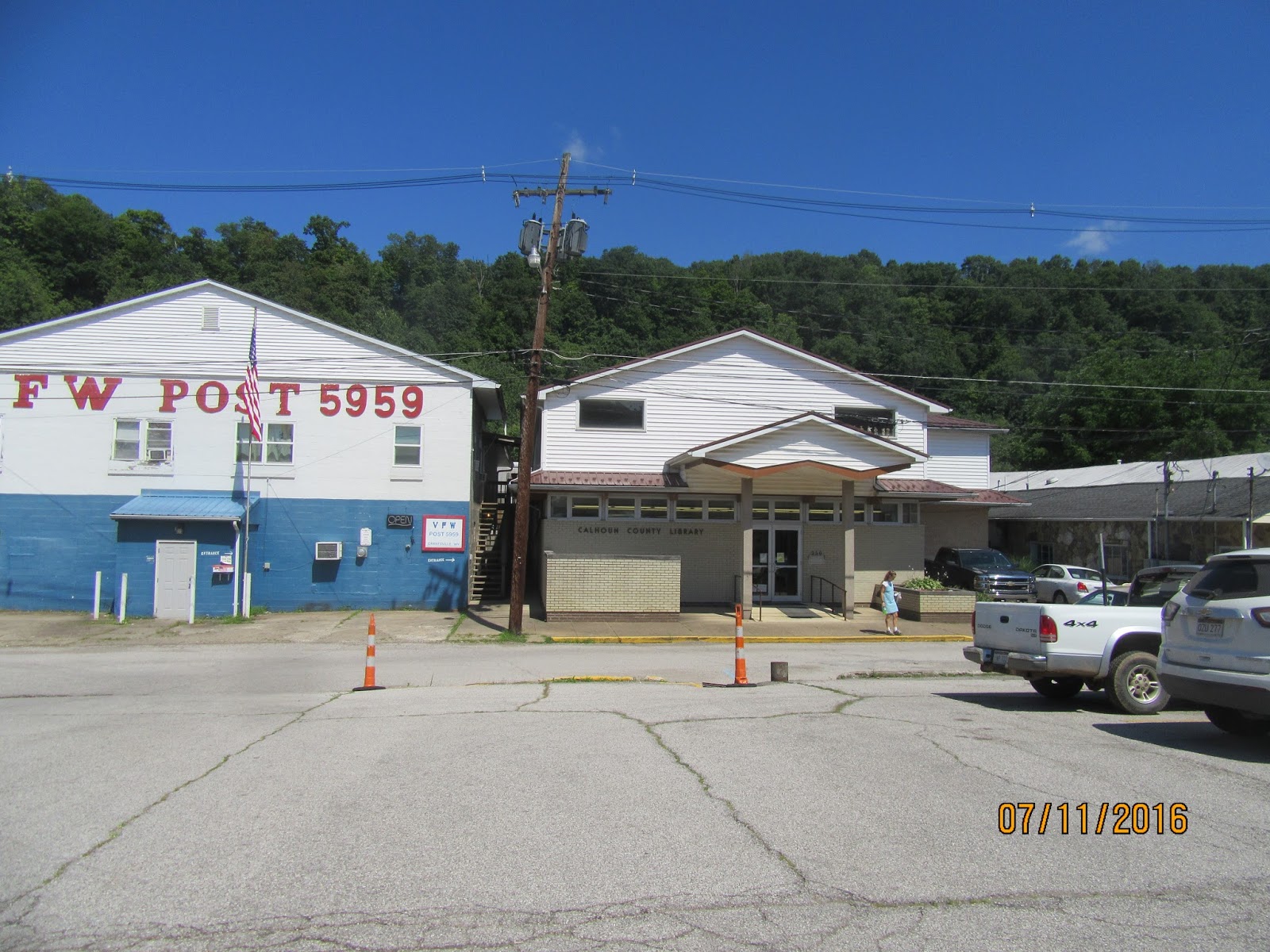
VFW Post and Library one block off Main St.

Calhoun County Courthouse, 1941

Funeral Home (left) and former bank building, across from the courthouse

Main St.,Grantsville

Historic Stump Hotel, Main St. To the left is the historical society museum, open Fridays

Sign on a fence a block of Main St.

Boat ramp on the Little Kanawha River

My lunch kit- not bad for $5.00

In the woods at Calhoun County Park

Alberts Chapel Methodist Church, 1903, rebuilt 2004


Thursday, June 30, 2016

The Election and What I'm Doing About It

This is one of those election years where no one really knows what will happen. The "Brexit" vote in England went against all predictions. Politicians there borrowed from Donald Trump's playbook here: bash immigrants, "The Elite" and prey on the legitimate fears of working class Caucasians that they are being left out of this so-called "recovery." They have a point, except that immigrants, gays, and women having abortions are clearly not the problem.

I have never voted for a Republican, and I don't plan to start now. In my campaign for West Virginia Delegate, I aligned myself with the Bernie Sanders people. This was not political calculation on my part (although Sanders won in every county in West Virginia). I am thrilled that a candidate came up who was willing to talk about economic inequality, breaking up the big banks, and being inclusive of everyone in our country. Although Sanders is not traditionally religious, he embraces core Jewish values, whether he knows it or not.

I don't believe Hillary Clinton is a crook or even a bad person. She would have been a great candidate in 2000 or 2004. She lost to a brash outsider in 2008, and I believe she deserves to lose now. Only the system is rigged in her favor. Sanders pointed out in an interview in Rolling Stone that despite winning in every county in West Virginia, six of our eight superdelegates are pledged to Clinton.

Things are worse than that in West Virginia. Our Democratic Senator, Joe Manchin, did not appear at the state's Democratic convention, except at a lunch he sponsored in honor of the Democratic Party's West Virginia chair, Belinda Biafore. There was an election for a new state chair, and Chris Regan, a hero to progressives in this state, was defeated for the position of state chair. Still, we passed a progressive platform from the floor of the convention. I'm sure the platform will be ignored. That's how things roll here.

There's hostility in this state  from Democrats toward their anointed leaders. Jim Justice, a coal mogul, Republican until last year, and the wealthiest person in West Virginia, has not taken positions on most issues. Our Attorney General candidate, Doug Reynolds, has an anti-gay, anti-choice and pro-gun voting record. Ugh. And Hillary Clinton's record of being the Senator from Wall Street has not helped her with working people here.

I've been fending off people on Facebook who post horrible anti-Clinton stuff. Not Republicans, because I have "unfollowed" them, but Democrats. At this point, I'm hoping for a convention miracle that will give Bernie the nomination, or at least that the platform will accept his ideas, for what that's worth. Still, if Clinton gets the nomination, I will support her.

On the Republican side, there is shock and outrage every time Trump opens his mouth. Republican stalwarts are abandoning ship for fear they will be tarred with his legacy and shamed forever. To me, the Republican Party has pandered to racists and gay-haters for decades. Trump only says what they've been thinking all along, only with his Outer Borough lack of manners and WASP "tastefulness." They deserve him.

This year, we will have to eat shit (to put it delicately) and vote for the Democrats. For the future, I would hope progressives and unionists will form a new, more open party, pro-union, pro-choice, pro-gay, pro-diversity, and pro-environment. We can start by electing local leaders who can reach everyone , uniting anti-corporate, pro-worker, inclusive people of good will to overturn the status quo in West Virginia and in the United States. We have our work cut out for us.