Wednesday, August 10, 2016

San Francisco - July 31- August 8, 2016

People were asking if we were planning a party for Joe's sixtieth birthday at the end of August. I didn't want to do that, so I suggested to Joe that we return to our adult roots (Joe from twenty-four; I from thirty-four) in California. He readily agreed and here we are. Joe lived in San Francisco from 1984-2004, and then in Los Angeles from 2005 to 2010. I lived in Los Angeles from 1984 to 2010.

We thought we would be adults and stay in motels instead of crashing with friends, until we looked at the cost. Joe's friend Nathan offered to put us up in his flat in Haight-Ashbury. He is remarkably generous. Joe arranged lunch and dinner dates with a dozen friends; I contacted my friend Art, whose parents and mine were friends in Baltimore before we were born. We traveled in Europe together in the summer of 1971.

What I noticed in San Francisco is what tourists always see: it's cold in August. Most of the clothes I brought were not warm enough to handle the low temperatures in the fifties at night. I've always loved San Francisco, and I saw again how beautiful it is, with its greenery, its architecture, the vistas from the parks and hillsides.

There were plans for San Francisco in the 1970s. No new freeways (indeed, two were torn down and not replaced after the 1989 earthquake), no big parking lots, preservation of most of the old  city. The vision was of a city where people would bicycle or take transit to work, where the old neighborhoods would be restored to their former glory.

This has worked, to a large extent. The problem here, as in other beautiful cities, is that the cost of housing has skyrocketed, pushing out those of meager means who helped transform the city. The rise of Silicon Valley, not far south, and full of highly-paid, highly-educated young people, has made San Francisco a go-to place to live.

We heard from friends in rent-controlled apartments that they fear their landlords will try to displace them. People we know complained about how "arrogant" the young are, how out of touch with local values. Those who own houses talk of cashing out and moving to Palm Springs, or other less expensive cities.

One of Joe's friends, who has done well selling real estate, said "Change is inevitable." And that's what I most agree with. The young people do ride bicycles or take transit to work They have fixed up, or caused to be fixed up, blighted neighborhoods.

There is an element of subverting the new San Francisco. We rented a car at the airport, and often during our stay had to park a mile from Nathan's home to find a legal space. With the lack of parking, people now take Uber and Lyft to work, so people don't park (nearly impossible and expensive if you can find it) but cars still crowd the streets. The city streets where the freeways used to be are jammed.

There are still people sleeping on the streets in Haight-Ashbury, and our friends took us to both expensive and cheap restaurants in town, or cooked for us. The Castro neighborhood is still the gayest place in the United States, although while there I noticed the older men on the street were still twenty years younger than I.

And that is what made me saddest. San Francisco was an epicenter of the AIDS crisis in the 80s and 90s. We are survivors of that epidemic. Some of Joe's friends are HIV positive, but coping well. Still, I felt the presence of ghosts all around me saying "Don't forget us." And I won't.

I posted pictures on Facebook of our visits with friends, and two people said they had never seen me look so happy. One friend in Morgantown answered "He's home." Spiritually, yes. I huffed and puffed more than I used to walking up the hills, and I didn't rent a bike or see Radiohead in Golden Gate Park, which I would have liked. Joe would not have liked either of those, and we stayed busy anyway.

I loved seeing Joe's friends (one of his best friends was in Europe, so we missed him). They are quirky in that old San Francisco way, very openly gay in their lives, and free to live how they want. It was only after I first met them that I thought I could stay with Joe. Still, I agree that the city has been "taken over" by young people. That happened in 1967 also, as I remember. And will probably continue to happen as long as there is a city.

We left Monday for Los Angeles, where we are now.
On a street above The Castro

Looking east to downtown from Buena Vista Park

At The Embarcadero, with the new San Francisco-Oakland Bay Bridge behind Joe

With my friends Art Siegel and Carol Gould at their home. The Oriental rug was in Art's parents home when we lived on the same street in Baltimore

With Joe's friend Randy, out to dinner. They met at Harvard

An apartment window in The Castro

A mural in Haight-Ashbury

Weller Street house in Haight-Ashbury

Joe and our host, Nathan, in his new kitchen

Anarchist Bookstore, Haight Street

Thursday, July 21, 2016

Open letter to John Raese

John Raese owns Greer Industries, a major industry in Morgantown. His companies also own the Dominion-Post, the only daily newspaper in town, and most of the local radio stations. He wrote a full-page letter in the newspaper to E. Gordon Gee, the president of West Virginia University, decrying the Morgantown City Council's failed attempt to block big trucks (typically working with Greer's gravel mining operations) from the city's streets. He also blames the council for banning (or trying to ban) fracking in the city limits. Apparently a WVU law professor helped with the lawsuits.

Here's my response to John Raese:

Dear Mr. Raese:

I read your letter in The Dominion-Post July 19. You raise some interesting points about Morgantown's City Council, the use of WVU employees as outside counsel, and the nature of freedom, capitalism and liberty.

No one is denying the contribution of your companies and your family to the economy and life of this city. Where I differ with you is the idea that capitalism is the only thing that matters, and that corporations have a final say in how things go.

People want their city to be clean and healthful. Yes, the truck ban was heavy-handed, and the courts ruled it illegal. Still, pollution levels from diesel trucks are too high along Beechurst Avenue and in the center city. The noise along Brockway Avenue from trucks makes it difficult to live there. Driving out Earl Core Rd. is harrowing in a car on a narrow road with giant trucks coming at you or behind you.

This is not the Morgantown of fifty years ago, or even ten years ago. We are now a bustling small metropolis, and people want to live in a clean and safe environment in their city. No one is attacking your liberty or the capitalist system. We, because I include myself, want to live in a more people-friendly environment. Perhaps we could come to a compromise. Trucks could be retrofitted to produce less toxic fumes. There are proposals to upgrade Greenbag Road as a bypass around the center city for trucks. I know weight limits are an issue, especially when carrying stone, but perhaps smaller trucks or less loaded trucks could be used that would be acceptable on the Interstates. Maybe new U.S. routes 19, 119 and State Road 7 routes could be built around the city, and the local streets could revert to the City of Morgantown.

As to fracking, in the Dominion-Post  on the same day your full-page letter appeared, there was an article on the front page from the Associated Press about a study in JAMA Internal Medicine, showing that people living near fracking sites were four times as likely as those living farther away to have asthma. Noise and light pollution are a problem with fracking sites, and water wells are at risk. Acceptable ways to dispose of waste from fracking are not in place. We in Morgantown have a right to worry about pollution and our health and that of our children. Our liberty and our freedom are at stake.

My point is that capitalism in our society does not have the final say. Of course it is important, the basis of our economy, but people everywhere generally, including in Morgantown, have a right to regulate capitalism, to make sure our physical environment and quality of life are not sacrificed so some can make money.


Barry Wendell
1319 Heritage Pl.
Morgantown, WV 26505-2426

Tuesday, July 12, 2016

Calhoun County, West Virginia

Today, Tuesday, July 12, will mark four years that Joe and I have lived in Morgantown. I set out to visit one county per month within three hundred miles of us, and last month I visited Cabell County, West Virginia, my forty-eighth county. This month's county is Calhoun, West Virginia. The county seat, Grantsville, is 115 miles southwest of Morgantown, far enough that I might stay overnight. Our budget being what it is, and with summer's late sunset, I thought I would go and come back. The county's population is only about 7,500 and Grantsville, the county seat and largest town, has fewer than 600 souls living there. I visited Monday, which looked to be the best weather of the week.

Calhoun is what people think of as the "real" West Virginia, off major roads, the smaller state roads following rivers and creeks with tiny villages along them backing up to the mountains. Most of West Virginia is more urban than this. Calhoun County is fifty-second of fifty-five counties in West Virginia in population.

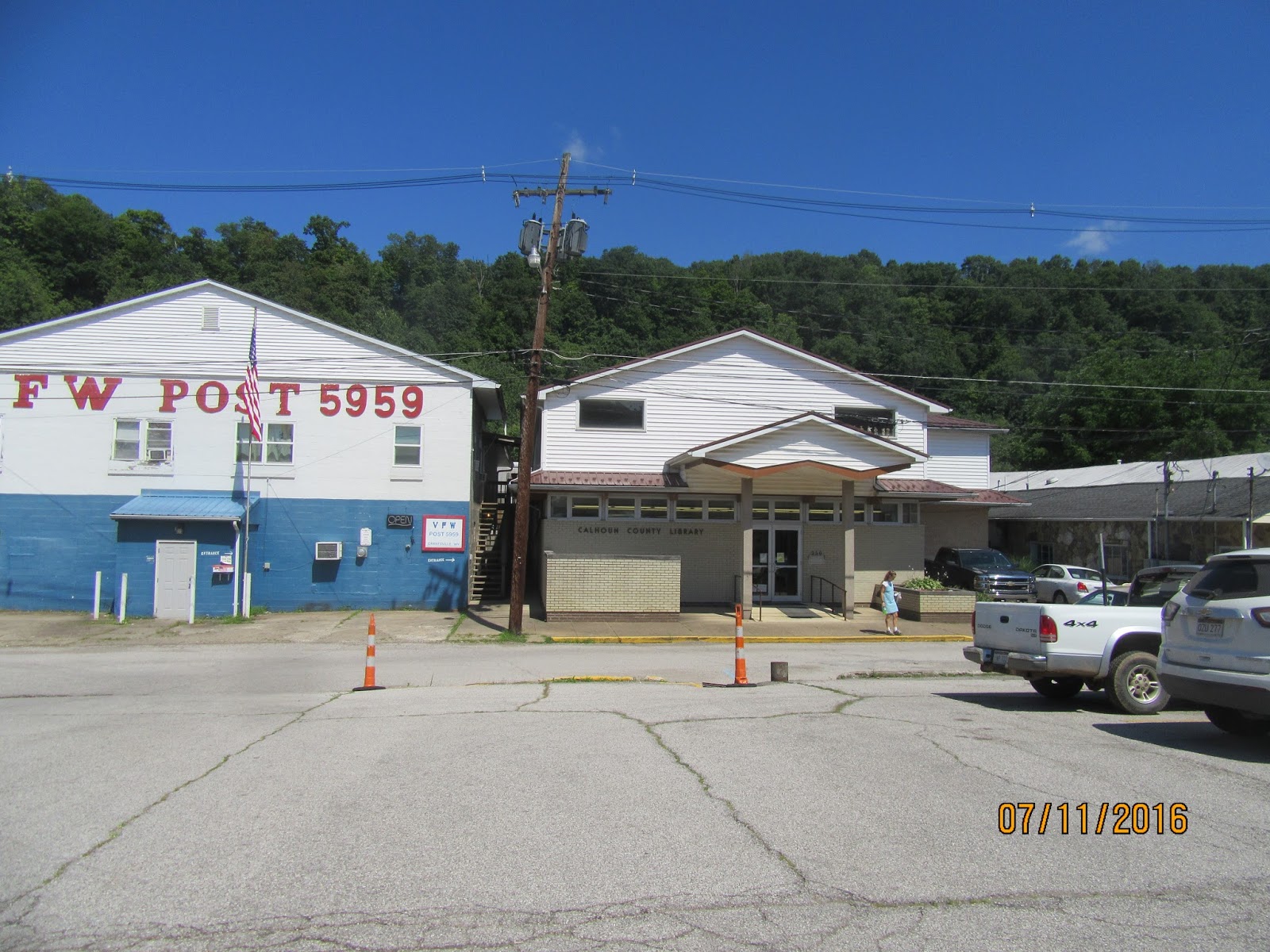
I left home at 9 A.M., and I was in Grantsville by 11:30. I like how obvious small towns are. There is the courthouse, the post office and the library, all within a block of each other, and a Main Street, with whatever stores there are. I started at the library, and asked the pleasant young woman what she would do with a day in Calhoun County? She seemed flummoxed by the question, but she suggested getting a sandwich at the market across the river (the Little Kanawha, as it turns out), then going to Calhoun County Park and sitting out in the nice weather on a picnic bench. There were two chain fast-food restaurants in town and a little local restaurant, where I would have eaten had the librarian recommended it. I walked two blocks up Main, and found a dollar store and a chain drug store. There was also a locally-owned drug store, and a chain auto parts place. While there is no historic district, there are a few historic homes. Named for U.S. Grant, the town didn't exist before the Civil War. I did notice thriving mimosa trees in peoples' yards, like my father planted on the front lawn of our house in Baltimore. These trees are native to Asia, and while there are a few in Morgantown, they are damaged or die back if the weather gets too cold here. There were also flowering bushes that I rarely see in Morgantown. My impression is that the winters are unlikely to be as cold as Morgantown's.

The people I saw were pretty much West Virginia stereotypes. I didn't see anyone who was not Caucasian. There were a lot of overweight people, tattoos, pick-up trucks. The used car lots featured Pontiacs and Saturns from the 1990s. I saw maybe five Confederate flags displayed throughout the county. People lived in old bungalows, mobile homes, and a few suburban-style comfortable-looking houses. There were abandoned buildings including an imposing stone former school building along the river, and vacant barns. This is not a wealthy area. The few people I spoke to were polite and kind.

I took the librarian's advice. On State Road 16, the main north-south road in the county, just over the bridge from Grantsville, is a Foodland Market, crowded, with a deli counter. They sell a brand of fried chicken, make sandwiches, and had some prepared lunches. The lady at the counter was concerned about my indecision and asked if I needed help. I picked up a complete lunch box and a peach, wanting something fresh, and headed for the park.

I took a side road before the market and found a boat ramp and fishing spot down the river. I snapped a pic of the river and headed back down 16 to the park. I parked off the gravel road by a shelter with benches where I ate lunch. It was getting warm and humid by then. Much of the park looks like reclaimed mine land, a hillside with grass and no trees, and a barren playground. Closer to the river there is a forest, and the pavilion I picked was on the edge of it. My lunch box had a turkey and cheese sandwich, a bag of barbecue chips, two cookies, and a bag of Capri Sun drink. I skipped the bread, but ate everything else. I took the clamshell packaging home with me, as there was no place to recycle. The trash cans had heavy covers on them to keep wildlife out. There is a trail in the woods, and I walked just far enough in to get a picture. The bathrooms were outhouse-style with no running water. Ick.

I headed south on Route 16, thinking I should have gotten gas in town. I saw a convenience store with gas pumps, but the store was closed. I passed through several villages, some with natural gas facilities, a few with small stores. Eventually, I reached US 119/US 33, a two-lane road that cuts through the middle of the county. I found the one National Register spot in the county, an octagonal church along 119/33, just north of 16 near Millstone.

I was worried about gas, but kept on, moving out of Calhoun County to Clay County. I finally found an Exxon station/convenience store at the I-79 intersection. The gas was more expensive than most places, and I couldn't get the pump to work. It kept asking me for my rewards card, which I don't have. The woman in the store (Smiley's) came out to help. She called me "Honey." I was in a foul mood. I have boycotted Exxon since the oil spill in Alaska. And I was in Clay County, where a clerk called two women applying for a marriage license "an abomination" and got away with it, and the school superintendent said he would not follow the Obama administration's guidelines about letting trans kids use the bathroom they wanted. The woman only saw that I was distressed and probably correctly figured I was overtired and maybe dehydrated; I'm sure she didn't know the rest of it.

Gassed up, I took the Interstate home, 120 miles, arriving just after four, in time to sleep an hour and a half before dinner.


Update Wednesday- I've been corrected. The clerk who harassed the two women getting  a marriage license was in Gilmer County, not Clay County. Gilmer is just east of Calhoun County; Clay is south. Thanks you, Brian Powell.

Grantsville Post Office, Main St.

VFW Post and Library one block off Main St.

Calhoun County Courthouse, 1941

Funeral Home (left) and former bank building, across from the courthouse

Main St.,Grantsville

Historic Stump Hotel, Main St. To the left is the historical society museum, open Fridays

Sign on a fence a block of Main St.

Boat ramp on the Little Kanawha River

My lunch kit- not bad for $5.00

In the woods at Calhoun County Park

Alberts Chapel Methodist Church, 1903, rebuilt 2004


Thursday, June 30, 2016

The Election and What I'm Doing About It

This is one of those election years where no one really knows what will happen. The "Brexit" vote in England went against all predictions. Politicians there borrowed from Donald Trump's playbook here: bash immigrants, "The Elite" and prey on the legitimate fears of working class Caucasians that they are being left out of this so-called "recovery." They have a point, except that immigrants, gays, and women having abortions are clearly not the problem.

I have never voted for a Republican, and I don't plan to start now. In my campaign for West Virginia Delegate, I aligned myself with the Bernie Sanders people. This was not political calculation on my part (although Sanders won in every county in West Virginia). I am thrilled that a candidate came up who was willing to talk about economic inequality, breaking up the big banks, and being inclusive of everyone in our country. Although Sanders is not traditionally religious, he embraces core Jewish values, whether he knows it or not.

I don't believe Hillary Clinton is a crook or even a bad person. She would have been a great candidate in 2000 or 2004. She lost to a brash outsider in 2008, and I believe she deserves to lose now. Only the system is rigged in her favor. Sanders pointed out in an interview in Rolling Stone that despite winning in every county in West Virginia, six of our eight superdelegates are pledged to Clinton.

Things are worse than that in West Virginia. Our Democratic Senator, Joe Manchin, did not appear at the state's Democratic convention, except at a lunch he sponsored in honor of the Democratic Party's West Virginia chair, Belinda Biafore. There was an election for a new state chair, and Chris Regan, a hero to progressives in this state, was defeated for the position of state chair. Still, we passed a progressive platform from the floor of the convention. I'm sure the platform will be ignored. That's how things roll here.

There's hostility in this state  from Democrats toward their anointed leaders. Jim Justice, a coal mogul, Republican until last year, and the wealthiest person in West Virginia, has not taken positions on most issues. Our Attorney General candidate, Doug Reynolds, has an anti-gay, anti-choice and pro-gun voting record. Ugh. And Hillary Clinton's record of being the Senator from Wall Street has not helped her with working people here.

I've been fending off people on Facebook who post horrible anti-Clinton stuff. Not Republicans, because I have "unfollowed" them, but Democrats. At this point, I'm hoping for a convention miracle that will give Bernie the nomination, or at least that the platform will accept his ideas, for what that's worth. Still, if Clinton gets the nomination, I will support her.

On the Republican side, there is shock and outrage every time Trump opens his mouth. Republican stalwarts are abandoning ship for fear they will be tarred with his legacy and shamed forever. To me, the Republican Party has pandered to racists and gay-haters for decades. Trump only says what they've been thinking all along, only with his Outer Borough lack of manners and WASP "tastefulness." They deserve him.

This year, we will have to eat shit (to put it delicately) and vote for the Democrats. For the future, I would hope progressives and unionists will form a new, more open party, pro-union, pro-choice, pro-gay, pro-diversity, and pro-environment. We can start by electing local leaders who can reach everyone , uniting anti-corporate, pro-worker, inclusive people of good will to overturn the status quo in West Virginia and in the United States. We have our work cut out for us.

Monday, June 27, 2016

Cabell County, West Virginia

On the way between Butler County, Ohio and the Democratic convention in Charleston, I stopped for two nights June 8 and 9, in Huntington, the county seat and largest city in Cabell County. This was my forty-eighth county visit, marking the end of four years that I have lived in Morgantown. The 2010 census shows Cabell County is the third largest in West Virginia by population, after Kanawha (Charleston) and Berkeley (Martinsburg). Since 2010, it appears my home county of Monongalia has surpassed Cabell for the number three spot. Huntington is still the second largest city in the state.

My first county in this fourth year was Boyd County, Kentucky, containing Ashland, the other major city in the Huntington-Ashland metropolitan area. I was a month behind, and visited Ashland in August, 2015. Both cities have parks on the Ohio River, across from...Ohio. Ashland looks more prosperous, and seemed more southern somehow, more casual and relaxed.

I liked Huntington. I stayed on US 60, the old road from Norfolk to Los Angeles, just east of town on the way to Barboursville, the suburb with the mall and all the stores. There were thirty-seven places on The National Register in Cabell County, and I figured, foolishly as it turns out, that I could visit all of them in a day and a half, it being only 150 miles from Butler County to Cabell, a half-day drive. I arranged the places from what I thought was west to east, but was in fact east to west. Once I realized what I had done, I decided to run with it.

I arrived after one, following online instructions that took me on pretty little back roads through southeastern Ohio. I'm sure something was wrong, because I spent lots of time on US 60, when I should have been on parallel I-64. I had a quick lunch, then headed out to the east end of the county, to the town of Milton. Near there is Morris Memorial Hospital, now vacant. It was built in 1936 by Works Progress Administration as a hospital for children with polio. It closed in 1960, was used as a nursing home after that, and has been vacant since 2009.

Also near Milton is Pumpkin Park, home of West Virginia's Pumpkin Festival, and the Mud River Covered Bridge. from 1875 relocated to the park in 2001. Blenko Glass, an historic maker of art glass, is near the park

 This is the two-block center of Milton:

I headed west to Barboursville, the big suburb of Huntington. It's the home of Huntington Mall. I took a break to check out the Mall. There is a Macy's and a BAM (Books-A-Million) where I bought the bound copy of the first six issues of the new, updated "Archie" comics. Yes, I 'm a fan. I headed back to the motel, checked in and fell asleep. Joe and I stayed at this motel at the end of our second day of driving back from his cousin's bar mitzvah in Memphis in September 2014.

I wanted something reasonably healthy for dinner. I remembered that there was a House of Pancakes outside the mall in Barboursville. I headed there. I had fish on spinach with a so-called Alfredo  sauce. It wasn't great. All along Route 60, there were fast-food restaurants, but nothing healthier than Subway. I thought this would be a step up. The menu said "Ask our servers about our selection of teas." I did. They only had one kind of tea. I felt like the people there were looking at me. After my trip to Butler County, being out in the southern sun, I was darker than usual, the darkest one in the restaurant. And I was alone. In a designer t-shirt. The manager came over and greeted everyone in the restaurant except me. Some think I make this stuff up, but ask anyone who is not entirely white, is gender ambiguous, or looks somehow different, and they will tell you I'm not.

I headed into Barboursville proper, where there is a historic district, and the Victorian Thornburg House.

Before dark, I was able to get into the east end of Huntington. There is a bridge in Rotary Park, a wooded hillside above the east end.

There was a separate town of Guyandotte, Virginia, before the Civil War, predating modern Huntington, but now in the city. It was hard to find, because much of it is walled off from the Ohio and Guyandotte Rivers. Interstate 64 also walls off part of the area. I've learned that there was  a flood on the Ohio and its tributaries in 1913, up to the second story in Augusta, Kentucky and Middletown and Ripley, Ohio. I imagine that is why there are walls along the rivers in Huntington. Before heading back to the motel, I found two historic houses in Guyandotte. The top pic is the Thomas Carroll House, built originally in 1810 with later additions, and now a public park; the other is the home of Zachary Taylor Wellington, built in 1847, and extensively remodeled in 1870. Wellington was a popular politician. Union soldiers were recruited in Guyandotte in 1861, and they were attacked that year by Confederates. Union soldiers came back and burned much of the town, because its people were apparently sympathizers with the Southern cause. There was a plaque at the Carroll House, but not remembering the details, I found information on e-WV, the West Virginia online encyclopedia.


I started the next morning thinking I might still hit all the places on the National Register. I headed back east to Barboursville, then north to River Rd., West Virginia Route 2, which follows the length of the Ohio River.  Near the town of Lesage along the river is a former tobacco plantation, run by slaves before the Civil War. The owner, Albert Gallatin Jenkins, became a Confederate general. There is a Native American archaeological site nearby, which is not accessible to the public. The house is abandoned.

I headed back into Huntington, mostly in the flats along the Ohio River, with north-south numbered streets and east-west avenues, also numbered. It should have been easy, but somehow I got confused and wandered around a bit. Like Oakland or Hollywood in California, the wealthy live up in the hills out of the grid. I found quite a few places, but not all.

Former Liggett-Myers Tobacco Warehouse, 9 27th St.

Ricketts House, Washington Blvd, in the hills

Simms School Building, 1080 11th Av.

"Old Main" Marshall University Campus


Marshall University, founded in 1837, is a state university, and has a central spot in Huntington, much as West Virginia University is at the center of Morgantown.

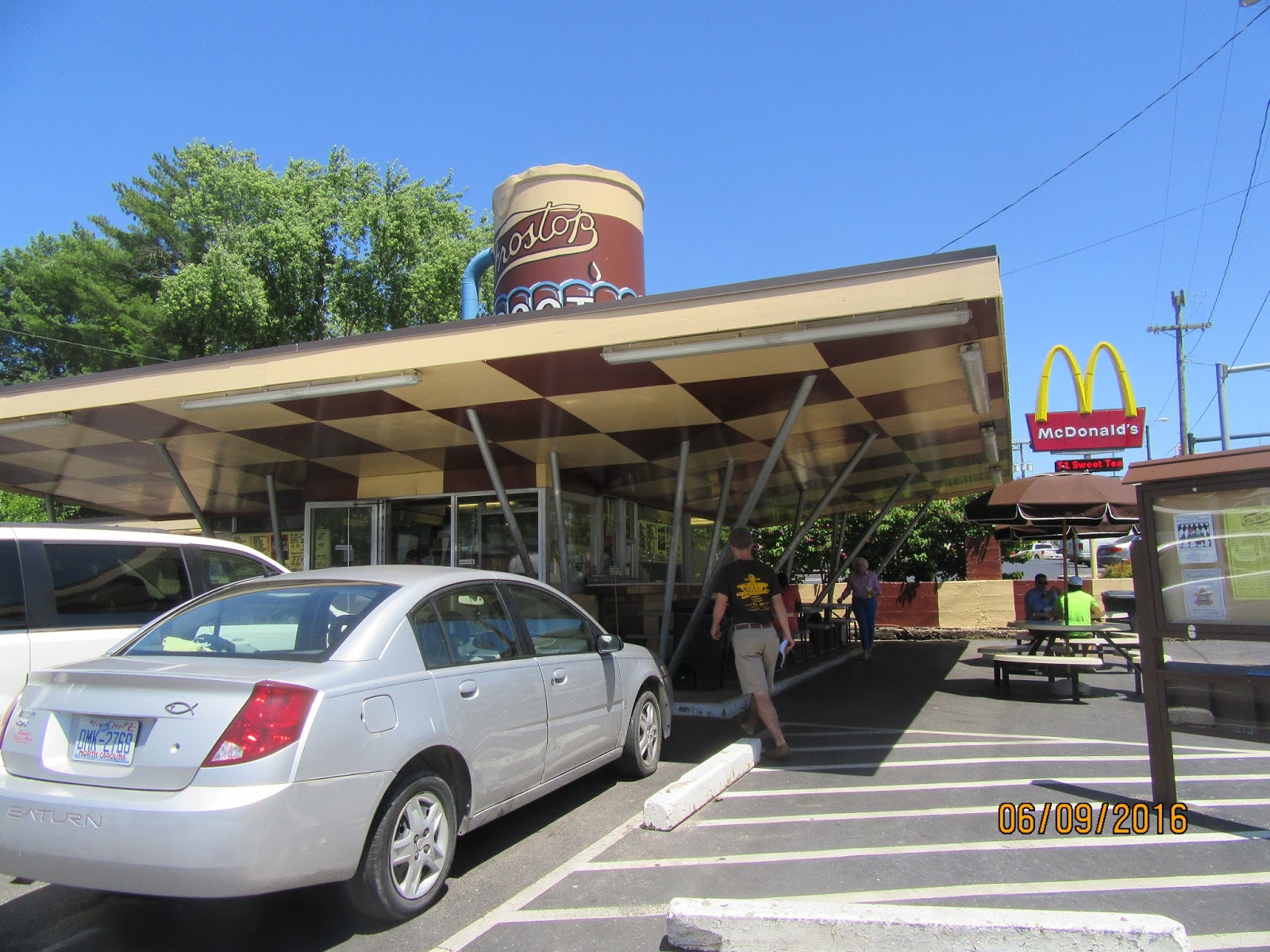
I found Frostop, a 1959 drive-in, complete with wait staff that comes to your car, in central Huntington, and stopped for an inexpensive lunch.
Here are more historic places I found in Huntington:

Ohev Shalom, 1928, now called B'nai Sholom after a merger with B'nai Israel, an Orthodox congregation.B'nai Shalom is Reform and Conservative, 10th Av. and 10th St.


Douglass Jr. and Sr. High, 10th Avenue, the "separate but equal" school for African-Americans, 1924, now a community center.

Freeman Estate, aka Park Hill Farm, McCoy Rd., in the hills, 1914

Cabell County Courthouse, 1899, Fifth Av., between Seventh and Eighth Sts.

Renaissance, part of the Downtown Huntington Historic District, now apartments

Keith-AlbeeTheater and Office Building, Downtown Hntington

River Tower, now a Masonic Temple, just east of downtown, Third Av. and Eleventh St., 1922 and 1926

Harvey House, 1874, Third Av. and Thirteenth St., forlorn between fast food places and auto parts stores


Elk River Coal and Lumber Company Steam Locomotive #10, 1924, now part of a museum, Eleventh St.
I stopped briefly to check messages. A friend said I should relax a bit and try to be less compulsive.

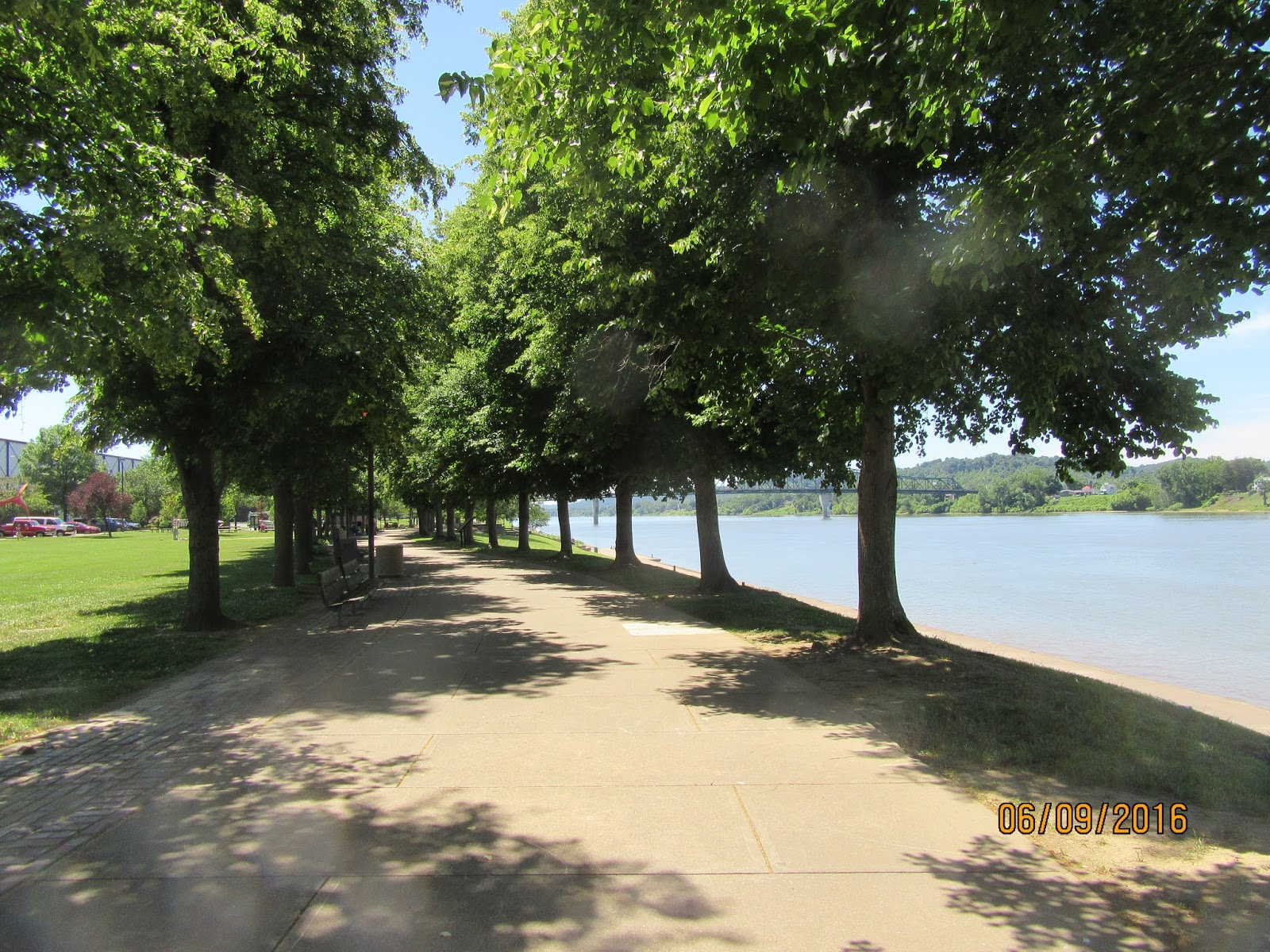
The locomotive was near the Ohio River, so I found an entrance to the park, and walked through. Here are some shots along the river.


I met someone on a bike and asked where the next entrance back into the city was along the wall. He didn't think there was one. We talked a little. I recognized a Great Lakes accent, and he said that he was from Michigan, but went to school in Chicago. He is a librarian, and was in Lawrence, Kansas where his wife was working on an advanced degree. They came to Huntington, because she got a job at Marshall University. They live near B'nai Sholom on 10th Av.

There are beautiful old homes near there, but like much of the city, that neighborhood fell on hard times. There are some hipster young people moving back in. It's convenient to the city center, which has had something of a rebirth.
Pullman Center, along the riverfront near the center of Huntington, has new shops and movies
.
After my nap, I went for dinner to Sheetz. Not very adventurous, I know. I capped the evening with soft ice cream from Frostop.

Huntington looks like a "real city" with 1940-era public housing projects like Baltimore's, only integrated. People in the city seemed friendlier than out in the suburbs, and I saw many cars with "Bernie" bumper stickers. The streets and avenues are tree-lined with mostly early twentieth century homes. Unfortunately, many of them were vacant, as the population has declined in recent years, and some seemed to be burned out. Still, there is a major university at Marshall, a revival of sorts in the center of the city, and a pretty and historic downtown. There is an art museum up in the hills.

Due to my stubborn way of doing things, I didn't go west of downtown. I know there was a lot to see there, but this is what I was able to cover. The west end of Huntington is in Wayne County, so maybe I'll explore more on another trip.


Tuesday, June 21, 2016

Unity, Part 2


I got into town from the Democratic convention in Charleston just about 6:30 P.M. Saturday, and met Joe at a restaurant downtown. Services at Tree of Life for Shavuot, Jewish Pentecost, were called for 7:30. Not many people showed up, and Joe was home by 10:30. The plan was to have study sessions and blintzes (traditional, but I don't know why) until midnight. I was exhausted and left early.

We awoke Sunday to the horrible news about Pulse in Orlando. There was a meeting in the afternoon of an interfaith group started to counteract gun violence. It then moved into combating Islamophobia and supporting Syrian refugees.  I don't always go, but I wanted to discuss what had happened in Orlando. I thought the group would draft a statement. The group from the local Islamic Center didn't show up, and not many people came. We all expressed support for the LGBT community, agreed not to condemn Islam generally for this crime, and said we would work for gun control. Eve Faulkes had designed headscarves for women and t-shirts for men with a message of peace, inclusion, and a plea to accept refugees. Joe bought t-shirts and Eve photographed us with a statement on cardboard from Rabbi Michael Lerner.

Facebook was awash with chatter about Orlando. There was a push from WVU people to have something, a ceremony of some kind. It was scheduled for Thursday night. Because so many people on Facebook were angry that there was silence from clergy (not entirely true), I checked with Joe, and he was willing to speak at the event. He is  probably the only openly gay clergy in the area. Word came back that they wouldn't need him. The event was well-attended, despite horrible storms just a few hours earlier, with some roads blocked by fallen trees. The speakers they had: a Vice President at WVU in charge of the Division of Diversity and Inclusion, the mayor of Morgantown, a Muslim student involved in student government, and a self-identified transgender Latina woman, an honors student in the Women's and Gender Studies Department.They all spoke well. The weather cleared and we were able to go outside to light candles at the end. I knew many of the people there. I know Morgantown has a large population of involved and caring people. It was for them that I ran for office.

Meanwhile, the local newspaper had run an anti-Muslim column from columnist Cal Thomas on Tuesday. The Islamic Association of West Virginia put out a strongly pro-gay statement, which I saw on Facebook. I called the paper and asked if they would run that and they said they would not without a local angle. So I wrote a letter critical of Thomas and excerpted the Islamic Association's post. Meanwhile friends of friends on Facebook whined about their "Second Amendment rights"; others went on about "Islamic extremism." A minister in California said it was too bad more pedophiles weren't killed, and a Republican from Texas said it wasn't really a gay bar. We have a lot of work to do.

A week after the tragedy, Morgantown was scheduled to have its first Gay Pride celebration, at 123 Pleasant, a hipster locale downtown. This being not West Hollywood, it was indoors in the evening, with a panel discussion called "Activism, Advocacy and Our Rights" organized by a friend from the LGBT Equity Commission at WVU. She asked me to be on the panel, and I agreed. I didn't have much to say, but I felt bad for one panelist, a gay male high school student who said he rarely goes to school because he is harassed. Apparently no one, including his parents, will stand up for him. This made me feel powerless. There was a poetry reading and some acoustic music. A band was coming in later. Joe was with me, and we left about ten.. That's as late as we stay out. I knew some of the people there, some gay and some straight allies, and I met a group of transgender women and heard their stories. That is a hard life.

Despite all of the negativity in this country, there is a core of people who care about where we are heading. They grieve with us for LGBT lives lost, and for Latino men and women out for a night of fun, who were gunned down or held hostage. They know blaming Islam is not a solution, that Republicans have never been in any way concerned about the LGBT community, even as they now try to paint Islam as the enemy of gay people. Banning assault weapons would be a useful start. I'm glad for all of that, yet we really need to look at why there are so many deeply disturbed men (almost always men) who fetishize weapons, have a deep-seated hatred of Barak Obama and Hillary Clinton, applaud deaths of gay people even as they ask us to condemn Islam.

Our Shavuot holiday was a bust, and I am just coming out of a week of depression over the events that weekend. I'm feeling more hopeful now. Maybe we can make a coalition of people of all races and faiths to see the United States as a unified country, one where we all care for each other and respect diversity in unity.

Here is what I wrote to the paper. They edited it; this is the original:

It's hard to tell when I'm not dealing well with the world, but there are tell-tale signs. Like when I don't want to go out of the house, or I spend time on Facebook arguing with people I don't know when I should be doing something else, or if someone asks how I am and I don't want to answer.

That's how it's been this week, and I know it is about the shooting in Orlando. I feel close to those people. I am no longer them; I would never be at a bar at two A.M., but there was a time when I would. I think of younger gays and lesbians as my children. Many of them have parents who support and nurture them. Even today, though, parents inflict pain and grief on their LGBT children. I'll take them in as mine. I feel like it was my children mowed down by a killer in Orlando.

Young people I know locally, college and just post-college, are mostly what we now call "allies," not gay, but supportive. Many of them still have friends in the little towns where they are from, and some of those friends have posted about their "Second Amendment Rights" on social media even before expressing sympathy to the gay community and our friends, who are in mourning. I tried to tell them to respond to our grief now, and talk about guns later. They mostly don't get it.

In your paper Tuesday, June 14, Cal Thomas expresses no sympathy for gay and lesbian people, for the general population of Orlando, or for the Latino population, mostly Puerto Rican in that bar from what I have read. He never has expressed any sympathy for LGBT people nor, for that matter, for people of color. Instead, he launches into yet another attack on President Obama for calling for control of assault weapons, and he says "No more mosques should be built in the U.S. until we gain an upper hand against radical Islamists." I'm sure Thomas thinks he is a great patriot, but that is clearly unconstitutional and hateful. He has the right to say it, but the Dominion-Post has the right not to print something that demonizes a whole religious group.

I got comfort from this, from the Islamic Association of West Virginia:

"We will continue to spread our belief in the tolerance, kindness and peace we have found within Islam, and we will stand with and support the LGBTQ community during this difficult time.We will prove that love conquers hate."

I would love to see that sort of statement, perhaps from other religious groups, on your pages more frequently. 


And here is the full statement from the Islamic Association of West Virginia.

Statement on the Mass Shooting in Orlando

Early this morning, as we woke to eat the suhoor meal before the beginning of our Ramadan fast, we received news of a horrifying shooting at Pulse, a gay bar and nightclub in Orlando, Florida, that has claimed the lives of fifty people, and seriously injured fifty more. It is the deadliest mass shooting in American history. Based on the information presently available, the perpetrator was twenty-nine year old Omar Mir Seddique Mateen, who was very likely motivated by Islamic extremism.
The Islamic Association of West Virginia strongly and unequivocally condemns this attack. We denounce acts of extreme cruelty and violence without reservation, and we offer our sincere condolences and heartfelt sympathy to the victims and their loved ones. We pray for the recovery of those injured, for the comfort of grieving friends and families, and for the healing and safety of LGBTQ communities the world over.
While the perpetrator claimed to be Muslim, he did not practice any form of Islam that we know. Our Islam vehemently forbids these heinous crimes, and the killing of innocents violates countless sacred laws and traditions of our religion. Furthermore, as Americans, we strongly believe that LGBTQ rights are an integral part of American civil rights and, more broadly, basic human rights. People of all gender identities and sexual orientations are entitled to dignity and respect, and we fully support their right to live, work and celebrate openly and without fear.
We will continue to spread our belief in the tolerance, kindness and peace we have found within Islam, and we will stand with and support the LGBTQ community during this difficult time. We will prove that love conquers hate.

Dr. Fryson, of WVU, speaking at the memorial event June 16

Candle lighting and traditional bell ringing outdoors at WVu's event, June 16

The panel discussion at 123 Pleasant, June 19
 

Thursday, June 16, 2016

Unity, Part 1

Last Friday and Saturday I attended the West Virginia Democratic Convention in Charleston. I arrived Friday morning from Huntington, about fifty miles west of Charleston. The theme of the convention was "Unity." I imagine this meant we were all to come together to anoint Hillary Clinton as the Democratic Presidential candidate in 2016. That didn't happen.

I hate to be a "Tuve,"Spanish for "I had." We used to speak, unsympathetically, in the Social Security office in Miami where I worked for many years, about people from Cuba who would start all their sentences with "Tuve" and tell us what they left behind in Cuba.

I attended the California State Convention in 2011 in Sacramento and 2012 in San Diego. There were scheduled lunches and dinners and guest speakers including Bernie Sanders in Sacramento, and Al Franken in San Diego, as well as the superstars of California politics, Jerry Brown, Gavin Newsom and Kamala Harris. Dianne Feinstein and Barbara Boxer put in appearances; Feinstein spoke at a dinner, open to the conventioneers, for an extra charge. The San Diego convention was at the Hilton. Many of us chose to stay elsewhere to save money, but the facilities were immaculate.

"Tuve" a much better time in California. Our convention here was at the dingy Charleston Convention Center, where there is construction going on and the thermostat was set at 50. There was a snack bar open Friday with $3.00 pretzels, small bottles of water and antique pizza. I never saw our Governor, and our one Democratic senator had a private lunch for the State Executive Committee honoring the chairperson, who, not coincidentally, was running for reelection. More on that later. I stayed just out of town in a place called "Mink Shoals" at a motel from the chain where I get points. There was only a three dollar per day charge to park in the Convention Center garage.

Thankfully, there were less jaded young people there, including a large contingent of Bernie Sanders supporters from Morgantown. Bernie beat Hillary by fifteen points in West Virginia, and won in each of our state's fifty-five counties. In the Rolling Stone issue marked June 16, Bernie Sanders was interviewed just after the West Virginia primary. He wondered why six of the eight superdelegates from West Virginia were pledged to Hillary. Good question.

Everything ran late at the convention. The real convention was to start at five Friday, but registration started at three. I arrived at 10 from Huntington, and met Selena Vickers, the technical wonk for the Bernie campaign, sitting next to a cardboard cutout of Bernie Sanders. I spoke with her briefly about possibly adding an amendment to overturn the decision to allow concealed carry of weapons without a permit. I looked up a similar law in California, which made me realize that it probably wouldn't get passed, this being West Virginia.

I found where the Reform synagogue is in Charleston. I called and got no answer, so I went there. It's a brick-and-glass modern building in a neighborhood of grand houses facing the Kanawha River. Probably the best neighborhood in town sixty years ago. The back door by the parking was open, so I walked in and met the secretary. He was unhappy that I was able to walk in and said he was not authorized to give me a tour without an appointment. I was okay with all that. I just explained who I was and why I was in town.

Back at the convention, I ran into Jamie Blake, a youngish (out of college) guy, one of the Morgantown Bernie organizers, and we went out for lunch at the mall for wraps in the food court. At least Charleston has a mall downtown.

We hung around until three, when we could register for the convention. There were committee meetings until five, when the convention started.No lunches or dinners were planned for the conference. I drove to my motel, checked in, and slept for an hour.

The convention started well after five. The rules committee had met before, and rules had been changed to make it easier to amend the platform and allow more time for debate. There were speeches from Doug Reynolds, the Democratic candidate for Attorney General, from Belinda Biafore, the state chair, and from Natalie Tennant, our secretary of state, whis running again. She lost two years ago for Senate, because she didn't take a stand on any issues. Reynolds is probably an improvement over Patrick Morissey, our paid-for-by-corporate-lobbyist Republican attorney general. Still, Reynolds voted for the Religious Freedom Restoration Act (also known as the Freedom To Discriminate bill) and introduced a bill that would mandate that colleges allow guns on campus. I confronted some Reynolds kids who had a table for him. They sputtered something about "just doing what his constituents wanted." Not good enough. I may have to vote for him, but I will never campaign for him.

I don't remember anything much else about Friday night- except that I hadn't had dinner. I bought a stale $3.00 pretzel in the lobby and went to my car and brought in some bottles of water, so no one should have to pay $3.00. Many people still don't drink the water in Charleston, after the chemical poisoning more than two years ago. Things broke up at 9:30. The kids asked me if I wanted to go out drinking with them, forgetting that I am sixty-six, not twenty-six. I stopped at a convenience store and bought snacks, which I brought back to my hotel and ate while looking at Friday's Charleston newspaper. I was asleep by eleven.

I had breakfast at the hotel, and got back to the Convention Center by nine. There were plenty of plots a-hatching. Many people had petitions out, about banning guns, legalizing marijuana, requiring superdelegates to vote for the winning candidate from the primary. I signed all of them, except the two that were meant to embarrass Hillary Clinton. It was too late for that. I noted that the vast majority of delegates were white, Christian and straight. In California, most of the Democrats were Mexican-American, African-American and Asian-American, Native, or Jewish. And a whole lot of them were gay. In talking to people, I found that there were more Jews than I originally thought, living in rural counties after escaping New York and their Jewish heritage. Someone pointed out that there were many more gay people than I imagined. Maybe so.

Jim Justice, the Democratic nominee for Governor, spoke once things got started. He was a Republican until last year, is a coal mine owner and the wealthiest man in West Virginia. He owns the Greenbrier resort in southeastern West Virginia, and avoided debates and policy statements during his primary campaign against two other contenders. He is notorious for not paying bills on time. Progressives in the state find him appalling. Our Bernie people, led by Morgantown's Shane Assadzandi, a young dynamo, planned a walkout during Justice's speech. I stayed in for the first ten minutes, while Justice talked on in an almost unintelligible rural West Virginia drawl about his foot surgery, how much money the Greenbriar brings into the state, and how he bought  a shovel and pail, which he had with him, from a woman by the side of the road, who was trying to raise money to buy food. I couldn't take any more and left. His speech seemed to go on quite a long time. He never mentioned any ideas for how to run the state, as far as I know.

John Perdue, the state treasurer spoke as well. My hearing is not great and the sound system wasn't clear either but it seems the Republican legislature was right to require English for state business. His drawl was so thick, I could understand almost nothing, and he went on for probably a half hour.

The superstar of the convention, our Kamala Harris, if you will, was Mary Ann Claytor, an African-American woman who came from nowhere to win the Democratic nomination for Auditor. I didn't vote for her, because another candidate had endorsements from people I liked, and because Claytor's website said she had a degree in religion from Jerry Falwell's Liberty University. That set off warning bells for me. She spoke with the cadences of Martin Luther King, Jr., preaching to us about her experience in the auditor's office, of her background, and how important it is to include everyone in the state. She was the first to mention the LGBT community, and how we needed to be included. She had the passion and fire that everyone else who had spoken lacked. People rose to their feet and cheered. And I understood every word she said.
When we finally got to amendments from the floor, it was noon, and there was no lunch break. Shane and his crew and a few others introduced bills to ban assault weapons, to ban fracking and mountaintop removal mining, to stop fighting the EPA on air and water quality regulations, have a gay rights bill. All of these passed on a voice vote. And why? Because the mostly older Hillary Clinton fans  joined together with the mostly younger Bernie Sanders fans to make West Virginia a more progressive place. The anti-Clinton petitions were never presented, and this helped us find the "Unity" we were looking for.

Until now, the Democratic Party in West Virginia's only claim to liberalism has been its support of unions. The people in charge of the party not only don't like Bernie Sanders,they don't think much of Hillary Clinton either. This convention brought together the Hillary and Bernie people in a new way.

Meanwhile, a graduating WVU student named Franklin, whip-smart and handsome, asked me for a ride home. I wanted to be back and eat before Tree of Life's Shavuot service at 7:30. In West Virginia, Jewish holidays are never figured into anyone's schedule. Franklin and I left at two and went to the mall for lunch, as nothing had been provided. I was freezing in that barn of a room, and about to go off on someone for lack of food. We got back to the car at three, and were about to drive away, when Danielle, the brilliant and most glamorous of the Bernie people in Morgantown, called my phone and begged us to come back. Franklin and I discussed it briefly and went back. Someone called for a quorum, and there was none. The seventy people on the central committee were gone to Senator Manchin's luncheon before a vote on the next chair. People came back who had drifted off for food, and the central committee said we could count them even if they weren't there.We finally passed the whole platform with all the progressive amendments intact. At four, we headed back to Morgantown.

Chris Regan, the vice chair of the central committee, a Bernie supporter, a smart guy and a great writer, who is appalled by most of what goes on in this state, and writes a blog about it (homeyesterday.com) was later defeated for chair of the central committee by incumbent Belinda Biafore, who presided over the loss of the Legislature to the Republicans, because the Democrats refused to stand for anything. Don't get me started.