Monday, June 27, 2016

Cabell County, West Virginia

On the way between Butler County, Ohio and the Democratic convention in Charleston, I stopped for two nights June 8 and 9, in Huntington, the county seat and largest city in Cabell County. This was my forty-eighth county visit, marking the end of four years that I have lived in Morgantown. The 2010 census shows Cabell County is the third largest in West Virginia by population, after Kanawha (Charleston) and Berkeley (Martinsburg). Since 2010, it appears my home county of Monongalia has surpassed Cabell for the number three spot. Huntington is still the second largest city in the state.

My first county in this fourth year was Boyd County, Kentucky, containing Ashland, the other major city in the Huntington-Ashland metropolitan area. I was a month behind, and visited Ashland in August, 2015. Both cities have parks on the Ohio River, across from...Ohio. Ashland looks more prosperous, and seemed more southern somehow, more casual and relaxed.

I liked Huntington. I stayed on US 60, the old road from Norfolk to Los Angeles, just east of town on the way to Barboursville, the suburb with the mall and all the stores. There were thirty-seven places on The National Register in Cabell County, and I figured, foolishly as it turns out, that I could visit all of them in a day and a half, it being only 150 miles from Butler County to Cabell, a half-day drive. I arranged the places from what I thought was west to east, but was in fact east to west. Once I realized what I had done, I decided to run with it.

I arrived after one, following online instructions that took me on pretty little back roads through southeastern Ohio. I'm sure something was wrong, because I spent lots of time on US 60, when I should have been on parallel I-64. I had a quick lunch, then headed out to the east end of the county, to the town of Milton. Near there is Morris Memorial Hospital, now vacant. It was built in 1936 by Works Progress Administration as a hospital for children with polio. It closed in 1960, was used as a nursing home after that, and has been vacant since 2009.

Also near Milton is Pumpkin Park, home of West Virginia's Pumpkin Festival, and the Mud River Covered Bridge. from 1875 relocated to the park in 2001. Blenko Glass, an historic maker of art glass, is near the park

 This is the two-block center of Milton:

I headed west to Barboursville, the big suburb of Huntington. It's the home of Huntington Mall. I took a break to check out the Mall. There is a Macy's and a BAM (Books-A-Million) where I bought the bound copy of the first six issues of the new, updated "Archie" comics. Yes, I 'm a fan. I headed back to the motel, checked in and fell asleep. Joe and I stayed at this motel at the end of our second day of driving back from his cousin's bar mitzvah in Memphis in September 2014.

I wanted something reasonably healthy for dinner. I remembered that there was a House of Pancakes outside the mall in Barboursville. I headed there. I had fish on spinach with a so-called Alfredo  sauce. It wasn't great. All along Route 60, there were fast-food restaurants, but nothing healthier than Subway. I thought this would be a step up. The menu said "Ask our servers about our selection of teas." I did. They only had one kind of tea. I felt like the people there were looking at me. After my trip to Butler County, being out in the southern sun, I was darker than usual, the darkest one in the restaurant. And I was alone. In a designer t-shirt. The manager came over and greeted everyone in the restaurant except me. Some think I make this stuff up, but ask anyone who is not entirely white, is gender ambiguous, or looks somehow different, and they will tell you I'm not.

I headed into Barboursville proper, where there is a historic district, and the Victorian Thornburg House.

Before dark, I was able to get into the east end of Huntington. There is a bridge in Rotary Park, a wooded hillside above the east end.

There was a separate town of Guyandotte, Virginia, before the Civil War, predating modern Huntington, but now in the city. It was hard to find, because much of it is walled off from the Ohio and Guyandotte Rivers. Interstate 64 also walls off part of the area. I've learned that there was  a flood on the Ohio and its tributaries in 1913, up to the second story in Augusta, Kentucky and Middletown and Ripley, Ohio. I imagine that is why there are walls along the rivers in Huntington. Before heading back to the motel, I found two historic houses in Guyandotte. The top pic is the Thomas Carroll House, built originally in 1810 with later additions, and now a public park; the other is the home of Zachary Taylor Wellington, built in 1847, and extensively remodeled in 1870. Wellington was a popular politician. Union soldiers were recruited in Guyandotte in 1861, and they were attacked that year by Confederates. Union soldiers came back and burned much of the town, because its people were apparently sympathizers with the Southern cause. There was a plaque at the Carroll House, but not remembering the details, I found information on e-WV, the West Virginia online encyclopedia.


I started the next morning thinking I might still hit all the places on the National Register. I headed back east to Barboursville, then north to River Rd., West Virginia Route 2, which follows the length of the Ohio River.  Near the town of Lesage along the river is a former tobacco plantation, run by slaves before the Civil War. The owner, Albert Gallatin Jenkins, became a Confederate general. There is a Native American archaeological site nearby, which is not accessible to the public. The house is abandoned.

I headed back into Huntington, mostly in the flats along the Ohio River, with north-south numbered streets and east-west avenues, also numbered. It should have been easy, but somehow I got confused and wandered around a bit. Like Oakland or Hollywood in California, the wealthy live up in the hills out of the grid. I found quite a few places, but not all.

Former Liggett-Myers Tobacco Warehouse, 9 27th St.

Ricketts House, Washington Blvd, in the hills

Simms School Building, 1080 11th Av.

"Old Main" Marshall University Campus


Marshall University, founded in 1837, is a state university, and has a central spot in Huntington, much as West Virginia University is at the center of Morgantown.

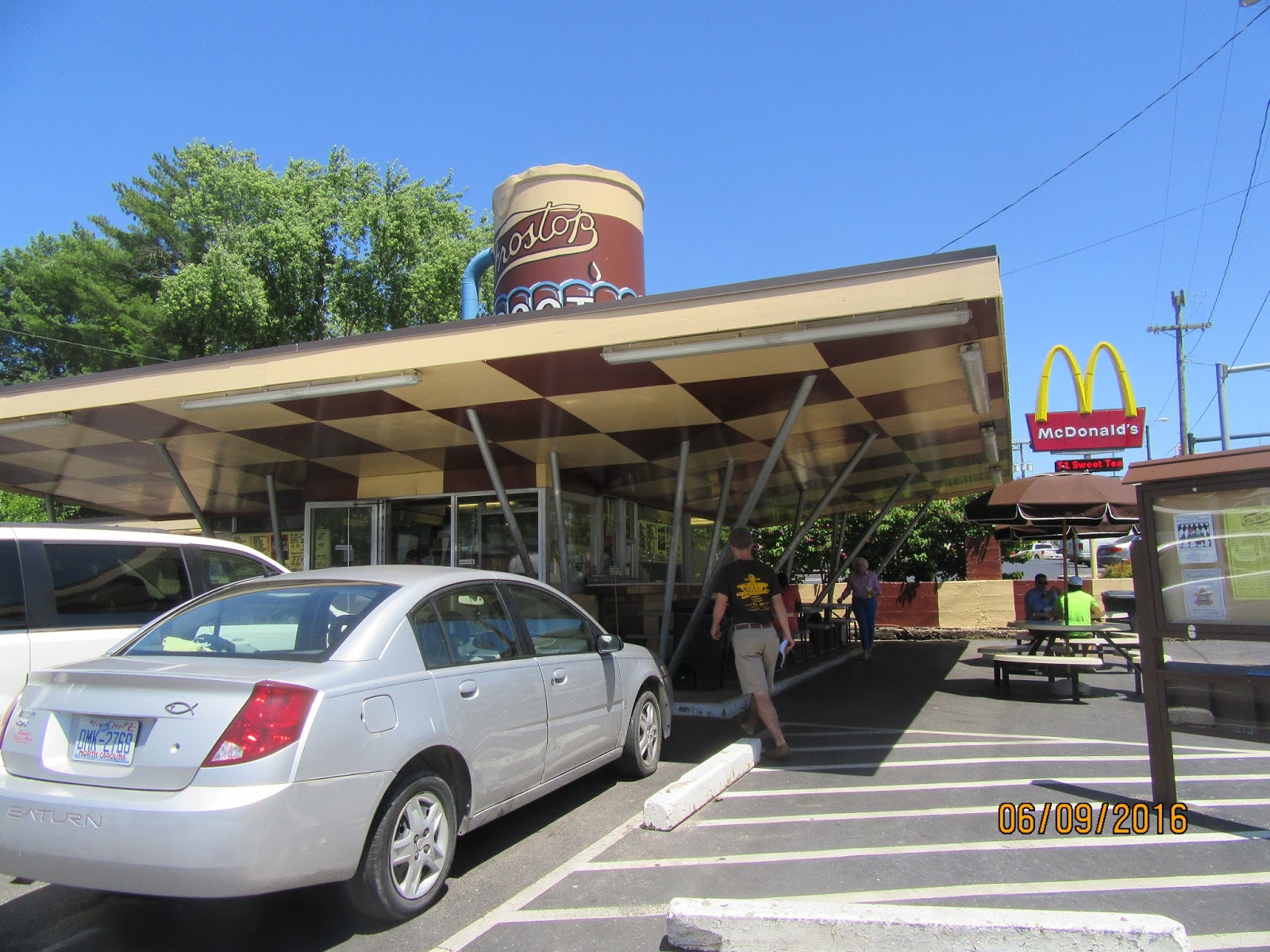
I found Frostop, a 1959 drive-in, complete with wait staff that comes to your car, in central Huntington, and stopped for an inexpensive lunch.
Here are more historic places I found in Huntington:

Ohev Shalom, 1928, now called B'nai Sholom after a merger with B'nai Israel, an Orthodox congregation.B'nai Shalom is Reform and Conservative, 10th Av. and 10th St.


Douglass Jr. and Sr. High, 10th Avenue, the "separate but equal" school for African-Americans, 1924, now a community center.

Freeman Estate, aka Park Hill Farm, McCoy Rd., in the hills, 1914

Cabell County Courthouse, 1899, Fifth Av., between Seventh and Eighth Sts.

Renaissance, part of the Downtown Huntington Historic District, now apartments

Keith-AlbeeTheater and Office Building, Downtown Hntington

River Tower, now a Masonic Temple, just east of downtown, Third Av. and Eleventh St., 1922 and 1926

Harvey House, 1874, Third Av. and Thirteenth St., forlorn between fast food places and auto parts stores


Elk River Coal and Lumber Company Steam Locomotive #10, 1924, now part of a museum, Eleventh St.
I stopped briefly to check messages. A friend said I should relax a bit and try to be less compulsive.

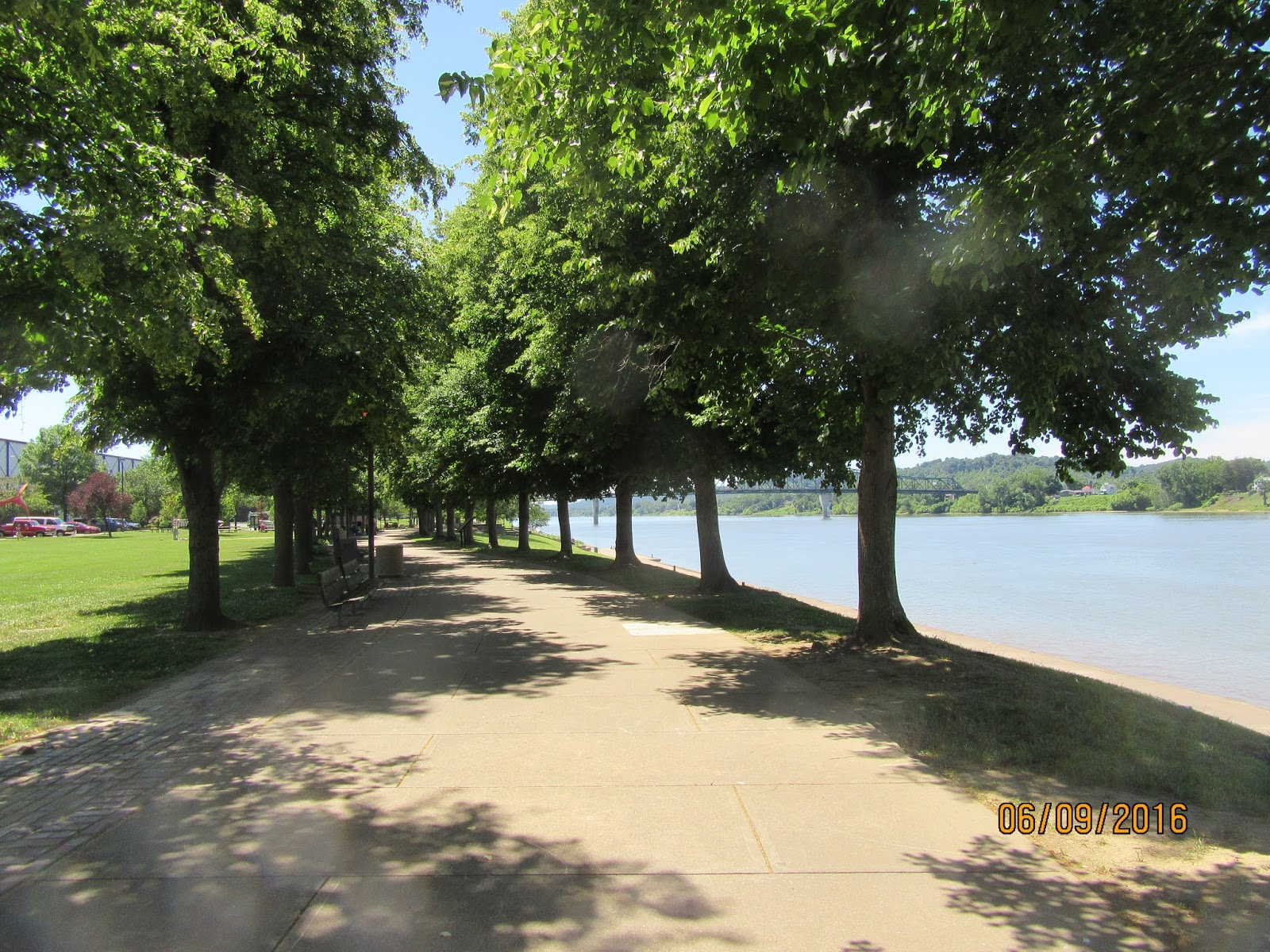
The locomotive was near the Ohio River, so I found an entrance to the park, and walked through. Here are some shots along the river.


I met someone on a bike and asked where the next entrance back into the city was along the wall. He didn't think there was one. We talked a little. I recognized a Great Lakes accent, and he said that he was from Michigan, but went to school in Chicago. He is a librarian, and was in Lawrence, Kansas where his wife was working on an advanced degree. They came to Huntington, because she got a job at Marshall University. They live near B'nai Sholom on 10th Av.

There are beautiful old homes near there, but like much of the city, that neighborhood fell on hard times. There are some hipster young people moving back in. It's convenient to the city center, which has had something of a rebirth.
Pullman Center, along the riverfront near the center of Huntington, has new shops and movies
.
After my nap, I went for dinner to Sheetz. Not very adventurous, I know. I capped the evening with soft ice cream from Frostop.

Huntington looks like a "real city" with 1940-era public housing projects like Baltimore's, only integrated. People in the city seemed friendlier than out in the suburbs, and I saw many cars with "Bernie" bumper stickers. The streets and avenues are tree-lined with mostly early twentieth century homes. Unfortunately, many of them were vacant, as the population has declined in recent years, and some seemed to be burned out. Still, there is a major university at Marshall, a revival of sorts in the center of the city, and a pretty and historic downtown. There is an art museum up in the hills.

Due to my stubborn way of doing things, I didn't go west of downtown. I know there was a lot to see there, but this is what I was able to cover. The west end of Huntington is in Wayne County, so maybe I'll explore more on another trip.


Tuesday, June 21, 2016

Unity, Part 2


I got into town from the Democratic convention in Charleston just about 6:30 P.M. Saturday, and met Joe at a restaurant downtown. Services at Tree of Life for Shavuot, Jewish Pentecost, were called for 7:30. Not many people showed up, and Joe was home by 10:30. The plan was to have study sessions and blintzes (traditional, but I don't know why) until midnight. I was exhausted and left early.

We awoke Sunday to the horrible news about Pulse in Orlando. There was a meeting in the afternoon of an interfaith group started to counteract gun violence. It then moved into combating Islamophobia and supporting Syrian refugees.  I don't always go, but I wanted to discuss what had happened in Orlando. I thought the group would draft a statement. The group from the local Islamic Center didn't show up, and not many people came. We all expressed support for the LGBT community, agreed not to condemn Islam generally for this crime, and said we would work for gun control. Eve Faulkes had designed headscarves for women and t-shirts for men with a message of peace, inclusion, and a plea to accept refugees. Joe bought t-shirts and Eve photographed us with a statement on cardboard from Rabbi Michael Lerner.

Facebook was awash with chatter about Orlando. There was a push from WVU people to have something, a ceremony of some kind. It was scheduled for Thursday night. Because so many people on Facebook were angry that there was silence from clergy (not entirely true), I checked with Joe, and he was willing to speak at the event. He is  probably the only openly gay clergy in the area. Word came back that they wouldn't need him. The event was well-attended, despite horrible storms just a few hours earlier, with some roads blocked by fallen trees. The speakers they had: a Vice President at WVU in charge of the Division of Diversity and Inclusion, the mayor of Morgantown, a Muslim student involved in student government, and a self-identified transgender Latina woman, an honors student in the Women's and Gender Studies Department.They all spoke well. The weather cleared and we were able to go outside to light candles at the end. I knew many of the people there. I know Morgantown has a large population of involved and caring people. It was for them that I ran for office.

Meanwhile, the local newspaper had run an anti-Muslim column from columnist Cal Thomas on Tuesday. The Islamic Association of West Virginia put out a strongly pro-gay statement, which I saw on Facebook. I called the paper and asked if they would run that and they said they would not without a local angle. So I wrote a letter critical of Thomas and excerpted the Islamic Association's post. Meanwhile friends of friends on Facebook whined about their "Second Amendment rights"; others went on about "Islamic extremism." A minister in California said it was too bad more pedophiles weren't killed, and a Republican from Texas said it wasn't really a gay bar. We have a lot of work to do.

A week after the tragedy, Morgantown was scheduled to have its first Gay Pride celebration, at 123 Pleasant, a hipster locale downtown. This being not West Hollywood, it was indoors in the evening, with a panel discussion called "Activism, Advocacy and Our Rights" organized by a friend from the LGBT Equity Commission at WVU. She asked me to be on the panel, and I agreed. I didn't have much to say, but I felt bad for one panelist, a gay male high school student who said he rarely goes to school because he is harassed. Apparently no one, including his parents, will stand up for him. This made me feel powerless. There was a poetry reading and some acoustic music. A band was coming in later. Joe was with me, and we left about ten.. That's as late as we stay out. I knew some of the people there, some gay and some straight allies, and I met a group of transgender women and heard their stories. That is a hard life.

Despite all of the negativity in this country, there is a core of people who care about where we are heading. They grieve with us for LGBT lives lost, and for Latino men and women out for a night of fun, who were gunned down or held hostage. They know blaming Islam is not a solution, that Republicans have never been in any way concerned about the LGBT community, even as they now try to paint Islam as the enemy of gay people. Banning assault weapons would be a useful start. I'm glad for all of that, yet we really need to look at why there are so many deeply disturbed men (almost always men) who fetishize weapons, have a deep-seated hatred of Barak Obama and Hillary Clinton, applaud deaths of gay people even as they ask us to condemn Islam.

Our Shavuot holiday was a bust, and I am just coming out of a week of depression over the events that weekend. I'm feeling more hopeful now. Maybe we can make a coalition of people of all races and faiths to see the United States as a unified country, one where we all care for each other and respect diversity in unity.

Here is what I wrote to the paper. They edited it; this is the original:

It's hard to tell when I'm not dealing well with the world, but there are tell-tale signs. Like when I don't want to go out of the house, or I spend time on Facebook arguing with people I don't know when I should be doing something else, or if someone asks how I am and I don't want to answer.

That's how it's been this week, and I know it is about the shooting in Orlando. I feel close to those people. I am no longer them; I would never be at a bar at two A.M., but there was a time when I would. I think of younger gays and lesbians as my children. Many of them have parents who support and nurture them. Even today, though, parents inflict pain and grief on their LGBT children. I'll take them in as mine. I feel like it was my children mowed down by a killer in Orlando.

Young people I know locally, college and just post-college, are mostly what we now call "allies," not gay, but supportive. Many of them still have friends in the little towns where they are from, and some of those friends have posted about their "Second Amendment Rights" on social media even before expressing sympathy to the gay community and our friends, who are in mourning. I tried to tell them to respond to our grief now, and talk about guns later. They mostly don't get it.

In your paper Tuesday, June 14, Cal Thomas expresses no sympathy for gay and lesbian people, for the general population of Orlando, or for the Latino population, mostly Puerto Rican in that bar from what I have read. He never has expressed any sympathy for LGBT people nor, for that matter, for people of color. Instead, he launches into yet another attack on President Obama for calling for control of assault weapons, and he says "No more mosques should be built in the U.S. until we gain an upper hand against radical Islamists." I'm sure Thomas thinks he is a great patriot, but that is clearly unconstitutional and hateful. He has the right to say it, but the Dominion-Post has the right not to print something that demonizes a whole religious group.

I got comfort from this, from the Islamic Association of West Virginia:

"We will continue to spread our belief in the tolerance, kindness and peace we have found within Islam, and we will stand with and support the LGBTQ community during this difficult time.We will prove that love conquers hate."

I would love to see that sort of statement, perhaps from other religious groups, on your pages more frequently. 


And here is the full statement from the Islamic Association of West Virginia.

Statement on the Mass Shooting in Orlando

Early this morning, as we woke to eat the suhoor meal before the beginning of our Ramadan fast, we received news of a horrifying shooting at Pulse, a gay bar and nightclub in Orlando, Florida, that has claimed the lives of fifty people, and seriously injured fifty more. It is the deadliest mass shooting in American history. Based on the information presently available, the perpetrator was twenty-nine year old Omar Mir Seddique Mateen, who was very likely motivated by Islamic extremism.
The Islamic Association of West Virginia strongly and unequivocally condemns this attack. We denounce acts of extreme cruelty and violence without reservation, and we offer our sincere condolences and heartfelt sympathy to the victims and their loved ones. We pray for the recovery of those injured, for the comfort of grieving friends and families, and for the healing and safety of LGBTQ communities the world over.
While the perpetrator claimed to be Muslim, he did not practice any form of Islam that we know. Our Islam vehemently forbids these heinous crimes, and the killing of innocents violates countless sacred laws and traditions of our religion. Furthermore, as Americans, we strongly believe that LGBTQ rights are an integral part of American civil rights and, more broadly, basic human rights. People of all gender identities and sexual orientations are entitled to dignity and respect, and we fully support their right to live, work and celebrate openly and without fear.
We will continue to spread our belief in the tolerance, kindness and peace we have found within Islam, and we will stand with and support the LGBTQ community during this difficult time. We will prove that love conquers hate.

Dr. Fryson, of WVU, speaking at the memorial event June 16

Candle lighting and traditional bell ringing outdoors at WVu's event, June 16

The panel discussion at 123 Pleasant, June 19
 

Thursday, June 16, 2016

Unity, Part 1

Last Friday and Saturday I attended the West Virginia Democratic Convention in Charleston. I arrived Friday morning from Huntington, about fifty miles west of Charleston. The theme of the convention was "Unity." I imagine this meant we were all to come together to anoint Hillary Clinton as the Democratic Presidential candidate in 2016. That didn't happen.

I hate to be a "Tuve,"Spanish for "I had." We used to speak, unsympathetically, in the Social Security office in Miami where I worked for many years, about people from Cuba who would start all their sentences with "Tuve" and tell us what they left behind in Cuba.

I attended the California State Convention in 2011 in Sacramento and 2012 in San Diego. There were scheduled lunches and dinners and guest speakers including Bernie Sanders in Sacramento, and Al Franken in San Diego, as well as the superstars of California politics, Jerry Brown, Gavin Newsom and Kamala Harris. Dianne Feinstein and Barbara Boxer put in appearances; Feinstein spoke at a dinner, open to the conventioneers, for an extra charge. The San Diego convention was at the Hilton. Many of us chose to stay elsewhere to save money, but the facilities were immaculate.

"Tuve" a much better time in California. Our convention here was at the dingy Charleston Convention Center, where there is construction going on and the thermostat was set at 50. There was a snack bar open Friday with $3.00 pretzels, small bottles of water and antique pizza. I never saw our Governor, and our one Democratic senator had a private lunch for the State Executive Committee honoring the chairperson, who, not coincidentally, was running for reelection. More on that later. I stayed just out of town in a place called "Mink Shoals" at a motel from the chain where I get points. There was only a three dollar per day charge to park in the Convention Center garage.

Thankfully, there were less jaded young people there, including a large contingent of Bernie Sanders supporters from Morgantown. Bernie beat Hillary by fifteen points in West Virginia, and won in each of our state's fifty-five counties. In the Rolling Stone issue marked June 16, Bernie Sanders was interviewed just after the West Virginia primary. He wondered why six of the eight superdelegates from West Virginia were pledged to Hillary. Good question.

Everything ran late at the convention. The real convention was to start at five Friday, but registration started at three. I arrived at 10 from Huntington, and met Selena Vickers, the technical wonk for the Bernie campaign, sitting next to a cardboard cutout of Bernie Sanders. I spoke with her briefly about possibly adding an amendment to overturn the decision to allow concealed carry of weapons without a permit. I looked up a similar law in California, which made me realize that it probably wouldn't get passed, this being West Virginia.

I found where the Reform synagogue is in Charleston. I called and got no answer, so I went there. It's a brick-and-glass modern building in a neighborhood of grand houses facing the Kanawha River. Probably the best neighborhood in town sixty years ago. The back door by the parking was open, so I walked in and met the secretary. He was unhappy that I was able to walk in and said he was not authorized to give me a tour without an appointment. I was okay with all that. I just explained who I was and why I was in town.

Back at the convention, I ran into Jamie Blake, a youngish (out of college) guy, one of the Morgantown Bernie organizers, and we went out for lunch at the mall for wraps in the food court. At least Charleston has a mall downtown.

We hung around until three, when we could register for the convention. There were committee meetings until five, when the convention started.No lunches or dinners were planned for the conference. I drove to my motel, checked in, and slept for an hour.

The convention started well after five. The rules committee had met before, and rules had been changed to make it easier to amend the platform and allow more time for debate. There were speeches from Doug Reynolds, the Democratic candidate for Attorney General, from Belinda Biafore, the state chair, and from Natalie Tennant, our secretary of state, whis running again. She lost two years ago for Senate, because she didn't take a stand on any issues. Reynolds is probably an improvement over Patrick Morissey, our paid-for-by-corporate-lobbyist Republican attorney general. Still, Reynolds voted for the Religious Freedom Restoration Act (also known as the Freedom To Discriminate bill) and introduced a bill that would mandate that colleges allow guns on campus. I confronted some Reynolds kids who had a table for him. They sputtered something about "just doing what his constituents wanted." Not good enough. I may have to vote for him, but I will never campaign for him.

I don't remember anything much else about Friday night- except that I hadn't had dinner. I bought a stale $3.00 pretzel in the lobby and went to my car and brought in some bottles of water, so no one should have to pay $3.00. Many people still don't drink the water in Charleston, after the chemical poisoning more than two years ago. Things broke up at 9:30. The kids asked me if I wanted to go out drinking with them, forgetting that I am sixty-six, not twenty-six. I stopped at a convenience store and bought snacks, which I brought back to my hotel and ate while looking at Friday's Charleston newspaper. I was asleep by eleven.

I had breakfast at the hotel, and got back to the Convention Center by nine. There were plenty of plots a-hatching. Many people had petitions out, about banning guns, legalizing marijuana, requiring superdelegates to vote for the winning candidate from the primary. I signed all of them, except the two that were meant to embarrass Hillary Clinton. It was too late for that. I noted that the vast majority of delegates were white, Christian and straight. In California, most of the Democrats were Mexican-American, African-American and Asian-American, Native, or Jewish. And a whole lot of them were gay. In talking to people, I found that there were more Jews than I originally thought, living in rural counties after escaping New York and their Jewish heritage. Someone pointed out that there were many more gay people than I imagined. Maybe so.

Jim Justice, the Democratic nominee for Governor, spoke once things got started. He was a Republican until last year, is a coal mine owner and the wealthiest man in West Virginia. He owns the Greenbrier resort in southeastern West Virginia, and avoided debates and policy statements during his primary campaign against two other contenders. He is notorious for not paying bills on time. Progressives in the state find him appalling. Our Bernie people, led by Morgantown's Shane Assadzandi, a young dynamo, planned a walkout during Justice's speech. I stayed in for the first ten minutes, while Justice talked on in an almost unintelligible rural West Virginia drawl about his foot surgery, how much money the Greenbriar brings into the state, and how he bought  a shovel and pail, which he had with him, from a woman by the side of the road, who was trying to raise money to buy food. I couldn't take any more and left. His speech seemed to go on quite a long time. He never mentioned any ideas for how to run the state, as far as I know.

John Perdue, the state treasurer spoke as well. My hearing is not great and the sound system wasn't clear either but it seems the Republican legislature was right to require English for state business. His drawl was so thick, I could understand almost nothing, and he went on for probably a half hour.

The superstar of the convention, our Kamala Harris, if you will, was Mary Ann Claytor, an African-American woman who came from nowhere to win the Democratic nomination for Auditor. I didn't vote for her, because another candidate had endorsements from people I liked, and because Claytor's website said she had a degree in religion from Jerry Falwell's Liberty University. That set off warning bells for me. She spoke with the cadences of Martin Luther King, Jr., preaching to us about her experience in the auditor's office, of her background, and how important it is to include everyone in the state. She was the first to mention the LGBT community, and how we needed to be included. She had the passion and fire that everyone else who had spoken lacked. People rose to their feet and cheered. And I understood every word she said.

When we finally got to amendments from the floor, it was noon, and there was no lunch break. Shane and his crew and a few others introduced bills to ban assault weapons, to ban fracking and mountaintop removal mining, to stop fighting the EPA on air and water quality regulations, have a gay rights bill. All of these passed on a voice vote. And why? Because the mostly older Hillary Clinton fans  joined together with the mostly younger Bernie Sanders fans to make West Virginia a more progressive place. The anti-Clinton petitions were never presented, and this helped us find the "Unity" we were looking for.

Until now, the Democratic Party in West Virginia's only claim to liberalism has been its support of unions. The people in charge of the party not only don't like Bernie Sanders,they don't think much of Hillary Clinton either. This convention brought together the Hillary and Bernie people in a new way.

Meanwhile, a graduating WVU student named Franklin, whip-smart and handsome, asked me for a ride home. I wanted to be back and eat before Tree of Life's Shavuot service at 7:30. In West Virginia, Jewish holidays are never figured into anyone's schedule. Franklin and I left at two and went to the mall for lunch, as nothing had been provided. I was freezing in that barn of a room, and about to go off on someone for lack of food. We got back to the car at three, and were about to drive away, when Danielle, the brilliant and most glamorous of the Bernie people in Morgantown, called my phone and begged us to come back. Franklin and I discussed it briefly and went back. Someone called for a quorum, and there was none. The seventy people on the central committee were gone to Senator Manchin's luncheon before a vote on the next chair. People came back who had drifted off for food, and the central committee said we could count them even if they weren't there.We finally passed the whole platform with all the progressive amendments intact. At four, we headed back to Morgantown.

Chris Regan, the vice chair of the central committee, a Bernie supporter, a smart guy and a great writer, who is appalled by most of what goes on in this state, and writes a blog about it (homeyesterday.com) was later defeated for chair of the central committee by incumbent Belinda Biafore, who presided over the loss of the Legislature to the Republicans, because the Democrats refused to stand for anything. Don't get me started.

Wednesday, June 8, 2016

Butler County, Ohio

I spent a marathon day in Butler County, Ohio Tuesday, after a three hundred mile drive Monday from Morgantown to West Chester Township, at the southeast end of the county, just north of Hamilton County, where Cincinnati is located. Butler County lies between Cincinnati and Dayton, mostly on the Miami River, just east of Indiana.

Richard Butler, for whom the county was named, was a Pennsylvanian charged with "negotiating" the Natives out of their land in what was, just after the American Revolution, the Northwest Territories. He was killed in a battle, won by the native tribes, where the Americans were commanded by Arthur St. Clair, for whom St. Clairsville, the seat of Belmont County, Ohio, just across the Ohio River from Wheeling West Virginia, is named. The largest city in Butler County is Hamilton, named for the one-time US Treasurer, and now Broadway star, Alexander Hamilton. It was Hamilton's idea to sell off the Northwest Territories to settlers to pay off the new country's debts from the war. In a park in Hamilton, there is a sculpture of a pioneer family next to a restored log cabin. Brave settlers! There is not a whiff of apology to the displaced Natives. Only at Miami University, in Oxford, at the northwestern edge of the county, is there a Department of Mayamee Tribe Relations.

There was lots of news about Butler County this week. An election took place Tuesday to replace John Boehner, who was the congressperson from this part of Ohio. The woman whose kid fell into the gorilla exhibit at Cincinnati Zoo was from Butler County; the courts decided not to charge her. And a fifteen-year old who shot several of his classmates with a gun he pulled out of a lunchbox, was sentenced to detention until age twenty-one. In a classic made-for-TV moment, his mother cried out at the trial "He has a good heart."

There are eighty-six sites on the National Register of Historic Places in Butler County. I picked ten to go see on Tuesday, randomly, every tenth one on the list. I added two - one in West Chester Township where I was staying, and one in Oxford on the campus of Miami University, because that's where it was. There's a small Conservative synagogue in Hamilton, and a mall outside of Middletown, the second largest city in the county.

West Chester Township is what Joe's demography teacher at Hebrew Union College called a "Boom Berg," i.e. a brand new city just far enough away from a major center, that seems to spring up overnight. In this case, it is just outside of the county that contains Cincinnati. Most of the township is new office parks, lots of new hotels (I stayed at a fine example of the chain I typically stay with, at a very good price). Nearby  is a planned development of pretty houses, townhomes and apartments, with trails and open space provided. And lots of shopping- not fancy, but big box names and chain restaurants. After a nap and a check of Facebook, I found a trendy supermarket chain, and thought I would go there for dinner. Instead, I had dinner at an Ohio-based chain restaurant.

Sunset in Hamilton on June 6 was at 9:11 P.M. Technically, western Ohio should be on Central Time, but I was happy to have late daylight to explore. I found a 1944 Voice of America station, moved inland for fear of attack on the coasts. I drove north to Hamilton and found the synagogue. I realized I enjoy cities more than rural areas, and decided to look for more than the two places I had planned to see in Hamilton.

The weather ranged from 53-73 F Tuesday, with alternate sun and clouds. Average weather in Hamilton at this time of year is two degrees warmer than Morgantown in the morning, and five degrees warmer in the afternoon. Tuesday was cooler than average.

I started my exploration with the Conrey House also called the "Spread-Eagle Tavern," although Wikipedia says there is little evidence that it was ever anything but a house. It sits back from Cincinnati-Columbus Road, which says it all. I parked on a suburban side street across the road, and walked up to take a photo. When I came back, a pleasant woman asked me what I knew about the house. Although she has lived near it for many years, no one seems to know much about it. The house is now a private residence. I told her where to look on Wikipedia for more information

Places I was to look for that were Native mounds (typical of the area) were unmarked and hard to find. One old farm didn't photograph well. Although I had carefully written out directions to each of the twelve places I was to visit, I found myself turned around more than once. Rather than a GPS system, I think my next purchase will be a compass for the car. I did find the Samuel Auspurger Farm, now called Chrisholm Historic Farmstead, near the town of Trenton, between Hamilton and Middletown, now operated as a park by Butler County. The house dates from 1874 and replaces an earlier house that burned.

My original plan was to find Butler County's Courthouse in Hamilton, and one other old house, called Edgeton, located in a 1950s suburban part of town. Instead, I spent an hour or so in Hamilton, and explored much of the central part of town. Hamilton flanks the Miami River. There are active railways through town, and at one time there was a canal to connect Lake Erie to the Miami River and thus the Ohio as well. Much of the town seemed derelict to me. Many of the old houses are now  halfway houses. There were lots of tattoos, smokers, and people who looked like they had seen better days. I did see some office workers, better dressed and coiffed, out to a handful of lunch places along High Street, the main downtown drag. I lunched at a chain sub shop in a strip mall in what had been the nice part of town (near the synagogue). Directly across the street was a pawn and gun shop. Throughout the county, there were more prosperous looking suburban neighborhoods.

Middletown, north of Hamilton, and separated from it by farmland, is smaller, and looks worse. Main Street, south of downtown, is lined with beautiful old homes, mostly well maintained. The center of town looked almost empty. There is a mall ten miles east, which I visited. It is almost empty, with Sears and Elder-Beerman still open. On the way back, I noticed that  the mall was in the next county.

It was getting late, I was far from my hotel, and needed a nap. Heading back south, I found OH-73, which I knew went to Oxford. I decided to go. It should have been ten miles. Instead, it was twenty-one because of an outrageous detour that took me back south to Hamilton before I could go north again.

Eventually, I got to Oxford, home of Miami University, a public college. Two buildings date from 1825 and 1839. In another building, I found murals about multiculturalism and a Department of Confucian Studies, where students learn Chinese language and meditation techniques. Until this time, I had thought of Butler County as a place of no intellectual life at all. The buildings on the wooded campus are all marked with names and dates. I found the McGuffy House, where the author of early twentieth century reading texts lived and worked.

North of Oxford is a restored covered bridge, and at the north end of the county, extending into the next county, is Hueston Woods State Park, mostly forest, but with a lake and a swimming beach. Some were in the water at the beach, but the weather wasn't that warm.

US 27 runs from the northwest part of the county into Cincinnati, I figured I would take it  to I-275, the loop around CIncinnati (I dare not call it "the beltway"), then find Tri-County Mall in Hamilton County, and eat dinner at the food court. There was also a ten mile detour on US 27. I found the mall by seven. It has a Macy's and a Sear's, but most of the other stores are closed. Nearby, there are "Town Center" type developments, featuring cheaper big box stores, all laid out in a seemingly random pattern off the highways. I had a plate of chicken teriyaki served up by a Mexican cook, and headed back to my hotel, napless, by 8:15.

Here are the pics:
Voice of America Bethany Relay Station, 1944, West Chester Township

James D. Conrey House, 1840?, West Chester Township

Butler County Courthouse, Hamilton, 1885, remodeled 1912

Dixon-Globe Opera House, Robinson-Schwenn Building, Hamilton

Lane-Hooven House, German Village, Hamilton

Public Library, Hamilton, 1885
Library interior

YMCA, Hamilton

Beth Israel Synagogue, 1931, Hamilton

Second National Bank, Hamilton


Civil War Monument to Union Soldiers, 1905, Hamilton

Pioneer cabin, with statues of a pioneer family, Hamilton

Miami River Bridge, Hamilton

Railroad bridge over the Miami River, Hamilton

House in Dayton-Campbell Historic District, Hamilton

Edgeton, historic house in Hamilton

Rossville Historic District, across the Miami River from downtown Hamilton

Samuel Augspurger Farm, now Chrisholm Historic Farmstead, a public park, near Trenton (named for Trenton, NJ)

House in South Main Street Historic District, Middletown

House in South Main Street Historic District, Middletown

John B. Tytus House, a National Historic Landmark, South Main Street, Middletwon

downtown Middletown

a mural in downtown Middletown

vacant movie theater, Middletown

Diversity mural, Miami University

Elliott Hall, 1839, Miami University, Oxford

Stoddard Hall, 1825,Miami University, Oxford,

A quad, Miami University

McGuffey House, Oxford, now part of Miami University

Pugh's Mill Covered Bridge, north of Oxford

Pugh's Mill Covered Bridge

Lake and Beach at Hueston Woods State Park

 Most of my info is from plaques around Butler County, what I see on my own, and Wikipedia. Factual errors are my own.

This was an epic trip, where I had no one to say "Stop, Barry, this is too much." I am now in Cabell County, West Virginia, where I arrived today. Maybe another post tomorrow about that.


Thursday, June 2, 2016

23 and me

I've had some interest in genealogy going back a while. I knew that my father's parents came from Belchatow (at least that's how we spell it) in Central Poland, and that their town was under the government of Russia when they came to America, although previously it was under Prussia, Austria-Hungary, and even Napolean for a few years.

I attended a Jewish genealogy convention in Washington in 2003. I met some cousins I had never heard about. A woman I met there with ancestry in Belchatow found her and my greatgrandfather's burial sites next to each other in New York City. I found that my father's family had been traced back to the early eighteenth century, when they first took last names. I also learned that my grandparents were not the first set of cousins to marry in that family, explaining our good looks and intelligence, but also our tendency to have bad hearts and immune system problems like asthma and psoriasis.

On my mother's side, I couldn't find much. I knew that my granfather's family was well-known in Europe, that great-grandpa was not born in Kamenetz in Ukraine, where he came from to New York. It's possible that their family had the rare privilege in Czarist Russia to live in St.Petersburg before the czar's assassination in 1881. I haven't verified that. And my grandmother's mother, the only great-grandparent I knew, although from "Russia," her papers from Ellis Island say "Austria-Hungary."

At Osher Life-Long Learning, or OLLI, where both Joe and I taught last quarter, a geneticist from WVU taught a class about DNA testing at what one might find. I signed up for the class and sent a vial of spit and some money to "23 and me" to find out more.

Jews in Baltimore in the 1950s and '60s had a peculiar status. We were restricted to certain neighborhoods, both wealthy (suburban Stevenson) and poor (Lower Park Heights Avenue in Baltimore City). I  went to junior high with kids from parts of Stevenson, and joined B'nai B'rith Youth at that time, where many of the kids lived in Lower Park Heights. Both were great places to grow up.  We lived in a new neighborhood in the early fifties, one that had excluded Jews until the builder of our house decided to advertise in The Baltimore Jewish Times.

We were clearly not African-Americans, who could not buy new houses in the suburbs or go anyplace outside of their neighborhoods. Still, we were excluded from the private neighborhood swim club near us.

I did have a sense that we were not exactly white people. I thought Pat Boone and Tab Hunter were handsome enough in the movies, but it was not until suave and gorgeous George Chakiris in West Side Story showed up (Greek from Ohio, playing a Puerto Rican) that I saw someone I might grow up to look like, except for the tall with long legs and a full head of hair part. My friends in seventh grade. Michael, Lenny and Alan, were all dark like me.

In Los Angeles and Miami, the two places I lived longest as an adult, I fit in better. I spoke good Spanish and could pass for Cuban. They were a majority in the city. In Los Angeles, I could be Mexican, Filipino, Armenian, or more correctly, Russian Jewish. The neighborhood where I lived with Joe from 2006-2010 was a homeland-in-exile for Russian Jews, many of them elderly and almost all of them of Jewish background. I saw them as different, but they spotted me, and I learned a few words of Russian to engage.

23 and me gives you a wealth of data, much of it just incomprehensible numbers, and lists of possible cousins with whom you share DNA. The first two of these, my closet relatives in this system, are my first cousins' sons, one on my mother's side and one on my father's. After that there is a lot of "Anonymous" and people whose names I don't recognize. A few have contacted me, but I can't find a connection by name.

They also can tell you your likely eye and hair color, which I already know, and if you are a carrier for a certain disease or condition, which might be helpful if is one is planning to reproduce.

They can tell you what ethnic group you are from. In my case, I am 97% Ashkenazic, or Jewish from Germany, Austria, Poland or Russia. Not shocking.

The most interesting thing was the haplogroups, data they can get from your parents' chromosomes. These show the branch of the family tree of our whole species that one is on. My father's haplogroup is most likely from Southern Europe, the Near East and North Africa. These people are typically  Bedouins, Ashkenazic Jews and Algerians. My mother's group is from the Near East, North Africa and Western Eurasia. These people include  Saudi Arabs, Yemeni Jews, and Bedouins.

So maybe we do go back to Bible times in Israel. And maybe the Arabs are not different from some of us at all. Perhaps my affinity to people from Iran is more genetic than I think it is.

Race is still an issue. I am perhaps overly sensitive to how I am treated, even by restaurant servers and hotel managers. I've heard from African- and Asian-Americans and from Middle Eastern people that they are looked at differently and with distrust here. It's happened to me, and I think how fortunate I am to not be African-American, and to be able to speak like an Appalachian person (my native Baltimore is not far from here, linguistically). I can pass for white, straight and local if I want my experiences to be easier.

This has become a longer and more complex rant than I intended. What I've gotten from 23 and me is a better sense of where I am from in the deep past. I am still, of course, American by birth and by choice, and Jewish for the time that that has existed, but I get now why I look as I do, and I guess i find comfort in that.

If you are on 23 and me, look me up. Maybe you are one of the thousands of cousins they listed for me.


Cicadas

The cicadas have been out in Morgantown, as part of their seventeen-year cycle. Or so I'm told. I wasn't here seventeen years ago. In suburban Baltimore, they came out in 1970, when I was in college. They were everywhere except our street, which was constructed in 1953, which must have torn up the cicadas' natural habitat.

In Suncrest, our neighborhood at the north end of Morgantown, people seem especially proud of their lawns. Our street, consisting of twelve homes in six semi-detached structures, has an association. Every Tuesday, a guy named Roger comes by and mows all our lawns. At the end of April, I heard someone else outside. He told me he was part of the lawn team and was spraying weed killer. I questioned him about what it was and he assured me it was not harmful, only we should keep our cat inside for an hour. I had my doubts.

Our street is quiet. Most of the cicadas came up from the ground and died.

Still, we can hear the cicadas from the empty lot behind the houses across the street from us. I was just reading that the cicadas eat tree sap, not enough to harm a mature tree. The maple in our yard is covered with cicadas who must have flown in.

There was a cicada festival last weekend at the Core Arboretum. They had dishes made with cicada, and studied them in detail. I watched one half-dead bug bravely climb our tree after I took him off our porch and placed him by the tree trunk. They don't bite or sting, and they seem tame enough if you pick them up. And while many find their song annoying, or deafening, depending on where you live. I find their sound soothing, a sign that nature still has some say in our urban world, and a warning about what happened to them where chemicals were sprayed.

I like living in a rare and unique time, both short-term, as the cicadas reportedly will be gone next month, and in the longer sense, in the times and places I've lived in sixty-seven years. I'd love to be here in seventeen years, although I will be eighty-three, and I don't know of any man in my family who lived to that age. I could pick up a cicada and say to it "I knew your parents."