Saturday, April 16, 2016

Let's Get Lost- Bucks County Edition

Bucks County and I have a history. In 2009, when Joe was ordained, Hebrew Union College put its graduates through a placement procedure, matching new rabbis with congregations. The problem was that the economy crashed in 2008, and many rabbis who had planned to retire found themselves without savings. And synagogues planning to hire a second rabbi changed their minds. So Joe was only asked to visit two congregations: one in Johnson City, Tennessee (although the synagogue building was in Blountsville, not that close), and the other was in Levittown, Bucks County, Pennsylvania.

I went with him to meet the congregation in Levittown, and they followed all the rules laid out by Hebrew Union College, except one. That was the one where they agreed not to discriminate because of sexual orientation. They told him they would not hire him because some members disapproved of his lifestyle. That's how they put it.

The people who took us around told us that the congregants didn't live in Levittown, which they considered low-class. They were more likely to live in newer suburbs, in bigger houses, like in Newtown, for instance. Anyway, Pelican Bay State Prison hired Joe a few months later, and we were off to Crescent City. The temple in Levittown merged with another Reform temple, probably the one in Newtown, and the rabbi they hired in 2009 lost his job.

I have my rules for where to go on these monthly trips. If you take old Mapquest, where you can ask for shortest distance instead of shortest time, the county courthouse has to be within three hundred miles (500 kilometers) of Monongalia County's courthouse on High Street in Morgantown. The Bucks County Courthouse in Doylestown is 299.94 miles away. And any county with more than 450,000 people gets an extra day. I made up the rules, so I try to follow them.

I did drive the shortest time, and the hotel chain I usually stay with gave me one of my three nights for free on points. I stayed in Bensalem, close to the border Bucks County shares with Philadelphia. Wikipedia says there is an Orthodox Jewish community and a Buddhist temple modeled on one in Thailand. I didn't see evidence of either of these.

My route took me on the Pennsylvania Turnpike from Bedford, north of Cumberland, Maryland, to U.S. 1, the old north-south road from Maine to Florida, in Bucks County. The toll was $26.40.

I had my list of places on The National Register of Historic Places - 256 of them, and I thought I would try to get to all of them- working south to north and taking a picture of each. I spent an hour looking for the first two when I got in, then headed to one of the two big malls to scout it out and have dinner.
The food court in Neshaminy Mall
I had my usual Japanese fast food. This is the older mall, in the south end of the county, the fifties and sixties suburbs of Philadelphia. There was a mix of ethnic people in the mall, mostly junky stores, but a Macy's , and Boscov's, a department store that advertises it is still owed by the original (certainly Jewish) family.

It occurred to me that I should limit myself to ten historic places each day, so I randomly chose twenty (every seventh and fifteenth) and divided them equally by north and south at 40 degrees, 15 minutes latitude. I also saw that in boroughs (what they call incorporated places) there might be other places close by. I tried to map everything out Monday night before I went to sleep, causing me to be up too late.

What I found is that there are layers of development, like in Rome or Jerusalem, but starting much later. William Penn himself founded Bucks County early on, and there are small colonial towns and farmhouses scattered around the county. Then, as Philadelphia grew up nearby, there were railroad commuter suburbs dating from the mid-nineteenth century. Following World War Two, Interstate 95, the bypass of the Pennsylvania Turnpike (I-276) and the Northern Extension (I-476) brought an explosion of new suburban housing. In the northern reaches, I found new developments of faux-colonial mansions, and new townhouses by the thousands, luxurious and not. In addition there are grand estates, new and old, owned by the wealthy of New York. It's a "thing" to have a country house in Bucks County. Still there are open spaces, with signs pointing out that land has been donated to a conservancy to be maintained either as forest or farm. There are pretty small towns that have kept development out on their edges.

I started Tuesday in Langhorne, both a colonial town and a railroad suburb, now off four-lane U.S. 1. My listing was for the Tomlinson-Huddleston House, on Maple, the main Street in Langhorne. The downtown area is a historic district, and the library and the Joseph Richardson House are also on The National Register.
The Tomlinson-Heddleston House

Joseph Richardson House. Lots of houses in suburban Baltimore and Philadelphia look like this, but this is the real deal, dating from 1738.

Langhorne library, 1888

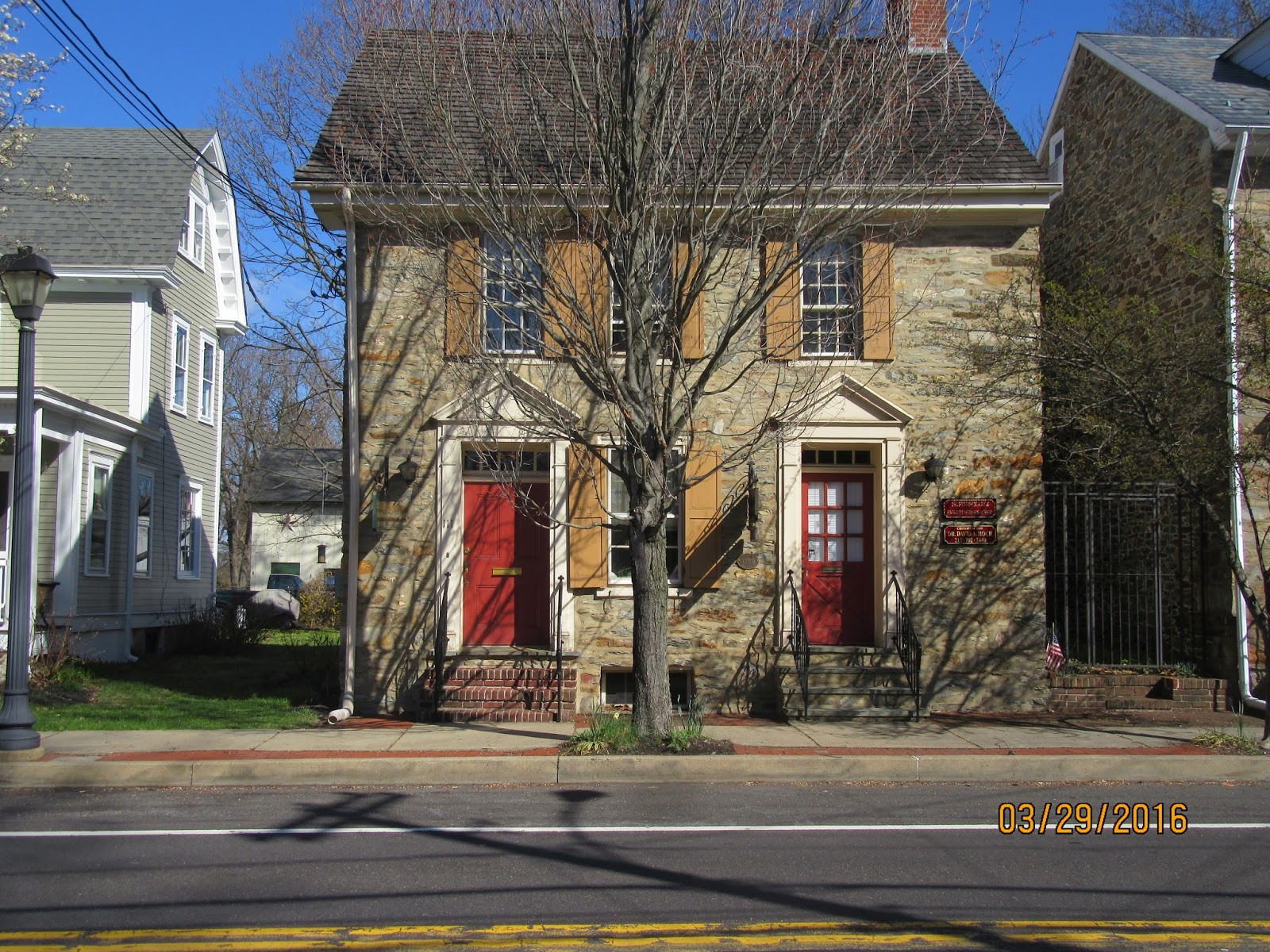
I missed a house in one of the townships (the unincorporated places), then found a bridge in the borough of Yardley. That didn't look like much, but Yardley has a historic district and a commuter rail station.


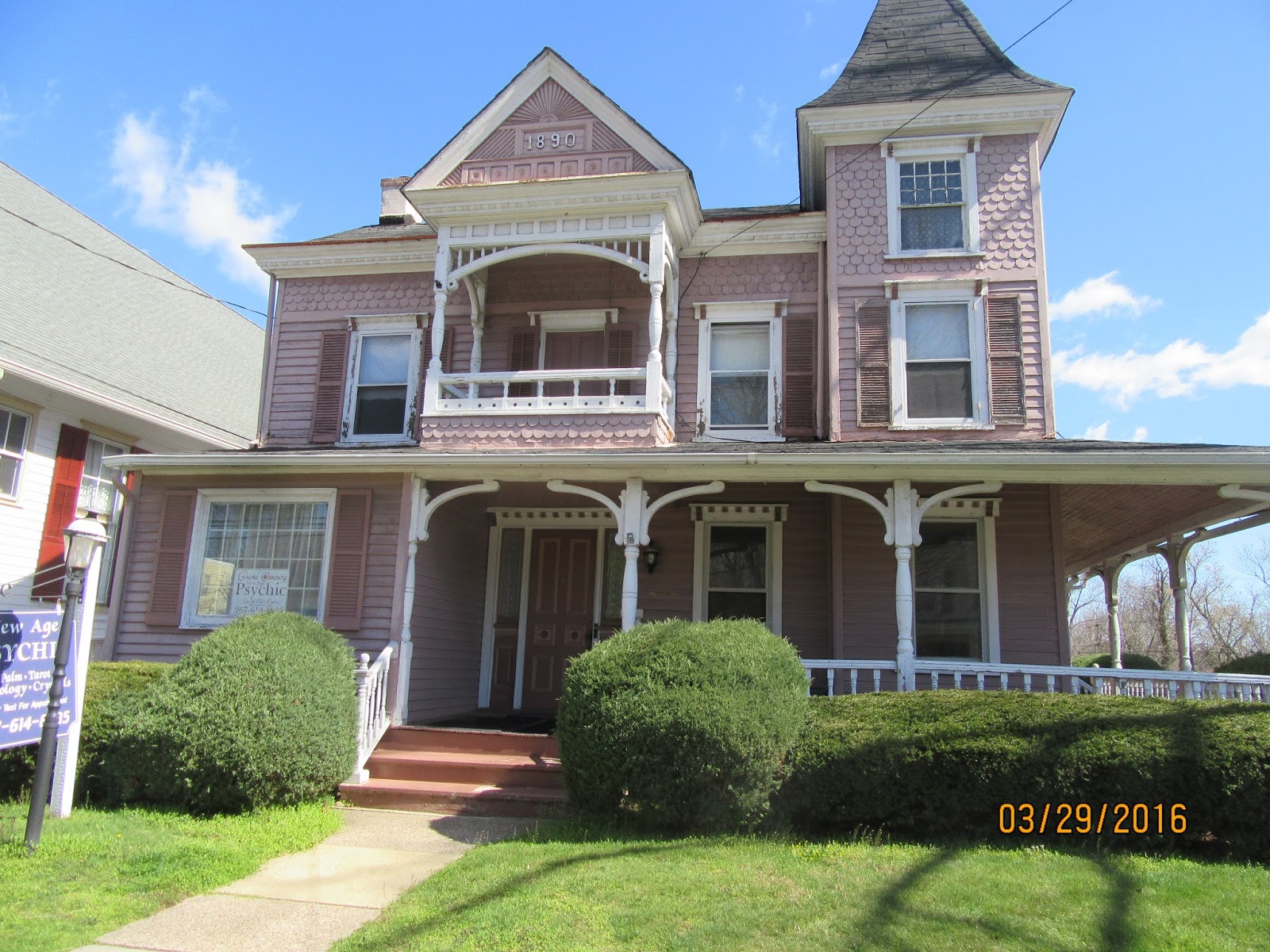
Yardley has a mix of colonial (above) and Victorian (below) houses. On Main Street, they are mainly businesses, some touristy and some more local, like doctors' offices and insurance companies.

The highlight Tuesday was visiting the site where Washington crossed the Delaware on Christmas night, 1776, to engage the Hessians, fighting for the British, in a battle for Trenton. This is considered the turning point of the Revolution, the time when it actually looked like we could beat the British. A community grew up there called Washington's Crossing, and there is a park celebrating the event and the subsequent town. Lucky for me it was sunny and in the low 50s, although windy. With trees and flowers in bloom, the park looked sparkly.
Looking across the Delaware River from the park on the New Jersey side

The bridge, built in 1905, from the Pennsylvania side

An early house, now part of the park

The left wing of this building was an inn that existed at the time of Washington's crossing the Delaware. The right side was added after the Revolution.

The pathway through the park. This is part of a trail the length of Bucks County along the Delaware and the canal that parallels part of the river

It was time for lunch, so I headed to my next stop, Newtown. I saw both the Conservative and Reform synagogues outside of town, near the new, big houses. They didn't look like much. I found a rustic-looking suburban shopping center with McCaffrey's Supermarket, not as good as Wegman's or Whole Foods, but with a hot and cold bar, where you could get lunch. There was a seating area off to the side. I was proud of myself for getting all veggies- salad, pineapple, black beans, and a "Moroccan Quinoa Salad." And an "everything" bagel. With a bottle of sugar-free iced tea, it came to less than ten dollars
Fully fortified, I headed into the borough of Newtown. My historic place was the old Presbyterian Church. I found that and a main shopping street, with a book and record store. I found a flyer for Newtown Chabad, near the center of town. Having three synagogues, according to my rules, makes Newtown an MJC, Major Jewish Center. I took pictures of the church and a few other historic spots, and I bought David Bowie's nearly posthumous album. It's brilliant, depressing and exhilarating all at once. Knowing he was dying, Bowie wrote an album about it.
Old Newtown Presbyterian Church

Newtown Friends Meeting House


Half-Moon Inn, Newtown

Court St., Newtown

Court St., Newtown

more proof that Newtown is and MJC- bumper sticker on Court St.


I've been back a week now, and I hope to finish this piece today. I feel like Zack Hample, Joe's half-brother, who writes endless blogs about baseball games he has attended.

On the way to to Doylestown, the county seat, I looked for Churchville, a historic district not in a borough. After some wandering through the suburbs, I found the historic area.
House in Churchville Historic District

I finally found Doylestown around three P.M. It was my goal to be back at the motel for a nap by 4. That didn't happen. There is a historic district in the center of Doylestown.

Fountain House, Main Street, dates back to 1758, was remodeled several times in the 19th century

State Street, Historic District, Doylestown. The theater is run as a non-profit and shows art house movies

Bucks County Court House

A House in the historic district

A House in the historic district

Mercer Museum, 1916, poured concrete

James A. Michener Museum, formerly the warden's house for a prison. Michener lived in the area.


I thought maybe I would come back to see a movie in Doylestown, but it was after four when I headed back to my motel. It took close to an hour to get the eighteen miles from Doylestown to Bensalem. I crashed- fast asleep, from five to six, then took another hour to catch up with e-mail and get enough energy together to look for dinner.

I decided to go to Levittown, a census-defined place, and site of our ill-fated trip in 2009. It's at the far south end of the county, near Philadelphia, not far from where I was staying. I still had trouble finding it. It reminded me of where I grew up in Baltimore, tiny ranch-style and cape cod houses, close together. Levittown is better organized than Campfield Gardens, my Baltimore suburb, mostly just because it was planned on a larger scale. When we were there in 2009, we heard about a near riot from white home owners when an African-American family moved in. I stopped at a sub shop for dinner and a grocery store for fruit and snacks. The people in the store were from a variety of races and ethnicities. I ate in the room, looked at the local paper, which complained that the schools couldn't find substitutes. Maybe if they paid them well and provided benefits, but don't get me started.
I watched a little television. There was a commercial for Republican Senator Pat Toomey.It showed a city burning and said how Toomey stood with the police and protected "you" when there were riots. This is what they mean by "dog-whistle" racism.

Wednesday started warmer and I had an ambitious agenda for the northern part of Bucks County. Things didn't go well. I found the Byecroft Farm Complex, an estate that has been in the same family for centuries, now preserved as farm and open space.

Byecroft Estate House

                   Open space at Byecroft


Next up was a house in New Hope. This town is a resort on the Delaware River. it was a notoriously gay town in the 70s, full of high-end antique stores and gay bars and hotels. I visited in 1975 with my friend Harvey from Baltimore. We stayed in a hotel in a big old house. As I remember it, the barn was converted into a gay club. I remember what happened fondly, and let's leave it at that. The place I was looking for was in the hills above town- all streets with "Private Road-No Trespassing" signs. I couldn't find what I was looking for, so I drove into town. There were people out on a cool Wednesday morning at the end of March. There were now t-shirt and sunglass shops and a large chain donut shop on the main corner. It's still a pretty town. I found an independent bookstore, and asked about the club I had been to in the 70s. A man and woman working there couldn't remember the name of it, nor could an elderly woman who came in to the bookstore. I was surprised that they were even discussing this. They told me about the one gay hotel-club still active in the town. I said "I can't say up late enough now to go there." I felt like the old man who returns to Paris in that Kingston Trio song, visiting a town full of ghosts of ex-lovers and friends, including a younger version of himself.

Victorian house in New Hope

New Hope

Hotel and Tavern in New Hope

Path on the Delaware River Canal, New Hope

Bridge from New Hope to Lambertsville, New Jersey on the Delaware River

Rhoads Homestead, New Hope


House in New Hope


The next historic place is called Phillips Mill, and appeared to be on Route 32, River Rd, just north of New Hope.

I think this is it, but there was no sign. There were a few other old stone buildings nearby.

There were other country places to look for, but River Road was detoured, and I had to find my way around on my own. I missed a turn somewhere, and tried to get back to a main road. On the way, I saw some abandoned silos and snapped a pic.

There were newer large suburban homes on the other side of the road.

I found a main road after quite a while. A sign said "Welcome to Doylestown" and just outside of what appeared to be the borough limits, I found "Manhattan Bagels." I had an "everything " bagel with lox and low-fat cream cheese. The young man at the counter asked me about my ring. I told him it was Eilat stone from Israel, and he bemoaned that he was now thirty-one and had missed his chance for a free trip to Israel from Birthright. I suggested he try ZOA. I went on their trip to Israel for young people at thirty-five in 1985.

There was one major borough left on my tour, in the far northeast part of Bucks County: Quakertown. I decided to go there and call it a day. Interesting place, as it turns out. Not gentrified, with a large Mexican population.
Historic Train Station, Quakertown

Main Street, Quakertown

5&10, half store, half museum

Along Main St, Quakertown

 There was a crowd standing around outside a store. I walked over to check it out. This is what they were selling.

Enoch Roberts House, about 1840, dormers and portico added later, Quakertown

Inn, Quakertown

Liberty Hall, Quakertown
 I had directions back to the motel- not that complicated, except I must have missed a turn. It took me about an hour to get back, from 3:30-4:30 P.M.

I slept and got back out about six. I had seen a Panda Express near the motel. It's one of those places you might not go to, unless you lived somewhere where there wasn't one, and then you miss it. I had my usual chicken and rice and vegetables. I asked for half the rice and more veggies.

I thought I would go to Bristol, the largest and probably most historic borough in the county, located along the Delaware at the south end of Bucks County. I didn't pick up any places there in my algorithm. I thought I could get there before dark, but I missed the entrance to U.S. 1 South coming out of the restaurant, then missed the entrance to U.S. 9 North to Bristol. I finally got there, after dark. Luckily, my camera adjusts for available light.

Here are some random pics in Bristol.


Naturally, I got totally lost coming back from Bristol to the motel. I couldn't find the streets I was looking for. I was heading north at one point, turned left to head west, then found I was southbound somehow. I was frustrated.

I came back to Morgantown Thursday, the thirty-first of March. I came down I-95 through Philadelphia and Wilmington and through the I-95 tunnel in Baltimore, up the Beltway to 70 and 68 home. It was twenty miles farther than the Pennsylvania Turnpike and took a half-hour longer. I saved $18.00 in tolls.

I've been back sixteen days, and I'm finally ready to publish this.


Thursday, March 24, 2016

The Campaign and Purim

I planned an event for last night (Wednesday March 23) not realizing that it was Purim. Technically, Purim didn't start until sunset, which as far west as we are in the Eastern time zone and with daylight savings time, was about 7:40. The event was 6 to 8.

Last December, I attended a training session in Wheeling for new candidates, run by a community organizing group called Our Children, Our Future. They said that to be successful, a candidate needs to start a year early, and have a committee of, ideally, twelve people to take care of the campaign. Then you have to call everyone you know personally and ask them for money.

I had already pre-filed to run when I attended this session. Actual filing had to be during a few weeks in January. I asked my friend Dee to be my treasurer. She agreed, and also put together a website for me. I've done everything else. People have offered me money, for which I am grateful, but I can't bring myself to call people and ask them to donate.

There are eight Democrats running in the primary; five of us will run in the general election. Five of them, including the incumbent, are friends, or at least acquaintances I respect. I've met one more, who seems nice enough, but hasn't run much of a campaign, and the eighth I have never met. People in town know him; their opinions of him are mixed.

I had an interview with the Mon/Preston Labor Council  the first Saturday in March. They were friendly, and I took their side on issues with no strain on my conscience. Then they asked me how much money I would need to win in the primary, and what was my organization like? I told them I had raised about a thousand dollars, and that there was no organization. Last week, Dan Doyle, the guy in charge of endorsing candidates, called to tell me they would not endorse me, because I had no organization.I perfectly understand that, and don't resent them or the people they endorsed (the five I like). Not that I wasn't depressed about it.

So I had a campaign event last night. Most of the other candidates, and the candidates for other offices, have had these at a sports bar near our house. One had his event at an out-of-the-way working class bar, and one had his event downtown at an Irish bar. I didn't want any of those places. Joe suggested Terra Café, a place on the river with good food, a little too "quinoa salad" for me.
I settled on Black Bear Burritos, a locally owned joint with good food, a branch downtown and one out by us. I chose the suburban location because parking is free.

In addition to Purim, West Virginia University has been off this week, meaning that lots of people are out of town. I didn't have signs or bumper stickers to give out. I tried to make a WANTED! poster with my picture in the middle, but I couldn't get the picture on it correctly. I finally asked Joe to do it, and then it was good. The event, called "Premiere!" because Joe doesn't like sports metaphors like "kick-off" was advertised by the local Democratic Party. I advertised with G2H2, the gay men's group we go out with every month, several Facebook groups for local activists, my main Facebook and Twitter feeds (mostly people who don't live here), and the LGBT Equity Commission at WVU, of which I am a member. We planned for sixty people.

We had more like forty people. They ate one-third of the food I ordered. I collected enough cash to pay for about three-quarters of the event. The local tax assessor came, two women from the Democratic central committee, two Bernie Sanders organizers, many people from temple, a woman from the LGBT Equity Commission, a parent whose son was in "Fiddler On The Roof" two years ago when I played the rabbi, and a few other local Jewish or gay or political friends.

Everyone got along well, people mingled and had a good time. I played "We're All In This Together" from "High School Musical" on Joe's boombox as the intro to my speech.

I spoke about how Joe and I came to Morgantown and were instantly accepted, how I teach at OLLI, and how Joe has become the go-to person for Jewish knowledge in eleven counties in West Virginia, Maryland and Pennsylvania. We were told that Morgantown was the college town  liberal bubble in West Virginia.

How is it then, I asked, that Republicans could grab four of our five local seats in the legislature, and vote for bills to allow home schooling by parents with less than a high school education with no reporting requirements, support charter schools, vote for a "religious freedom" law to allow businesses to discriminate against LGBT people and "right-to-work" to bust up unions, and a bill to allow anyone to carry a concealed weapon without any training or a permit despite the fact that law enforcement throughout the state opposed this. It's easy to attack this year's legislature this year. They did not pass a budget or fix the state's hopelessly non-maintained road system. Instead they passed a law mandating that state business be conducted in English (no one had proposed anything else) and that welfare recipients be drug-tested if the worker thinks they look suspicious, a lawsuit against the state waiting to happen.

I pointed out that the other Democratic candidates were sticking to a pro-union agenda, but were afraid to talk about social issues like guns, God, gays and abortion. I suggested that they lost last time because people were not inspired by their caution. I came out strongly for gay rights, women's reproductive rights, and sensible gun regulation. People said I spoke well, and had nice clothes.

People have said in the past "Too bad you didn't get to use all that acting training." Acting training helped me as a teacher, a politician and a public speaker.

I'm happy with how my event went. I proved to myself that I do have a base here in Morgantown, people I like and respect. At this point, I will probably come in sixth and not qualify for the general election. But like that other old Jew, Bernie Sanders, one of my role models, don't count me out yet.

Joe showed up late at the event after tutoring bar mitzvah kids. We packed up the five trays of food we didn't get to, and walked out to a giant, beautiful Purim full moon. The Chabad rabbi in town called Joe and invited us to hear the megillah last night, and come to dinner tonight. It feels good to be invited, but it was already late last night when we left Black Bear, and we have plans tonight. Still, even the Orthodox rabbi in town is our friend. On Purim, it is a commandment to bring food packages to the poor. We called a local homeless shelter, and they agreed to take our four trays of gourmet wraps and one of veggies and hummus. Thus we fulfilled, without thinking of it in advance, one commandment of Purim.

Purim is also the anniversary, on the Jewish calendar, of my mother's death in 2003. I thought of her as I was dressing to go to the event last night, about how important it was to her, no matter what, to dazzle people with her stylish clothes. We got home after nine, lit a candle in her memory, and despite the lack of ten people normally required, I recited the Kaddish prayer.

Here are the pictures;

With med student Bradley and activist TIm

with fellow candidate Nancy Jamison

Friends (from left) Shirley, Maggie and Alexandra

Friends Ruth, Judy and Laura

Candis (Milford Mill '69, back left) and her daughter Lauren, Jamie and her two sons and another friend

with my friend, author Benyamin Cohen

with Jamie and Danielle, Bernie Sanders activists
Here's link to my candidate website: http://www.barryinthehouse.com .

Thursday, March 10, 2016

More pics from Israel

Mosque on the sea at the entrance to Tel Aviv

Soldiers at McDonald's in Yafo.

Ruth Daniel Residence, where we stayed in Yafo. An American tourist was stabbed to death on this street March 8.
Graffiti and flyer in Neve Tsedek, between Tel Aviv and Yafo. The flyer is in memory of someone on the anniversary of their death. The stencil in English says "There is no pride in occupation."

A street in Neve Tsedek

Someone photographing an Ethiopian Wedding, Botanical Garden, Tel Aviv

Russian Church from The Botanical Garden, Tel Aviv

Café scene, Neve Tsedek, Saturday afternoon

Hipster hangout, Yafo

Yafo on the coast, looking at Tel Aviv's skyline

New housing, Tel Aviv, from Neve Tsedek

Carpets for sale in the shuk, or market, in Yafo

The view from our hotel, Yafo

Dinner at a "Tripolitan" (from Tripoli, Libya) restaurant with our friend Arieh David Scharnberg, from Humboldt County, California, now living in Yafo.
English-language ad for luxury condos, Yafo. Draw your own conclusions.

Poster for "Man of the Hour" a dance performance, Neve Tsedek.


Seaside mosque, Yafo
These are the pictures from Tel Aviv-Yafo (Jaffa) that I promised last week in my blog post "Israel."

Thursday, March 3, 2016

Israel

We’re on the plane on our way back from Israel a week after we left to go there. It’s almost ten P.M. in Israel now, three P.M. in New York, our next stop.

I had my doubts about this trip-not that we would be stabbed by an Arab teenager in Jerusalem, or that I would object to everything Israel stands for. People asked if we would be able to get decent food there, and the truth is that the food there is healthier and fresher than the stuff we eat in the United States.

I was worried more about the traveling itself. Two eleven hour plane rides in eight days is not my idea of fun, and we were to switch hotels in the middle of the trip-three nights in Jerusalem and three in Tel Aviv. I didn’t register for the convention, since I’m not a rabbi, only married to one, and I wasn’t sure what I would do while Joe was praying, studying text, visiting all over the country and meeting with dignitaries.

What I did is what I often do when I’m in a strange city (not entirely strange, as it turns out, because I visited Israel in 1985 and 2007). I took my camera and wandered around. There is certainly plenty to see.

We arrived in Jerusalem Monday morning, the middle of the night in America’s Eastern time zone. We went walking in the cold rain, looking for something to eat. We found a little place run by young Orthodox Jewish men. I ordered my usual chicken and rice, in this case a skewer of marinated roasted chicken. We were served ten little plates of salad first: cucumbers, olives, pickles, hummus, beets, carrots, and other delicacies. I tried to explain in Hebrew that we had only just arrived in the morning.

I brought no winter clothes with me, assuming we would have only warm weather. It was in the 40s, raining and windy when we arrived in Jerusalem. The plane was delayed because there was a storm in Tel Aviv.

The conference actually started Tuesday afternoon. Joe and I spent Tuesday morning walking through the Old City, part of Jordan before the June 1967 war, now annexed by Israel. My politically-correct self didn’t want to go there, thinking of the Jews who feel we should rebuild the Temple. Never mind that there has been a mosque on the site for over a thousand years. We preach in Judaism about God being everywhere, yet people revere that spot as Judaism’s holiest. I suggest that like God, we don’t need a specific place, and should leave The Temple Mount  to the Moslems.The Old City was quiet on a rainy Tuesday in February, the shopkeepers, selling religious items to Jews, Christians and Moslems, patriotic kitsch to both Israel’s fans and those who hope for an independent Palestine, begging us to come into their stores.

One of my friends suggested that the emptiness of the place was not from the time of the year or the weather, but that people are afraid to travel to Israel because of a series of  stabbings by Arab youth, and some drivers deliberately running over Jewish pedestrians. Our hotel, in a residential neighborhood, and not one of the palatial hotels in town, was full. But the visitors were American Christians, not Jews. They seem to be less fearful than our fellow American Jews.

We visited the Western Wall, the retaining wall of the Temple Mount, the last piece of ancient work still intact there. It’s a ritual to write a request on a piece of paper and put it in a crack in the wall. There has been some contention at the wall. For a number of years, there have been separate men’s and women’s sections, since Orthodox Jewish men do not pray with women. But a group of women, called Women of the Wall, or Nashot Hakotel in Hebrew, have defied tradition by bringing a Torah scroll to their section, wearing traditionally male prayer shawls and reading from the Scroll. They have been roundly vilified by the Orthodox masters at the wall, and often arrested by the police. A new compromise is that a different section has been marked off for men and women to pray together, as a sop to the Conservative and Reform Jews who make up the majority of American Jews, and whose numbers are increasing in Israel.

We approached the men’s section of the wall, nearly empty,  as it was not time for traditional prayers, and I think Joe wrote something to put in one of the cracks between stones, and said a prayer. I stood there, not praying, but I felt a vibration from the place. There is a Presence there, and I imagine Jews, Moslems and Christians all feel the same vibrations. We got lost in the Old City (easy to do) but eventually found our way out and headed back. It was nearly one and Joe had to attend the opening of the conference. He went off to his meeting, and I visited a supermarket near our hotel. I bought a roll, a container of yogurt (which turned out to be made from goat milk, and delicious) and an apple. I returned to our room to eat and sleep. A lot of sleep. The conference visited the new space along the wall, but at 6:30 Wednesday. We didn’t rush out to go.

The big news while we were in Jerusalem was how three hundred Reform rabbis from America visited the Knesset, Israel’s parliament, and met with many of the members. This was probably the most important political thing that happened. The Netanyahu government is in coalition with the so-called religious parties. These are the Haredi (black hat) Orthodox and some of the settler groups in the territories who claim a  right to live there based on Abraham’s purchase of land close to 4,000 years ago. These religious groups make sure that Reform and Conservative rabbis cannot perform legal weddings or convert people to Judaism in Israel. They are against rights for women, for LGBT people, and for non-Jews. They maintain power by uniting with secular right-wing groups and  Prime Minister Netanyahu’s Likud Party. For a swarm of liberal rabbis from America to come to Israel to confront the Knesset about these issues was a huge deal.

The Reform rabbis meet every year, and every seventh year, they go to Jerusalem. This year we also visited Tel Aviv, the much bigger, more Jewish, largely secular city on the Mediterranean coast. Tel Aviv is often ranked as one of the best gay vacation spots in the world, and is a center for high tech. Our last night, we met the mayor of Tel Aviv and the American ambassador, who is based there. I found it refreshing to be in a modern city, a pioneer city, still a little rough around the edges. We stayed in Jaffa, or Yafo, walking distance from Tel Aviv, but older, and with a distinctive character. When I visited there in 1985, it was almost all Arab and in a serious state of decay. It seems to be better economically, but like formerly poor neighborhoods in New York or San Francisco, it has been invaded by hipsters, who will probably soon be pushed out by gentrification.

For Shabbat, they split us into groups visiting fourteen different congregations outside of Jerusalem and Tel Aviv. We visited Kehillat Hashachar, in the community of Even Yehuda, a town of 14,000, off the coast and north of Tel Aviv. There are twenty synagogues in the town, mostly Orthodox and subsidized by the government. This Reform congregation meets in the town’s museum. We were supposed to be there early on our bus, but we were only on time because of the horrendous traffic coming out of Tel Aviv on Friday afternoon. It reminded me of Los Angeles. The people of the synagogue welcomed us. Many of them spoke English, some had lived in the United States, some had come from other parts of the English-speaking world and the former Soviet Union. Many of the people had roots in the area going back to the 1920s and earlier. They had a lovely service with a singer, guitarist and keyboard, singing mostly American tunes to the traditional prayers. Joe and I could easily follow the Hebrew service and knew most of the tunes. Neither of us are able to converse easily in modern Hebrew.

The congregation provided a wonderful potluck dinner, all dairy and vegetable, with pastas, salads, and fresh fruits and vegetables. Joe and I sat separately to meet more people and compare notes.I explained to the people at my table that I am not a rabbi, but live in West Virginia with a man I am married to. They were surprised, but not judgmental. They have a woman rabbi, a natural-looking, 70s style “earth mother” type. What we heard from the people was gratitude that we Americans would come to their little synagogue. Reform Judaism is growing quickly in Israel, but it is still a novelty to many people. The members told us they liked it because women and children are welcome at services, the music is lively, and there is a spirituality and friendliness that appeals to them. Many of them expressed fear of the future of Israel. They disapprove of the West Bank settlements, the violence often committed against Arabs and the antagonism they feel from the right-wing and the Orthodox. I feel a lot of the same worries about the United States- the harsh anti-Moslem, anti-gay, fundamentalist politicians who don’t believe in diversity. It was good for them and for us, that we meet each other. We have much more in common than we would have thought. The Shabbat evening experience made me feel closer to Israel generally.

I have three friends in Israel. My friend Arlan, whom I met at BCC, the temple in Los Angeles where I met Joe, lives in Eilat, at the southern tip of Israel. Arlan and I have known each other more than twenty years ago. He and his spouse, David, moved to Israel ten years ago. David died last year. I thought I might visit Arlan. When we talked on Facebook, he suggested flying, as it is an eight-hour bus ride from Jerusalem. It was more than I could handle, so Joe and I promised we would visit there next time, we should all live and be well.

My friend Bonnie was born in Israel, but her American parents came back when she was a baby. Bonnie used to teach Israeli dance, and she was my dance partner for many years. Her daughter has become Orthodox and now lives in north-central Israel with her husband and four children under age five. Bonnie moved to Israel to be near her daughter and lives in Modi’in, a completely new town of 80,000 between Tel Aviv and Haifa. She came to Jerusalem on the bus to meet me Wednesday, and we took the new light rail line, then a bus to Modi’in, then a new train from there to Benyamin and another bus to Zichron Ya’acov, a trendy resort town in the north, a kind of Santa Fe of trendy shops and restaurants. The weather was noticeably better, sunny and 65 F. It took three hours to get there and three hours back; we were in town eating, shopping, and seeing historic sites for another three hours. Bonnie left me at Modi’in, and I had to take two buses back to our hotel in Jerusalem after dark. I changed buses on the edge of Mea Shearim, the most Orthodox section of Jerusalem,  Not that I have never seen black-hatted men with side curls before, but I had never been on a crowded bus where almost everyone was like that, with the women in scarves or wigs and long skirts and lots of children.  I suppose I felt threatened, but I wasn’t really. I was just different. Eventually the bus left that area, and  was repopulated by the elderly and the young hipsters who inhabit central Jerusalem.

What I noticed in Israel was that people just assume I am Jewish. I look like traditional Eastern European Jews look, but I think there was less instant judgement of people by their looks than in West Virginia. I used to brag about Los Angeles, where I could pass for Armenian, Mexican or Filipino, and maybe “slightly” Negro, allowing me to travel freely anywhere incognito.. I find that in Appalachia, full of blonds and redheads and pale people, I stand out more and get suspicious looks sometimes. I try to defuse that by speaking perfect American English, with a not-hard-to-fake local accent, only slightly different from my native Baltimorese. It reminds me of BCC, where we were mostly gay and lesbian, thus taking that away as an issue. We didn't have to talk about it or defend it. In Israel, where being Jewish is the norm, even though there are wide differences politically and religiously among Jews, that most people are Jewish means it is already assumed.

Our third friend in Israel is Arieh David Scharnberg. I’ve become friends with him on Facebook, although we only met a few times when we lived in Crescent City. His father was the rabbi in Arcata, the college town seventy-five miles south of us. Rabbi Scharnberg came to Crescent City once or twice a month to teach and lead services.

Arieh is a model of a young hipster, tall, a little unkempt and working in the film industry in Tel Aviv. He lives in Yafo, not far from  where we stayed. We met him at our hotel Thursday night and walked to a Libyan restaurant nearby. The food was good, unpretentious and interesting. I had  meatballs made with chicken and spinach, Arieh and Joe had fish a in a red sauce. Arieh told us he moved to Yafo because it is a mixed Jewish-Arab neighborhood, but what he has found is hostility from many of the Arab residents, and a process of gentrification, where Jews are displacing Arabs and newer buildings will not rent to Arab families. He worked against Netanyahu in the last election, and was disappointed in the results. He worships at a modern Orthodox synagogue, and asked us to join him. We didn't. The conference had a Reform Saturday morning service at theTel Aviv Art Museum. Joe went. I went back to sleep. Arieh is not certain he will stay in Israel. There are family issues in Northern California, and he may need to go back. I admire his commitment to Judaism, his grasp of the issues there, and his ability to express them.

Among liberals and leftists, and I count myself as one, there  has been talk about Israel as an apartheid state. I’ve even read this from Israeli commentators. The Netanyahu government has no intention of giving anything to the Arabs. New settlements for Jews are being built in the West Bank.We traveled from the airport to Jerusalem on Route 443, a short-cut through the West Bank. There is a checkpoint along the road, staffed with soldiers, and one can see Arab communities behind the walls along the road. The Arab communities have no access to this highway. I asked Ari, our driver, about this situation, and how he expected it to end. He didn't expect anything to change. He remembers the intifada, more than ten years ago, when things were more open, and suicide bombers from the West Bank came into Israel with the purpose of killing as many people as possible. He doesn't think the Arabs want peace. The walling off of Arab lands stopped the suicide bombers.

Joe went out to the West Bank as part of the conference to speak to both Arabs and Jewish settlers. Ask him what he learned when you see him. Much of the help in the restaurants and hotels are Arabs. Yasmine, who staffed the front desk at our hotel, is pretty, dresses modern-style with makeup and hair exposed. She speaks fluent Arabic, Hebrew and English, at least, and was unfailingly polite. A more traditional looking woman chatted up me and Bonnie on the bus. She is learning English and practiced on us. There are Moslem and Christian people throughout Jerusalem. My impression is that most people, like folks everywhere, want to make a decent living, and be with their families. Still, places like Modi'in are Jewish only, so I don't think the apartheid label is wrong. Our last night in Tel Aviv, we ate with a retired rabbi from Virginia, in an Arab restaurant in Jaffa. They had menus in Hebrew, Arabic and English,and although they may have looked at us askance, we were treated well and the food was plentiful and good. Our waiter wore an Armani Exchange t-shirt.

We loved our time in Israel, despite our frustration with some Orthodox rabbis condemning the Reform movement, with the politics of apartheid in the West Bank, the walls cutting off communities, and the segregation in many places. Still, it was something to not feel a stranger, even with our difficulty speaking the language.

There were ads around, in English, in parts of both Tel Aviv and Jerusalem, advertising expensive condos in Israel, clearly aimed at wealthy Jews in New York, Los Angeles, London and Johannesburg. Many of these people, I imagine, would use these million dollar condos as a second and third home. Some of the older, much smaller apartment houses in both cities were being torn down to build the new buildings. Maybe it's wishful thinking, based on my support for Bernie Sanders in the United States, that this gentrification (ilut, a new Hebrew word) will bring together the groups that are at odds in Israel: the Orthodox, the young hipsters and the Arabs, to try to preserve their neighborhoods.  Just a thought.

Although I started this post Sunday on the plane from Ben Gurion Airport to Newark, I'm just finishing it and posting pictures Thursday afternoon. If you see me or Rabbi Joe, ask us questions about this trip. I'm grateful to Joe for insisting I go with him. He is correct that it was important that we travel together in Israel. I hope now that we can do it again.


These are pictures from Jerusalem. I will post more pictures... soon.

A dance troupe on a street at night

A Middle eastern combo playing at a hair salon at 9:30 P.M.

The King David Hotel

A street scene

The park near the Old City

Near the Old City

Early spring tree in bloom

In the Old City near Jaffa Gate

A street in the Old City

Above the Kotel, the Western Wall

Below the Temple Mount, a Moslem holy site for 1500 years. We chose not to go there.

Ruins of the Roman main street, now in The Old City's Jewish Quarter

posters on a wall

The Jerusalem light rail line was under construction on my last visit in 2007

A plaza in West Jerusalem

A new park near City Hall

Putin Pub

Park

Russian Church, Central Jerusalem