Tuesday, December 15, 2015

Brown County, Ohio

I wonder what it would feel like to be from a place that barely exists anymore? That question came up today exploring Brown County, Ohio. Wikipedia says this county is part of metropolitan Cincinnati, and that's apparent where I'm staying, in Mt. Orab, a town near the intersection of OH-32, the Appalachian Highway, which runs from the border with West Virginia at Parkersburg with US 50 to Athens, then continues to Cincinnati. At the intersection of OH-32 and US 68, there is a development of new houses, a giant Kroger, and a plethora of fast food restaurants. The rest of the county is a series of little farm towns, some looking empty.

The two most interesting towns, Georgetown, the county seat and the childhood home of Ulysses S. Grant, and Ripley, on the Ohio River, home of the Underground Railroad from Kentucky, are quaint and interesting to look at, but many of the storefronts in both towns are empty.

The sign at Mt. Orab (Hebrew Horeb, another name for Sinai?) say that it is thirty-six miles to Cincinnati, two counties over. There probably are places to shop in the closer-in suburbs west of here.

The young woman at the Chamber of Commerce-Visitor Center told me she is from Fayetteville, a smaller, unhappening town in the northern part of Brown County, but now lives in a town in the southwest part of the county, one I didn't visit. She swears her town is not suburban, and like many people I've met in almost-all-white rural  areas, she can't imagine living in a big city. She recommended a restaurant up the street for lunch, and I ordered a grilled chicken sandwich with cheese and marinara sauce. Like most restaurant food, it had too much salt and came with chips and a pickle, putting the sodium content through the roof. They had homemade apple pie, so I declined the offer of either ice cream or whipped cream and had a slice. It was very good- good enough that I forgave myself the caloric indulgence. My check was $9.99.

For dinner tonight, I ate from the salad bar at Kroger, mostly salad (and some cottage cheese and Thai-style noodles). There were lots of sweet and salty selections. The bar was more boring than the Kroger salad bar in Morgantown.

Typically, I will eat at a small Chinese restaurant when I'm away, but there were no obvious Asians here. I nodded "hello" to one African-American on the street in Georgetown, and overheard two people greet each other in Spanish at Kroger. There is no sign that there was ever a Jewish presence in this county.

After arriving as it was getting dark yesterday, I only really explored today. I followed my plan-to be on the road by nine, stop an hour for lunch, go until four when I come back to my room for a nap. I saw probably nineteen of twenty-four places on The National Register. I didn't see any big park, mall or synagogue. I did see a small college run by the Ursulines, and a one-building community technical college. There is lots of farmland, fallow now, but usually planted in tobacco.

One thing that struck me is how General (and President) Grant is revered here. I could tell I was not in Virginia.

The high temperature today was 50 F., not as warm as it was last weekend, but still seven degrees warmer than average. The sun shone only briefly. The temperature was warmer on the Ohio River than inland by a few degrees. Indeed, I saw magnolia trees along the Ohio, but not inland.

There weren't a lot of people around to interact with and no traffic issues. The people I saw at the hotel, restaurants, Kroger and the Chamber of Commerce were happy to engage in conversation.

This is what I do for fun, and I enjoyed the Ohio River, the pretty towns, and the lack of anything to do except explore.

I did watch one hour of "The Voice" last night. We don't have a TV that works at home, so this was rare. I liked Jordan, because I thought he was the best singer, because he is a little gender ambiguous, and because he sang "Climb Ev'ry Mountain" from "The Sound of Music" and "God Only Knows" from The Beach Boys' "Pet Sounds" album. He was fortunate to have Adam Levine mentor him.

Next month (hopefully), Buchanan County, Virginia.
Thumann Log House, Perry Township, near St. Martin, looks abandoned

Ursuline Church, next to the campus of Chatfield College, Perry Township, near St. Martin

House in St. Martin, now a community center

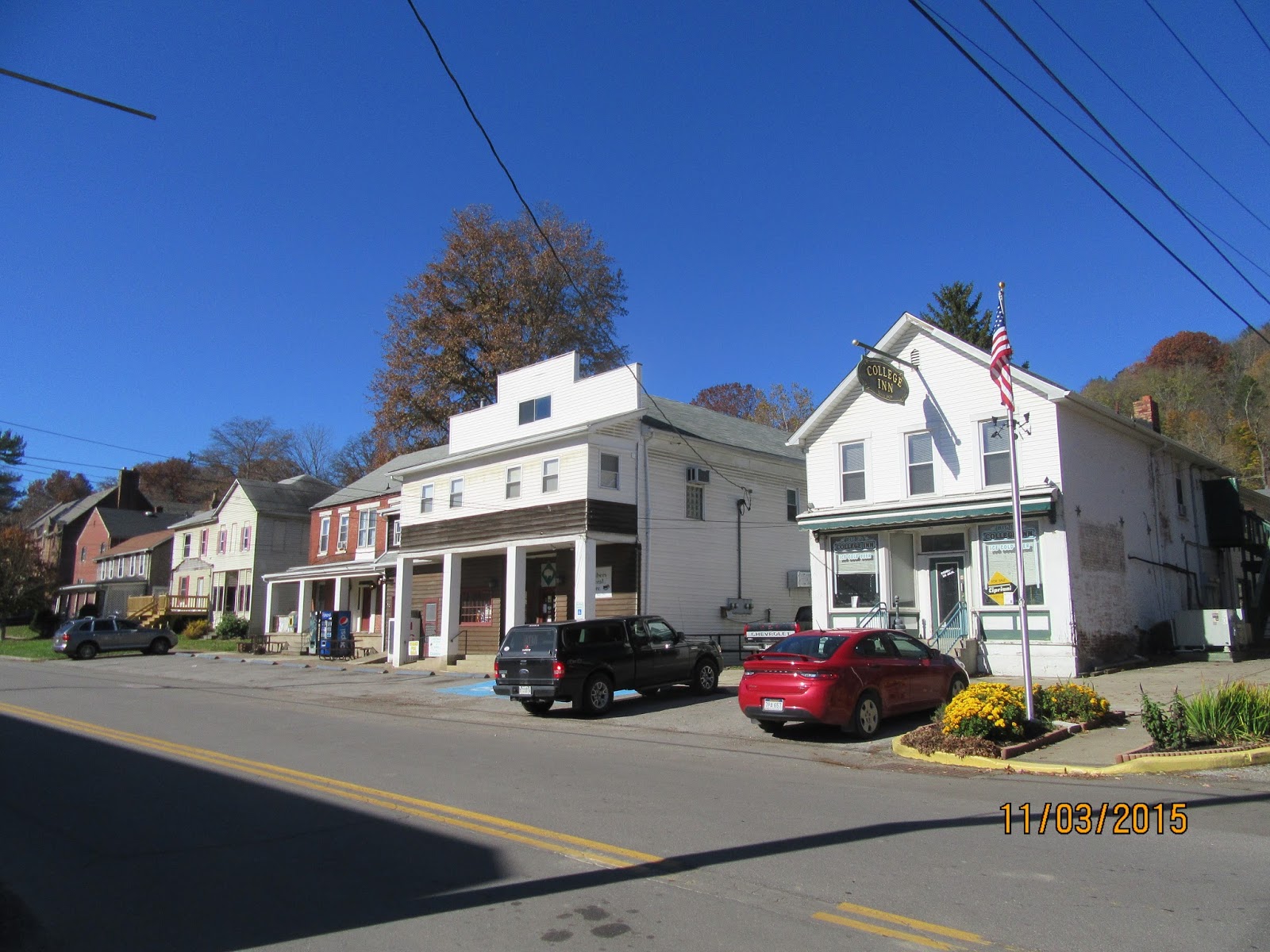
Main St., Georgetown


Brown County Courthouse, Georgetown

Ulysses S. Grant childhood home, Georgetown

Bailey-Thompson House, now a bed and breakfast, Georgetown

School, Higginsport, vacant


Rankin House, on the bluff overlooking the Ohio River, Ripley. This was an important spot on the Underground Railroad.

John P. Parker House, Ripley. Parker was a free African-American inventor before the Civil War.

Homes on the Ohio River, Ripley


Library, Ripley, 1915, designed by H.T. Liebert, a German-born architect active in Michigan and Wisconsin.


Bridge over the Ohio River from Aberdeen, Ohio to Maysville, Kentucky, 1931

Thursday, December 10, 2015

The Campaign

As with everything I have tried (speaking Spanish fluently, acting, singing, teaching, being a cantor, marriage), politics is more work than I expected it to be. Last Thursday, I attended three meetings: first about the possiblity of a new bridge over the Monongahela River, then a meeting of the Democratic Central Committee for our county, and then Suncrest Neighborhood Association. We live in Suncrest, part of Morgantown. Monday, I attended a kick-off campaign for the reelection of Judge Phillip Gaujot. I've been meeting lots of people, and enjoying that, and getting my name out there, and I have opinions to share in every forum.

I had signed up for an all-day training for new candidates, led by Stephen Stone Smith, a community organizer in Charleston. Training was held in places throughout the state. I attended the one in Wheeling, 74 miles from home. Although it was billed as non-partisan, I don't think many Republicans attended. The work Smith outlined for us is detailed and intense. One should have a committee of ten to help write and execute a written out campaign strategy, should go door-to-door to meet people in the district, and should calll people and ask for a specific amount of money from each person. At first, I didn't think I could do any of this. I now see I will have to bite the bullet and do most of these things.

Still, I have people helping me. I have a treasurer, who also can do tech for me, named Dee Quaranto. A friend from temple, who is active in politics, thought I shouldn't run and wouldn't help, but she has given me good advice about what to do since I seem to be stubborn about running. Another friend from Maryland has offered advice and help.

I'm still working on my 90-second "stump speech" which I gave, in draft form, to the other people at the workshop in Wheeling, who were supportive and gave good feedback. None of us of whatever political leaning, are "establishment" candidates, and I could see myself reflected in them and the struggles they will face to get elected. I've ordered business cards, which will arrive next week.

I met a candidate for the same office, a friend at Judge Gaujot's fundraiser. She complained that she has a full-time job and doesn't have much time to campaign. I thought I had something on her there, but I do our shopping, cooking and bill-paying, and I attend most events at Tree of Life. Joe and I are going to Israel for the CCAR (Reform rabbis) convention in late February, and I'm teaching a class at OLLI from January 25 to February 22, just before we leave for Israel.  My time is not inexhaustible, and the primary is in May, not that far off.

Things are moving. I believe now that there will be at least nine Democrats running for five nominations for Delegate in our district. Candidates have until January 30 to file, so there may be even more. It's easy to criticize Republicans on issues, but the Democrats, most of whom I know, are people I generally agree with on issues. I think of myself as more "upfront" than they are, more "in your face." I want to be the Bernie Sanders of West Virginia.

Meanwhile, thanks to Dee, my website is up. I'm very happy with it, but there may be some changes down the road. Here's the link:

www.barryinthehouse.com

Don't be surprised if you get a call asking for a donation, or an invitation to a fundraiser, or, if you are in Morgantown, a knock on your door.

Thursday, December 3, 2015

Thanksgiving 2015

We're back from Thanksgiving in Memphis. Joe's aunt (his late mother's sister) puts on a feast every year. Aunt "Nadly" as she is known, and Uncle Jimmy have two daughters, Molly in Memphis, Katie in Austin, Texas. Each daughter has a husband and a son and daughter. Aunt Nadly's two granddaughters are now sixteen; the boys are fourteen. Joe's sister Martha lives in Memphis; Joe's brother Henry often comes from rural southern Louisiana.

There is a cousin of Joe's mother and Aunt Nadly, known as"Anty," who comes from Buffalo, where the family started out. She has a married son and daughter. The daughter has two young sons; the son married last June and has a new baby daughter. Joe co-officiated at their wedding. Anty has two younger sisters. One is Marny, living in Humboldt County, California, who we saw often when we lived in Crescent City. She has a married son, Sascha, in Portland. We attended Sascha's wedding in Portland in 2012, a month after our move to Morgantown. Joe officiated. Anty's other sister, Annie, lives in Boston.

There is a tradition of people bringing their new "significant other" to Thanksgiving. I was that person in 2007. One year, Sascha came with his then-girlfriend Sara. This year, Molly's sixteen-year-old daughter brought her boyfriend. He is handsome and smart and put up with the silly games and the singing of old obscure songs. She seemed serious about him. He seemed too young to be in a serious relationship.

In my family, there is no older generation. Of this whole crew, I am closest in age to Joe, but closer in age to the old folks than to Joe's siblings and cousins. There is a fiction that everything is the same every year, but it's not. Most obviously, the children have gone from six and eight to fourteen and sixteen. As teens, the kids seemed less happy to be with family than they were as children.

We flew this year on Wednesday and Sunday, and while everything went surprisingly smoothly, this was physically hard for me. We arrived home by car from Pittsburgh airport at 1:45 A.M. We ate  unhealthy amounts of salt, sugar and fat, despite a relatively healthy menu on Thanksgiving Day.

My maternal grandparents, Nanny and Poppy to us, made Thanksgiving in New York just about every year. We got together with our Long Island cousins. My grandparents cut us off when I was eighteen and a freshman in college and they were seventy. They sold their New York house, and moved to a small apartment near Miami.

I don't remember details about those Thanksgivings, I only retain a warm glow thinking of my grandparents at this time of year. This year Thanksgiving was November 26, my Nanny's birthday. She would have been 118 this year. My parents, aunts and uncles are all gone, too. I have to rely on Joe's family for an older generation. I'm friendly with my cousins on my mother's side, but we don't routinely get together. I never see my father's family any more.

Next year, we will probably go to my sister Robin for Thanksgiving. She gets together with her son Evan and his girlfriend Kelli and a close friend of hers and her kids, one of whom has known Evan since preschool. Robin always laments when we go to Memphis that she and I are not together and with other family members.

This year, more than others, I felt the passage of time at Thanksgiving. I hope Joe's family can stay together, more than mine has, and that we'll be able to travel to Memphis again to be with them.

Joe, Martha and Henry sing out at Thanksgiving in Memphis

Tuesday, December 1, 2015

World AIDS Day 2015

It was in the Dominion-Post, our local paper, that there would be a candlelight march tonight for AIDS from the Mountainlair, the student union at the center of West Virginia University, to Jamison's, a bar/restaurant on High Street in downtown Morgantown, a few blocks away. I felt I should go.

It rained most of the day, with showers on and off later. The temperature was close to 60 at seven P.M., at least ten degrees above the average mid-day high for December 1.

Joe had bar and bat mitzvah tutoring in Clarksburg, an hour drive south of here, so I was on my own. I walked a half mile to the PRT, the driverless rail system that connects the far flung parts of campus and downtown, and got off at the station near the center of WVU's Downtown campus.

When I arrived at The Mountainlair, I spotted Ed Cole, from the Division of Diversity, Equity and Inclusion, dressed in his customary khakis, navy blue blazer and bow tie. There were people from Caritas House, the local charity group for People With AIDS (PWAs). They apparently sponsored the event. A group of students joined us, possibly all from one class, and mostly women. Some of the people from Caritas House introduced themselves, including Justin Siko, the assistant executive director. I said "We've met before" and we left it at that. We had a confrontation a few years ago about a donation Joe and I made jointly, where a thank you note was sent only to Joe at Tree of Life, even though the check was from our joint account, signed by me, and had our home address on it. At the time I was livid that we were not acknowledged as a couple, and I let Mr. Siko know that. I don't think he wishes to speak to me again. We have not since then been invited to their events.

Sharon Wood, who is the executive director, spoke at the beginning of the march and led the group. We were given candles and a red cup to hold them.

I spoke mostly to a photographer from the Dominion-Post who went along with the group. We were the two who somehow didn't fit in with the others.

Just as we got to Jamison's there was a downpour. Luckily they have an awning, so we were dry. Ms. Wood spoke about the work of Caritas House, how "AIDS doesn't discriminate by race, gender or sexuality." She told us how she became involved when her godson was hospitalized with an AIDS-related illness many years ago.

Then she asked if anyone else had something to share. I was the only one who did. This is more or less what I said, as it wasn't written down.

"I guess I'm the outsider here. I'm a sixty-six year old gay man. In the early days of the AIDS epidemic, in the eighties and nineties, most of the people who died from AIDS were gay men, many of them close friends of mine. The gay newspaper in Los Angeles, where I lived at the time, used to publish three, four and five pages of obituaries of men, mostly young, who had died of AIDS in the previous week. I especially want to remember my close friends, Fred Shuldiner, Art Horowitz, Rue Starr, Hal Wakker, Avram Chill, and David Fyffe, who died just a year ago, although he was diagnosed in 1985. I remember many more people whose lives touched mine, and I feel bad that after twenty-five or thirty years, I have forgotten some of their names." Sharon Wood said "But they still live on in your heart." True.

No one else said anything. Justin Siko read a good, non-sectarian prayer off his phone and I said "Amen." The photographer looked at me, shocked and speechless. No one else said anything, so Sharon Wood invited us all in to Jamison's to socialize. I returned my cup and candle to one of the Caritas House people, and headed home.

At The Mountainlair

At The Mountainlair

Sharon Wood addressing the crowd on High St., in front of Jamison's

Sunday, November 22, 2015

My Time Is Now

It's been two weeks of intense feelings, both positive and negative. Last week, I heard speakers about the Israeli and American elections, met the head of The American Conservative Union (who thought it was okay if I was not served in a restaurant because I am gay). The news about the elections is only good because no one believes the Republicans have a credible candidate. As far as Israel, there is a sense of hopelessness that there is any leadership that will solve the problems there.

Then the Mormon Church effectively kicked out same-gender couples and their children. At least many of their own church members rebelled. We heard about the attacks in Paris, and less-publicized attacks in Kenya, Afghanistan and Iraq.

We attended a service and dinner as guests of WVU Hillel Friday. Saturday, I spent most of the day in bed, not willing to deal with the hordes around a WVU football game, and feeling physically and emotionally exhausted.

Things picked up for me Saturday night, when we saw Morgantown Theatre Company's production of "Oliver!" This is the children's theater group where I played the rabbi in "Fiddler on the Roof" in the winter of 2014. Joe and I were blown away by the professionalism of these kids, who range in age from six to eighteen. After ten years of acting classes, I could not have done what the nine-year-old who played Oliver did. It was beautiful and heartbreaking.

Last Sunday we dined at the home of a gay couple we have come to know in Greene County, Pennsylvania, just north of here. It was a chance to let down our (virtual) hair, away from any professional connection, with three other long-time same-gender male couples. I'm grateful to them for adding us to their clan.

I was back at WVU for the Women and Gender Studies Department Fair on Monday and Transgender Day of Remembrance on Wednesday. It's amazing how college has changed since my graduation in 1971. Johns Hopkins, where I was an undergraduate, did not admit women until 1970 (four transferred into my junior class in 1969). They thought they were liberal because they added a "History of Africa" that year. There was no study of women, of gender as a concept, nothing Jewish, certainly nothing gay.

At some point in the spring of 1970, my junior year, the spring of Kent State, I walked down Calvert Street in Baltimore to 29th. I was wearing bell bottomed jeans, a plain t-shirt with a blue ring collar, and a brown "wet look" belted jacket. My already-thinning shoulder length hair was flying in the breeze. I  flashed a peace sign at a passing police car, and a policeman growled at me from the car. Maybe I misremember the details after forty-five years. Or maybe it was a dream. I remember feeling  that this was my time in the world.

I rode the PRT, Morgantown's "futuristic" rail transit line (from 1973) into town Wednesday to the LGBT Equity meeting on WVU's downtown campus. It's a half-mile walk from our house to the last station on the line. It was unseasonably warm and sunny. I had my iPod on, playing "Little Black Submarines" by The Black Keys. And for a minute, I had that same 1970 feeling that I was exactly where I was supposed to be. Maybe it was the weather or my heart being fixed with new stents or running for office, or just being a part of something on campus. The world is falling apart and our country is a mess, much like 1970. Perhaps my euphoria is that I understand how bad everything is, but I know that I am doing well.

Our meeting was short, and the Transgender Day of Remembrance after was more moving than I expected it to be. I met some students who came to support transgender people on campus. One young woman told me she was Jewish and confided that she had heard that the rabbi in Morgantown is gay. I was delighted to introduce myself as the rabbi's spouse.

It's Sunday night now as I finish this. It is cold out. There was no sun today. ISIS has united Russia, France and the United States. What the Republicans have been saying about Syrian refugees not being welcome here has resonated with Jewish people, and, for once,  all segments of the Jewish community are together, remembering the Jews who were turned away from the U.S. in the late 1930s.

I would like to think that good will come from the events of the past week, even the tragic events. Despite my advanced age and creaky body, I plan to be part of what happens here in West Virginia, in the United States and in the world, for as long as I am able. 


Thursday, November 12, 2015

Manifesto

I'm working on technical issues for my campaign for Delegate to the West Virginia State Legislature. This manifesto outlines my ideas for the state. I hope you who read this will join in my campaign.


My issues are basically economic. For an economy to work, people must have money to spend. Tax cuts for corporations and the very rich will not accomplish this. West Virginia University is the basis for economic growth in Monongalia County. And yet, the budget has been cut the last few years. To cope, the University has cut classified positions and raised tuition. We need to fully fund the University so that in-state students can afford to go to the state's flagship school. Classified people need jobs to maintain the economic growth of this area.

University employees, school teachers and public employees are being hit with cuts in PEIA, the Public Employees Insurance Agency. Employees will pay more for less coverage, taking money out of the local economy, and potentially causing valuable employees and teachers to leave West Virginia.

The same is true of "right-to-work" laws, which serve to lower wages for corporate profit or executive pay. Skilled workers in the state need to be able to maintain a high standard of living for everyone's sake.

Charter schools seem to be unworkable in a (mostly) non-urban state like West Virginia. More importantly, they remove union protections from teachers, and divert public money to private corporations at the expense of teachers and students. One of our local Republicans proposed charter schools for West Virginia in the last legislative session.

It's no secret that the coal industry in this area is not doing well. We must make sure, however, that miners and retirees don't lose hard-fought for health and pension benefits. Companies declaring bankruptcy should not be able to divest themselves of these costs while paying out million-dollar bonuses to CEOs for cutting labor costs. I have to wonder if these people have any conscience at all. Last year, some safety regulations in the mines were repealed or relaxed in a bill introduced by one of our local Republican legislators. These former standards need to be reinstated to make sure our miners are as safe as they can possibly be. Cost should not be a factor when lives are at stake.

Global climate change is real and affects West Virginia. We must work with the United States Environmental Protection Agency to maintain our health and the health of our mountains and forests. Our university can work on creating jobs to make coal burning cleaner and find alternative energy sources.

I know social issues will be part of this campaign. Sectarian prayer in schools has been outlawed since the 1960s, abortion has been legal since 1973, and same-gender marriage is now legal in all states. Attempts to overturn these laws are futile and a waste of time and money. We all must recognize that there are many different religious beliefs, even in West Virginia, and especially in Morgantown. One of our Republican delegates proposed a resolution to ask for a United States Constitutional Convention to ban any recognition of same-gender relationships. Another Republican delegate supported this resolution. I can only describe this as mean-spirited, exclusionary and colossally useless.

I propose raising money for the state in several ways. First, we should restore the tax money that has been cut from corporate taxes in the last few years. That was supposed to make the state more competitive; instead it has meant that the state cannot cover basic services. We should raise the gasoline tax to cover desperately-needed road repairs. And Mon County needs to demand a fair share of gas tax money. People in other parts of the state have told me that the roads here are worse than in their counties.

In many places there are fees on developers. Homes can't be built until the developer widens and repairs the road where the new development will be. We see development all over Mon County where roads are not upgraded. Could we not implement a plan to make new developments contingent on better roads?

Our economy will grow if we can make sure that the people who work here are making a decent wage, if good jobs are available at our West Virginia University, if teachers have competitive pay and benefits, and if Social Security, Medicare, and the new Medicaid expansion are protected.

I ask for your vote to help me make West Virginia a vibrant economic engine for all our people.

Barry Lee Wendell
November 12, 2015

Thursday, November 5, 2015

Brooke County, West Virginia

This is my forty-first county, corresponding to our forty-first month in Morgantown. The weather was predicted to be unseasonably warm and sunny this week, and since it is already a new month, I thought to take advantage. My friend Dee, who will be my campaign treasurer, offered to go with me. She loves to be out in nature, I prefer being in cities. I like to have my picture taken; she wouldn't let me put her in a picture. She is tech-savvy, detail-oriented, smart-mouthed and funny. I love her. She is a good bit younger than I, but has, in addition to a husband, a grown-up daughter and two grandchildren.

Brooke County is in the Northern Panhandle of West Virginia, the part between the Ohio River and Pennsylvania, which was only in Virginia before the Civil War because of the way Mason and Dixon drew the borders. Brooke County occupies a ten mile stretch betwen Ohio and Pennsylvania. There are 24,000 or so people in the county; the population peaked in 1980, and like much of West Virginia, has declined over the last  thirty-five years. We saw wharves no longer in use, and vacant sites where there may have once been steel mills.

Follansbee, part of Weirton, and the county seat, Wellsburg, are along the Ohio River. Bethany, the home of Bethany College, is a few miles inland. We arrived there on back roads from I-79 and I-70 out of Washington, Pennsylvania, in the first county in Pennsylvania south of Pittsburgh.

Bethany College was founded in 1840 and chartered by the State of Virginia. What I know about it is that Alex, a former intern at the WVU-affiliated gym I used to go to, attended there as an undergraduate. He told me they were taught to respect all people, including gays and lesbians. I didn't expect that from a Christian-affiliated college. I first heard of Bethany when a cousin told me his daughter was attending a summer science camp there, and was it close to us? It's about seventy miles.

There is not much "town" in Bethany. The college, which has a beautiful campus, is most of what there is in town.

We looked around for an hour or so, then headed down the road to Wellsburg, on the Ohio River. We saw one smokestack in use, and as we approached town, we noticed a pervasive pungent odor. I attended a meeting in Morgantown about air pollution in West Virginia a few weeks ago, and learned that the Northern Panhandle is the worst place in the state for air quality.

We were ready for lunch, and Dee, who teaches tech at OLLI (where I teach rock and roll history) found us a restaurant on Yelp on her IPhone. We ate at The Crooked Dock, in an industrial area on the river. I had a grilled chicken sandwich (no cheese or mayo) with french fries for ten. I gave Dee half of my fries and still didn't finish them. Dee had a fried cod sandwich ("Fresh from the river," said the waitress, "just not this river") with cole slaw. It was good, if simple, and Dee joked with a table of older women (my age) who were out for lunch together.

There are twenty-three places on the National Register in Brooke County. Some are on the campus of Bethany College, some in town in Wellsburg where there is a street on the ridge above the river lined with the homes of the wealthy from the old days. Those homes looke well-maintained. Some of the more inland historic homes were abandoned, as was much of the town. We breezed through Follansbee, a working class suburb from the 1920s and 30s, more prosperous than Wellburg, full of pizza places and bars with Italian names, like many places around Pittsburgh. We didn't get to the part of Weirton in Brooke County. Most of that city is in the next county north.

Dee noticed details, like a 19th century door hinge, or a stone foundation that was black from the soot of the factories that belched smoke through most of the last century. I notice how a place or a neighborhood is part of a city's pattern.

I looked up the weather before we left. On average, Wellsburg is one degree cooler at night, and two degrees cooler midday than Morgantown at this time of year. Still, the leaves there seemed to be more green than those in Morgantown.  It was 74 in Wellsburg, warmer in Morgantown.
Alexander Campbell Mansion, Home of the Founder of Bethany College, just east of Bethany

Delta Tau Delta House, Bethany

Old Main, Bethany College, a National Historic Landmark

the cloister at Old Main, Bethany College

On Pendelton Street, Bethany

Main Street, Bethany

Nicholls House, just south of Wellsburg

Brooke County Courthouse, Wellsburg

Wellsburg Historic District

an overgrown, probably abandoned home, downtown Wellsburg

Mansion on Pleasant Avenue, Wellsburg

Mansion on Pleasant Avenue, Wellsburg

Kirker House, Grand Avenue, Wellsburg

Vancroft, near Wellsburg, not sure how this is used now.

Brooke Cemetery on Pleasant Avenue, looking across the Ohio River, Wellsburg

Reeves House, apparently abandoned, near Wellsburg

Inn at Fowlerstown, restored but not in use, Fowlerstown

Danforth House, probably abandoned, east of Wellsville


By 3 P.M., it was time to go back, We had seen most of the historic spots, even if I didn't get pictures of all of them. There is a major county park which I forgot about. We took a few minutes for ice cream and something to drink at Dairy Queen in Wellsburg, then headed back. It was 5:30 and just getting dark when I dropped Dee back at her car just off I-79 on the way back home.